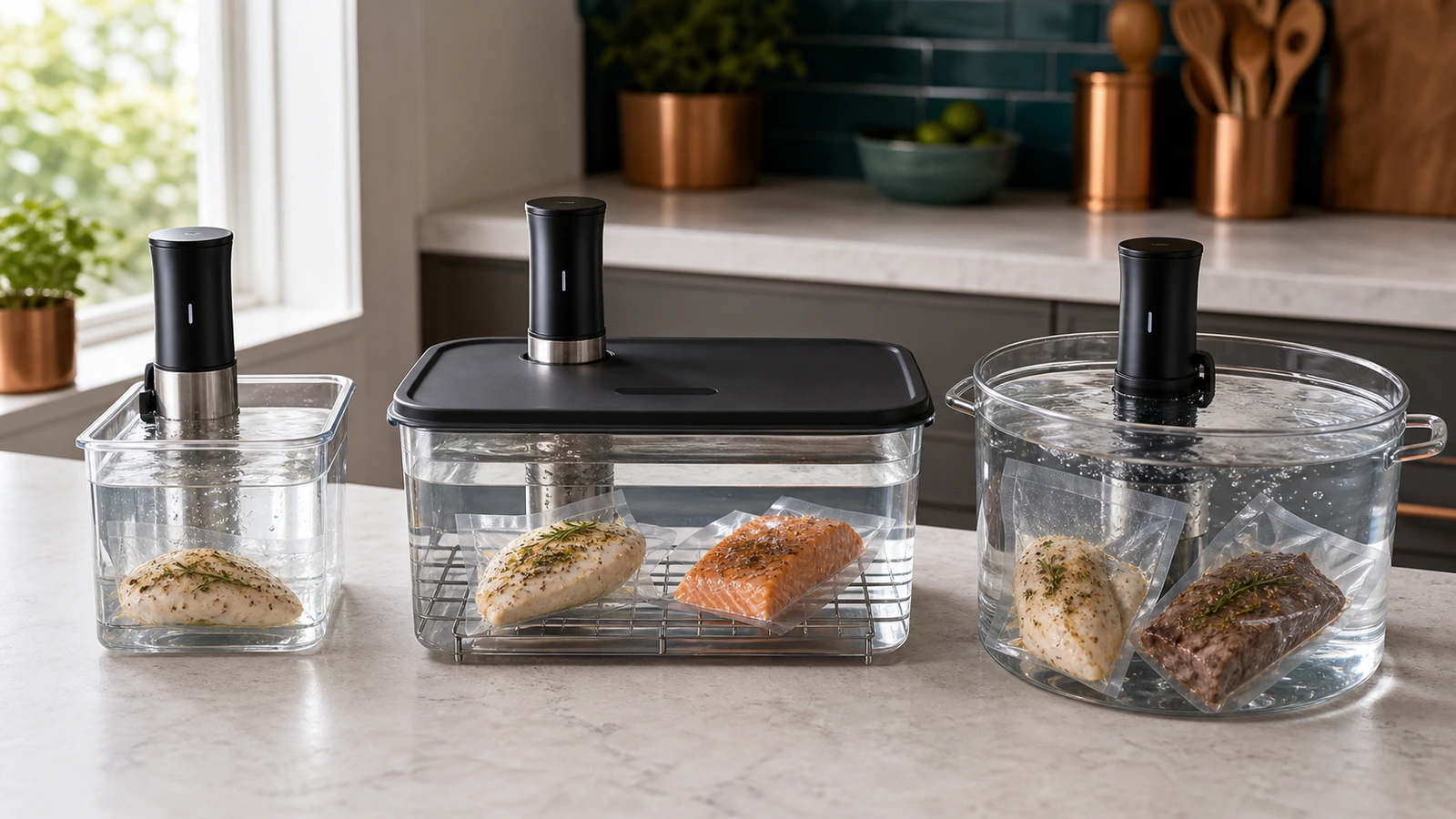
Best sous vide containers at a glance
| Container | Best for | What you get | Main limitation |
|---|---|---|---|
| Anova Precision Cooker Container 12L | Coordinated system | 12 L tub, silicone lid, removable rack | Specialized and relatively bulky |
| HOMENOTE 12 Quart Container Kit | Bundled accessories | Container, center-cut lid, rack, sleeve, cookbook | Cutout fit is not universal |
| Rubbermaid Commercial FG631200CLR | Modular square setup | 12-quart commercial container body | Lid and rack are separate |
| Cambro RFSCW12135 | Round multipurpose use | 12-quart commercial container body | Low-stock third-party listing at our check |
Fast decision: pay for a complete kit only when its lid, rack, and cutout solve problems you actually have. A bare commercial tub is the better starting point when you want to choose those accessories yourself.
Choose the system before the container
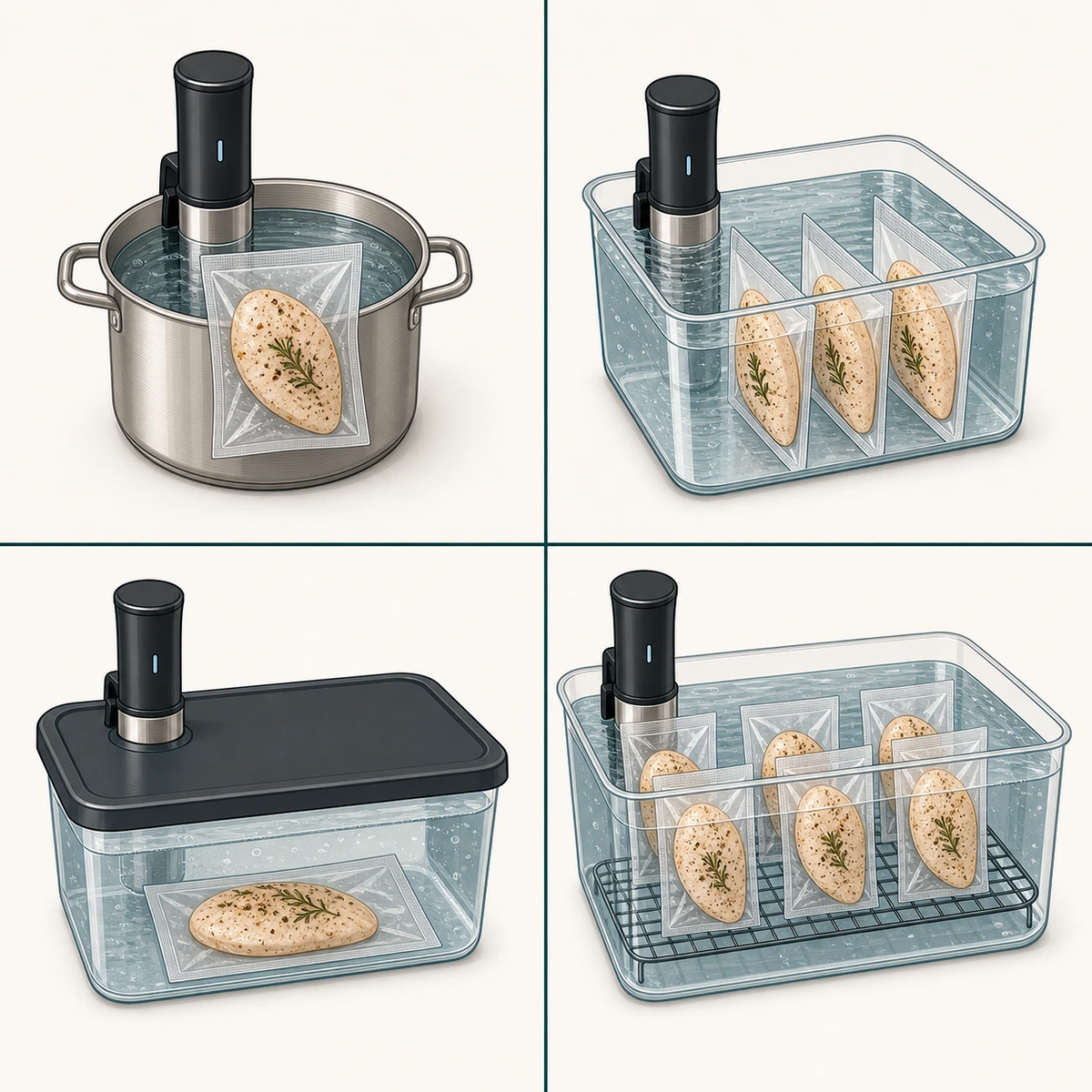
Capacity is only one part of container fit. Clamp clearance, minimum and maximum water marks, pouch spacing, lid opening, and cabinet space can matter more than the number printed on the side. Use this order to avoid buying a large tub that still needs the wrong accessories.
| Decision | Choose this route | Why it matters |
|---|---|---|
| You cook one or two portions occasionally | Start with a suitable stockpot | You avoid buying and storing a dedicated tub before you know what is missing. |
| You run long or multi-bag cooks | Prioritize a fitted lid and a rack | The lid limits evaporation; the rack creates repeatable space between pouches. |
| You already own clips, weights, or a lid solution | Buy a modular container body | You pay only for the component you still need. |
| You batch-cook | Check the circulator’s supported bath size before sizing up | More labeled capacity also means more water to heat and more space to store. |
How we chose the four picks
We searched Amazon.com by kit type, capacity, commercial-container format, and compatibility while the project browser displayed delivery ZIP 10001. Fourteen candidates entered the longlist. Each final product then had to clear exact-child identity, current availability, rating-volume and recent-activity checks, official support, and a distinct use case.
Review count was a filter, not the ranking. We rejected unavailable seed ASINs and did not retain a 26-quart option simply to create a large-batch pick: the current candidates had small samples, incomplete official model support, or family listings that did not separate models cleanly. We also excluded claims that would require hands-on measurement, including faster heating, more even circulation, and superior durability.
Best Overall Complete System
Anova Precision Cooker Container 12L
Choose the Anova 12L when you want the container, lid, and rack designed as one coordinated system.
Anova’s current 12L product page lists a 12 L (12.68 qt) container, 100% silicone lid, removable rack, and 3 mm raised base. Its dimensions are 15.4 × 9.4 × 8.4 inches. The practical advantage is accessory certainty: you do not have to find a separate rack or improvise an evaporation cover, and the rack handles provide one way to lift a group of pouches together.
Anova calls the curved interior HemiFlow and says it improves circulation. Treat that as a manufacturer design claim, not proof that the container heats faster than every square tub. The more concrete tradeoff is storage: this is a dedicated vessel, and its value drops if a suitable pot and your existing clips already handle your normal cooks. Before combining separate accessories, use the rack, weight, and clip compatibility guide to check circulation, bag contact, fit, and exact-model limits.
Good fit if: you want an integrated lid and rack for long or multi-bag cooks.
Look elsewhere if: you already own a suitable vessel or need a compact multipurpose pot.
Best Accessory Bundle
HOMENOTE 12 Quart Container Kit with Lid, Rack and Sleeve
Choose the HOMENOTE kit when you want a center-cut lid, adjustable rack, and insulating sleeve in one package and can verify the circulator opening.
The current HOMENOTE product page identifies a 12-quart container, center-mount cutout, rack, sleeve, and cookbook. Bundling those pieces reduces accessory shopping, but the fixed opening is also the key limitation. HOMENOTE says it checked fit with Anova and ChefSteps machines and tells buyers of other circulators to compare the opening before ordering.
The accessible owner sample was positive about the included parts, but it does not justify a durability claim. One verified-purchase four-star review reported a strong initial sleeve odor and described the folding rack as wobbly; that is an isolated report, not a documented recurring defect.
Good fit if: you want the lid, rack, and sleeve without assembling a system from separate listings.
Look elsewhere if: you cannot confirm the cutout or are sensitive to material odor.
Best Modular Square Container
Rubbermaid Commercial 12 Quart Square Container, FG631200CLR
Choose Rubbermaid when you want an exact commercial square tub and prefer to select the lid, rack, clips, or weights separately.
Rubbermaid’s official SKU page identifies FG631200CLR as a 12-quart clear square polycarbonate container with graduated liter and quart markings and NSF 3-A and NSF 2 certifications. The square body makes efficient use of rectangular cabinet and counter space, while the graduations help you return to a known fill level without making capacity a proxy for usable pouch space.
This pick is the container body, not a ready-to-run kit. At our ZIP-10001 check, Amazon displayed the intended child ASIN and 12-quart title, but its family canonical link pointed to a sibling and the seller shown was Amazon Resale. Match the checkout page to ASIN B000R8JOUC and SKU FG631200CLR; do not assume a family listing has kept the same size, lid, or seller.
Good fit if: you want a modular square body and already know which accessories you need.
Look elsewhere if: you want a factory-cut lid and rack in the same box.
Best Round Multipurpose Container
Cambro Camwear Round 12 Quart RFSCW12135
Choose the Cambro when a wide round opening and non-sous-vide kitchen uses matter more than an integrated lid-and-rack system.
Cambro’s current Camwear Rounds table lists RFSCW12 at 12 quarts (11.4 L), with an operating range of −40°F to 210°F (−40°C to 99°C), NSF listing, and a two-year pro-rated warranty. Amazon uses the color-suffixed model RFSCW12135. The round opening gives broad access for arranging pouches, and the container can return to general prep or storage jobs between cooks.
The retail evidence is less stable than for the first three picks. On July 30, 2026, the exact child showed only nine units left from a third-party seller at ZIP 10001, and its canonical link belonged to a family page. It also includes neither a sous-vide cutout nor a rack. Verify ASIN B000KIE73I, model RFSCW12135, seller, and current availability before checkout.
Good fit if: you value a round opening and a container that can serve other kitchen tasks.
Look elsewhere if: you want an integrated kit or a more stable first-party retail option.
Compatibility and model-lock checklist
- Find the exact circulator model, then compare its clamp and body with the rim and lid opening.
- Check the machine’s minimum and maximum water marks against the container depth.
- Confirm whether the listing includes the tub, lid, rack, sleeve, or only one component.
- Leave open water around the broad faces of every pouch; labeled capacity is not usable food capacity.
- Measure cabinet and counter space before moving beyond the 12-quart class.
- Match the child ASIN and manufacturer model/SKU at checkout, especially on family listings.
- For long cooks, choose a fitted lid before adding insulation; a sleeve does not correct a loose mount or falling water level.
If you are still choosing the circulator, compare mounting styles in our guide to the best sous vide machines. For batch size and pouch choice, use our sous vide bag guide.
When you do not need a dedicated container
A stockpot you already own is the value choice when the circulator mounts securely, the water remains between its marked limits, and the pouches have room for water to move around them. Upgrade only when a recurring problem points to a specific component: evaporation suggests a lid, overlapping bags suggest a rack, and awkward clamping suggests a different rim or cutout. Buying the problem-solving component is more useful than buying the largest kit.
Sources and methodology
This is a research-based comparison, not a hands-on test. We built a current Amazon longlist from five use-case queries, confirmed the marketplace and delivery ZIP 10001, then checked exact child identity, availability, rating volume, visible review activity, official product support, and role diversity. Amazon supplied retail-state and limited owner-feedback evidence; official sources controlled product specifications. Facts were checked July 30, 2026, and retail conditions can change.
- Anova Precision 12L Container
- HOMENOTE 12 Quart Container Kit
- Rubbermaid Commercial FG631200CLR
- Cambro Camwear Rounds
The bottom line
Start with the missing component in your current setup. The Anova 12L is the clearest one-box choice; Rubbermaid FG631200CLR is the strongest modular starting point. Choose HOMENOTE for its accessory bundle only after checking the cutout, and treat the Cambro as a round multipurpose alternative whose seller and stock need a fresh checkout check.