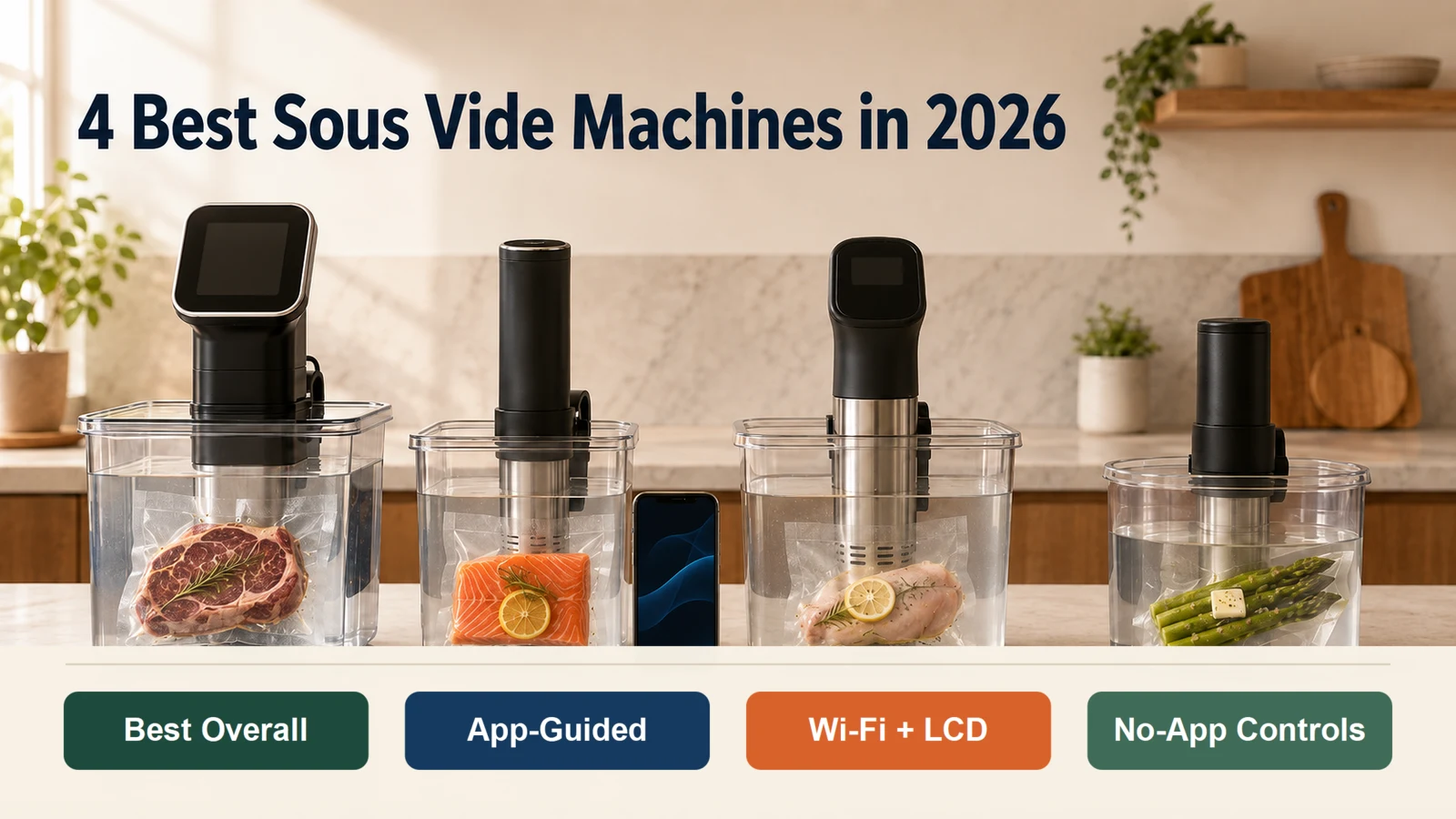
The best sous vide machines at a glance
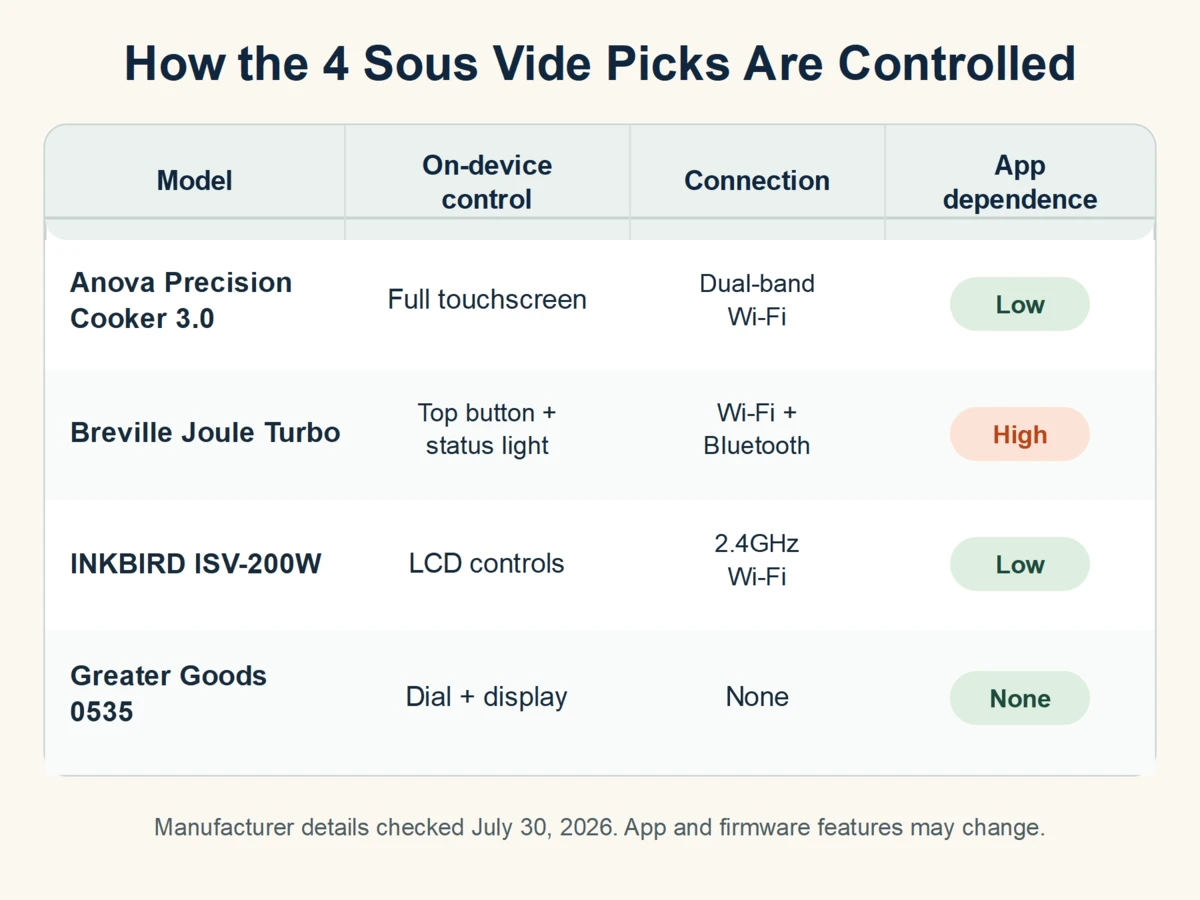
| Model | Best for | Controls and connection | Mounting | Main trade-off |
|---|---|---|---|---|
| Anova Precision Cooker 3.0 | Best overall under our criteria | Touchscreen; dual-band Wi-Fi | Adjustable, detachable clamp | Some premium app features cost extra |
| Breville Joule Turbo | App-guided cooking | Breville+ app; Wi-Fi and Bluetooth | Magnetic foot; attached clip; optional Big Clamp | App, phone, and network are central to normal control |
| INKBIRD ISV-200W | Wi-Fi plus physical controls | LCD; 2.4GHz Wi-Fi | Adjustable clamp | Published accuracy units conflict; not marked IPX7 |
| Greater Goods 0535 | No-app operation | Physical dial and display | Adjustable clip | No remote monitoring; interrupted programs need resetting |
Retail listings can change. Before ordering, verify the exact model, selected child, seller or item condition, voltage, warranty eligibility, and current app terms.
How we chose these four machines
We searched Amazon.com across general, manual-control, Wi-Fi, app-guided, compact, and current-generation queries, then checked each finalist against current manufacturer pages, manuals, support information, and exact child listings. Old article picks remained unverified seeds until they passed those checks.
- Usable controls and fallback: Can you run a basic cook from the device, or is the app the normal control path?
- Current model and support: Is the exact generation still documented and sold through a credible current channel?
- Mounting and container fit: Will the clamp, clip, or magnetic foot work with the vessels you use?
- Cleaning and warranty: Can you access the lower housing, and what support period does the manufacturer publish?
- Documented limitation: Every pick needs a distinct buyer and a clear reason someone else should skip it.
This process removed the older Anova Nano 2.0 from the final list. Its large review pool did not outweigh the existence of a newer generation and the seller, condition, and warranty uncertainty around the legacy Amazon child.
Best Overall
1. Anova Precision Cooker 3.0
Choose the Anova 3.0 if you want complete device controls, optional Wi-Fi, and a mounting system that works across different pots.
Anova lists 1,100 watts, dual-band Wi-Fi, a two-line touchscreen, an adjustable detachable clamp, a removable skirt, a 32°F–197°F (0°C–92°C) range, stated accuracy of ±0.2°F (±0.1°C), IPX7 water and splash resistance, and a two-year warranty. [1]
The touchscreen changes the ownership experience more than the wattage number: you can set time and temperature on the cooker if pairing fails or you simply do not want to use your phone. The detachable clamp helps with different containers, while the removable skirt gives you better access for cleaning than a sealed lower body.
The app is optional, but its terms still matter
Anova says a subscription is not required for manual operation or basic connected control. Its current free tier covers core device functions, while paid plans add premium recipes and other features; those terms can change. [2]
Good fit if: You want full controls on the cooker, optional Wi-Fi, flexible mounting, and a two-year warranty.
Look elsewhere if: You want the simplest no-app machine, dislike paid premium content, or prefer an app-led recipe system.
Best for App-Guided Cooking
2. Breville Joule Turbo
Choose the Joule Turbo when guided recipes and Breville+ are the reason you want a connected cooker, not just an optional extra.
Breville’s US materials list a 1,100-watt circulator with Wi-Fi and Bluetooth, a magnetic foot, an attached standard clip, and a one-year North American warranty. A separately sold Big Clamp expands the mounting options for larger containers. [3] [4]
The magnetic foot is useful with induction-ready or magnetic steel cookware. With a nonmagnetic pot, you use the attached clip or confirm that the optional Big Clamp fits your vessel. That mounting check matters more than assuming one accessory works with every container.
Turbo is a manufacturer feature, not our measured result
Breville says its Turbo algorithms can shorten cooking time for selected supported recipes compared with traditional sous vide. The feature does not apply to every recipe, and Perfect Sous Vide did not independently measure the time savings. [3]
The trade-off is control dependence. The top button and status light are not a complete time-and-temperature interface, so normal operation depends on a compatible phone, the Breville+ app, and a working connection.
Good fit if: You want step-by-step app guidance, selected Turbo recipes, and a magnetic mounting option.
Look elsewhere if: You want complete local controls or do not want your cooking workflow tied to an app, phone, and network.
Best for Wi-Fi Plus Physical Controls
3. INKBIRD ISV-200W
Choose the ISV-200W if you want 2.4GHz Wi-Fi monitoring without giving up a usable LCD control panel on the cooker.
INKBIRD lists 1,000 watts, US 120V input, 2.4GHz Wi-Fi, a dot-matrix LCD, low-water protection, a 32°F–194°F (0°C–90°C) range, a 15-liter stated bath limit, and a one-year warranty. [5]
The LCD gives you a local fallback for a basic cook, while Wi-Fi adds remote monitoring. Because this model uses 2.4GHz Wi-Fi, check that your router setup allows a 2.4GHz device during pairing.
Two documentation limits are worth knowing
INKBIRD publishes accuracy as 1°F / 0.1°C, but those values are not equivalent, so this guide does not normalize the figure or use it as a ranking advantage. The company’s comparison table also marks IPX7 for the ISV-300W, not the ISV-200W. Do not assume the two models share that rating. [5]
Good fit if: You want Wi-Fi monitoring, an LCD fallback, and a current exact model with documented local controls.
Look elsewhere if: You need dual-band Wi-Fi, verified IPX7 status for this exact model, or cleaner published accuracy documentation.
Best No-App Option
4. Greater Goods Sous Vide Cooker 0535
Choose the Greater Goods 0535 if you want a physical dial, local time-and-temperature control, and no app setup.
The model-specific guide lists 1,100 watts, 120V/60Hz input, a 15-liter maximum bath, a 68°F–203°F (20°C–95°C) range, an adjustable clip, a removable lower housing, and a five-year limited US warranty with registration. Time and temperature are set from the dial and display. [6]
This is the clearest local-control workflow in the group: turn the dial, confirm the setting, and cook without pairing a phone or reviewing subscription terms. The removable lower stainless housing also gives you a defined cleaning path in the manufacturer’s guide.
The simplicity comes with two trade-offs
You do not get remote monitoring or app-guided recipes. Greater Goods also says the time and temperature settings must be entered again if the cooking process stops, so this is not the best fit if remote alerts and connected recovery matter to you. [6]
Good fit if: You prefer a physical dial, want no app or Wi-Fi setup, and value a five-year registered US warranty.
Look elsewhere if: You want remote monitoring, guided recipes, or a connected alert system.
Choose by control style before wattage
Published power ranges from 1,000 to 1,100 watts across these four, so wattage alone does not resolve the choice. The more useful distinction is how you want to start, adjust, and monitor a cook.
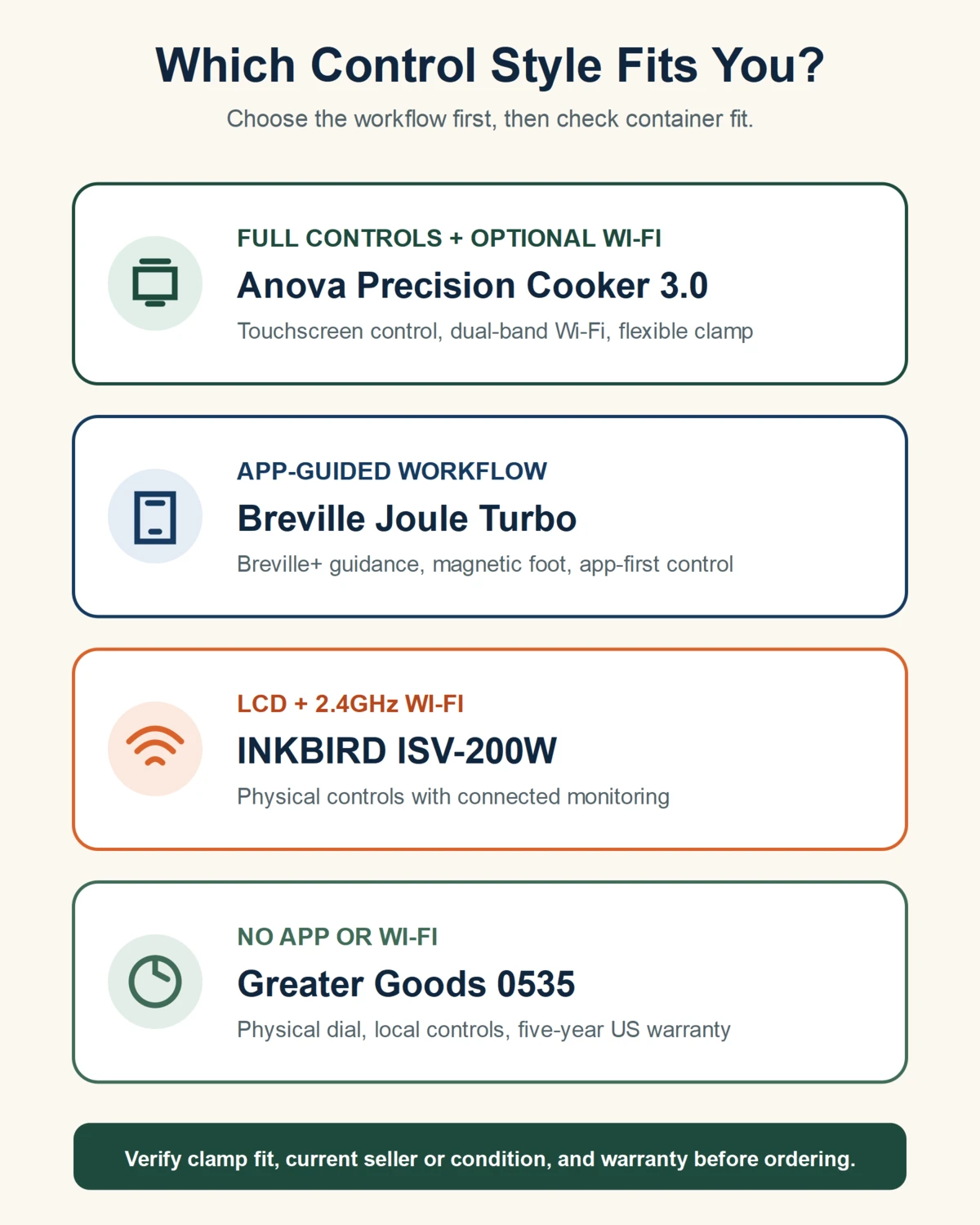
| Your priority | Best match | Why | Check before buying |
|---|---|---|---|
| Full controls plus optional Wi-Fi | Anova 3.0 | Touchscreen fallback and dual-band Wi-Fi | Seller, item condition, and current app terms |
| Guided app workflow | Joule Turbo | Breville+ is the core experience | Phone, app, region, network, and container mounting |
| Wi-Fi plus an LCD | INKBIRD ISV-200W | 2.4GHz monitoring with local controls | Router band, clamp fit, and documentation limits |
| No app or Wi-Fi | Greater Goods 0535 | Physical dial and display | 15L limit and reset behavior after interruption |
What to check before you order
Do not treat wattage as an accuracy score
Wattage describes heating capacity, not measured temperature precision. More power can provide extra headroom for larger baths, cold starting water, heat loss, and recovery after food is added, but insulation, bath volume, lid use, and starting temperature also affect heating time.
Match the mount to your container
Check the clamp opening, required water depth, wall thickness, and whether a magnetic base needs magnetic cookware. Container compatibility can outweigh a small specification difference. For dedicated vessels, see our guide to choosing a sous vide container.
Verify the exact model and buying channel
Similar product names can span several generations. Confirm the model number, selected child, voltage and plug, included mounting hardware, seller, item condition, warranty eligibility, and current app terms. A large review count on an older listing is not proof that it is the best current choice.
Plan for cleaning access
Mineral buildup can collect around the heater and circulation area. Always unplug the cooker, let it cool, and follow the exact manufacturer’s instructions before removing a skirt, lower housing, or cap.
Frequently asked questions
Do you need Wi-Fi on a sous vide machine?
No. Wi-Fi is useful for remote monitoring and alerts, but it is not required for precise water-bath control. If you prefer local operation, choose a cooker with full onboard controls and treat connectivity as optional.
Do you need a vacuum sealer?
Not for every cook. A freezer-grade zipper bag and the water-displacement method work for many foods, while a vacuum sealer is more useful for repeat prep and long cooks. See how to sous vide without a vacuum sealer, then compare suitable sous vide bags.
Sources and methodology
This is a research-based comparison, not a hands-on test. We searched current Amazon.com listings using delivery ZIP 10001, locked each final child ASIN, and used manufacturer pages and manuals for specifications, warranty, controls, and limitations. Retail status was checked July 30, 2026 and can change.
- Anova Precision Cooker 3.0 specifications
- Anova app and subscription information
- Breville Joule Turbo product page
- Breville Joule Turbo US manual
- INKBIRD ISV-200W specifications
- Greater Goods model 0535 guide and warranty
The bottom line
Start with the control path you will actually use, then eliminate any model that does not fit your container, cleaning preferences, or buying conditions. That approach is more reliable than choosing the largest wattage number or the oldest listing with the most reviews.