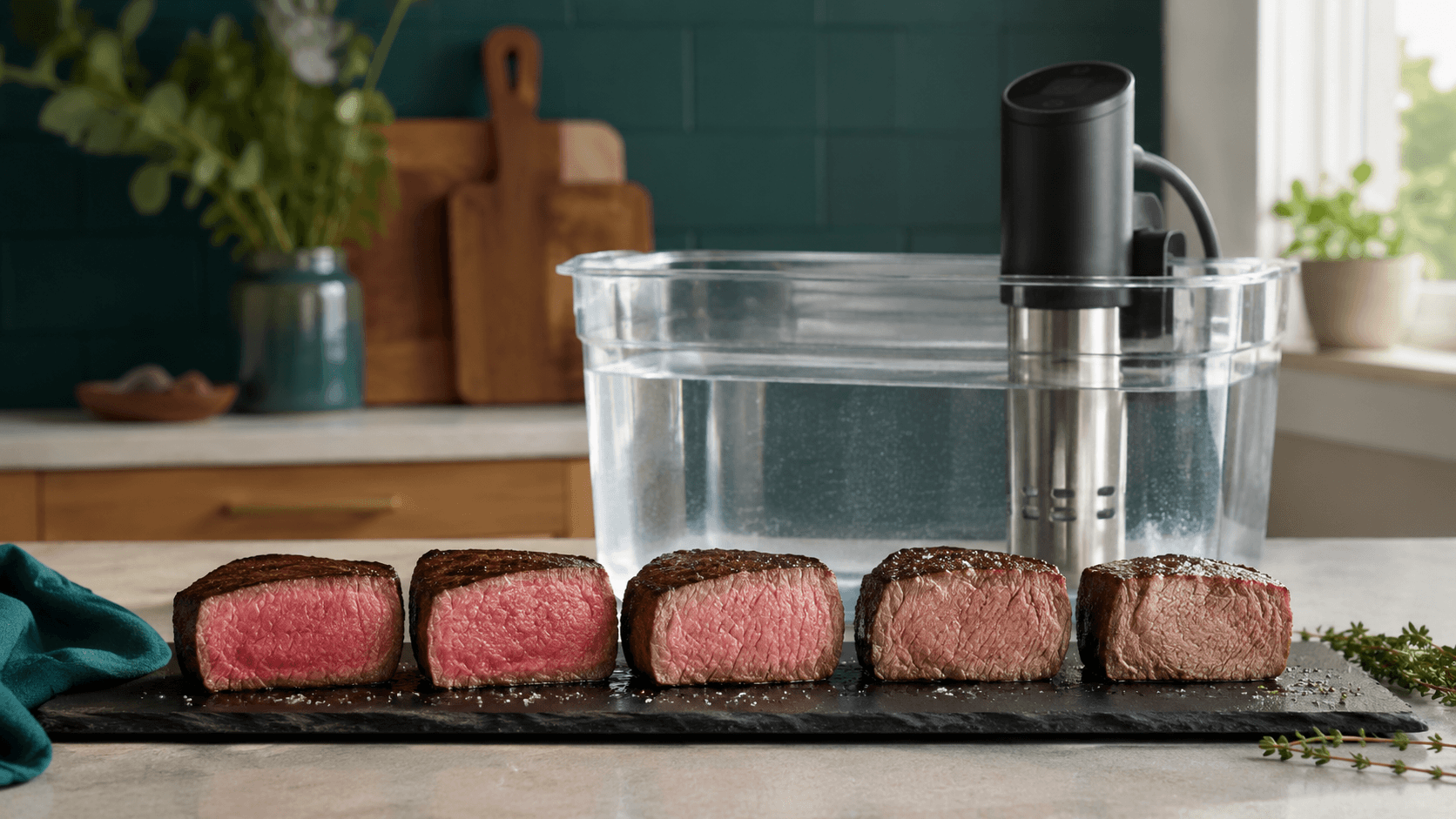
Scope: This guide covers intact whole-muscle steaks. Mechanically tenderized, blade-tenderized, injected, ground, rolled, or stuffed beef can carry surface bacteria into the interior and needs product-specific safety handling.
Do not transfer these steak schedules to a bone-in lamb rack. Use the rack of lamb guide for its cut-specific geometry, attributed texture ranges, and finishing workflow.
Sous vide steak temperature by doneness
| Preference | Bath temperature | Expected interior | Safety note |
|---|---|---|---|
| Rare | 125–128°F (52–53°C) | Red, very soft | Texture range only; not a pasteurization schedule |
| Medium-rare | 129–134°F (54–57°C) | Red to red-pink | Use a thickness-specific total-time schedule when pasteurization is intended |
| Medium | 135–144°F (57–62°C) | Pink, progressively firmer | Use a thickness-specific total-time schedule when pasteurization is intended |
| Medium-well | 145–154°F (63–68°C) | Slight pink to mostly brown | USDA conventional whole-cut endpoint begins at 145°F with a 3-minute rest |
| Well-done | 155°F+ (68°C+) | Brown, firm | Texture changes quickly as temperature increases |
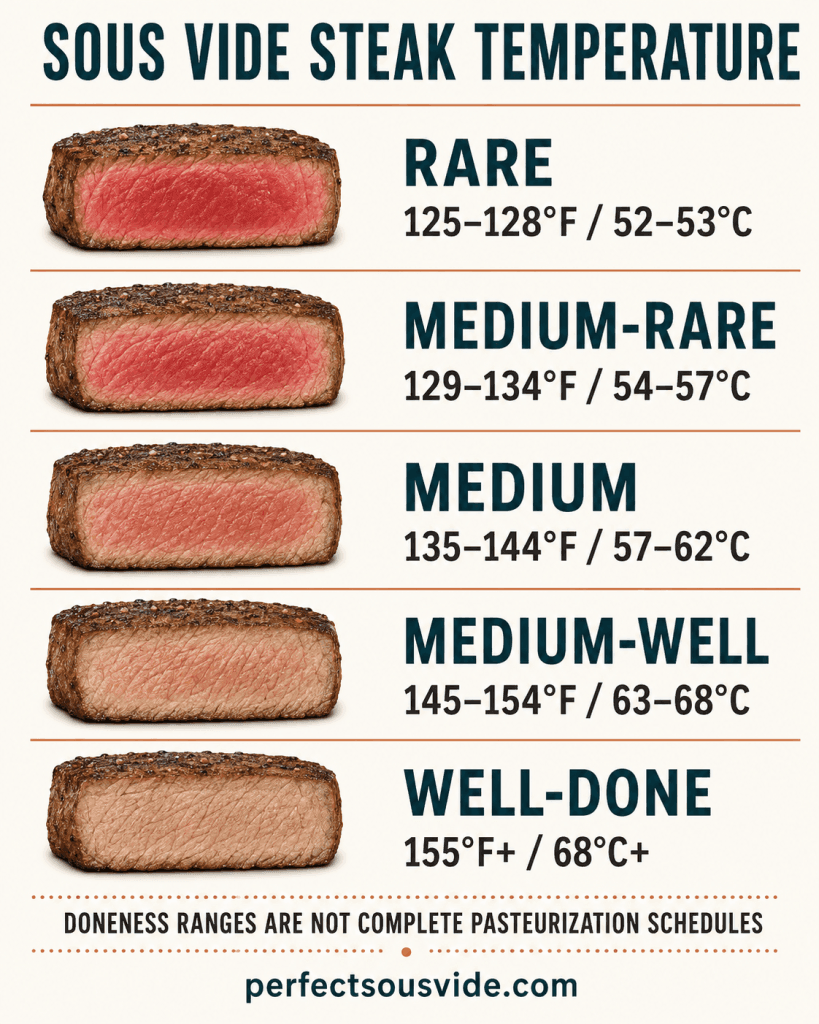
These ranges describe texture preference. They do not mean every temperature in a row is interchangeable for safety. The USDA Food Safety and Inspection Service gives 145°F with a three-minute rest as its simple conventional endpoint for beef steaks, roasts, and chops. Lower-temperature sous vide pasteurization depends on holding time and the full set of cooking conditions.
Temperature, heating time, and pasteurization are different
- Bath temperature guides eventual doneness and texture.
- Heating time brings the coldest part of the steak close to bath temperature.
- Pasteurization hold time is time spent at the required coldest-point temperature to achieve a selected pathogen reduction.
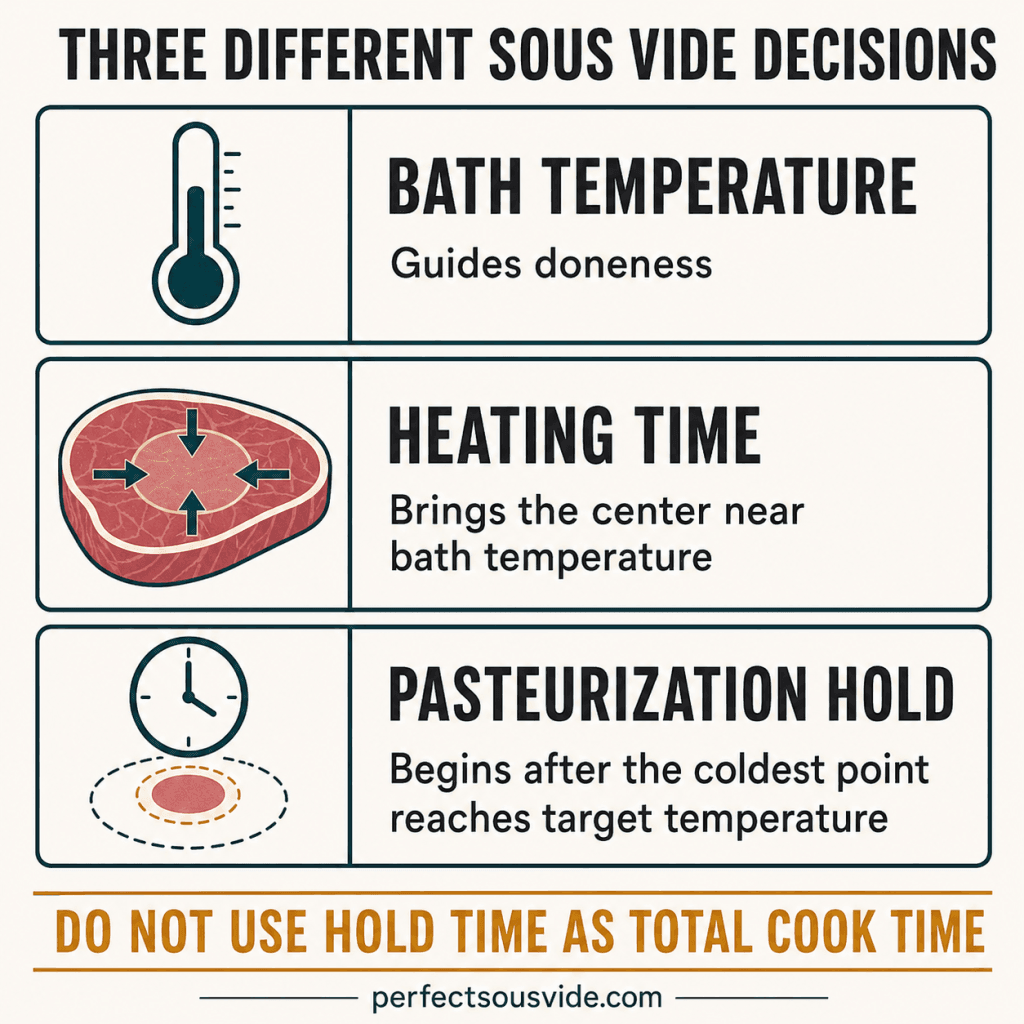
The clocks overlap during cooking, but they are not the same measurement. A pathogen-reduction hold begins only after the coldest point reaches its target, while a total pasteurization schedule includes the heating phase. Use a food-specific total-time model that accounts for thickness, shape, starting condition, and bath temperature, such as Douglas Baldwin’s tables.
Sous vide steak heating time by thickness
The table below adapts slab-heating estimates from Douglas Baldwin’s Table 2.2. It assumes a thawed, slab-like steak starting at 41°F (5°C) and estimates time for the center to come within about 1°F (0.5°C) of the bath. It is a heating table, not a pasteurization table.
| Steak thickness | Approximate heating time | What this means |
|---|---|---|
| 1.0 in (25 mm) | 1¼ hours | Center approaches bath temperature |
| 1.2 in (30 mm) | 1½ hours | Heating only |
| 1.4 in (35 mm) | 2 hours | Heating only |
| 1.6 in (40 mm) | 2½ hours | Heating only |
| 1.8 in (45 mm) | 3 hours | Heating only |
| 2.0 in (50 mm) | 3½ hours | Heating only |
Heating time rises faster than thickness because heat must travel farther to reach the center. Frozen steaks take longer than thawed steaks. Bone, irregular shape, stacked bags, crowded baths, and circulator recovery can also change real cooking time.
Total pasteurization time by steak thickness
The table below adapts Douglas Baldwin’s Table 5.1 for thawed beef starting at 41°F (5°C). These are total times from placing the steak in the bath, not hold times added after heating. Baldwin’s model targets at least a million-to-one reduction in Listeria monocytogenes, at least a three-million-to-one reduction in Salmonella spp., and at least a hundred-thousand-to-one reduction in E. coli.
| Steak thickness | 131°F (55°C) | 140°F (60°C) | 145.5°F (63°C) |
|---|---|---|---|
| 1.0 in (25 mm) | 2¾ hours | 1½ hours | 1¼ hours |
| 1.2 in (30 mm) | 3 hours | 1½ hours | 1¼ hours |
| 1.4 in (35 mm) | 3¼ hours | 1¾ hours | 1½ hours |
| 1.6 in (40 mm) | 3½ hours | 2 hours | 1¾ hours |
| 1.8 in (45 mm) | 4 hours | 2¼ hours | 2 hours |
| 2.0 in (50 mm) | 4½ hours | 2½ hours | 2¼ hours |
Use this table only within its stated assumptions. It applies to thawed, slab-like meat in a circulating bath with bags fully submerged and not overlapping. Frozen, unusually shaped, crowded, injected, mechanically tenderized, or acid-marinated meat requires different handling; Baldwin notes that acidification may increase the required pasteurization time.
How long can steak stay in the bath?
A steak does not rise above the bath temperature at equilibrium, but it continues changing. Muscle proteins, connective tissue, and moisture distribution respond to time. Tender steaks can become softer or develop a less steak-like texture during a long hold.
There is no universal safe window that fits every steak and temperature. When pasteurization is the goal, use a food-specific total-time schedule with its stated thickness, geometry, starting-temperature, and bath assumptions instead of relying on a broad four-hour rule.
Choose time by steak type as well as thickness
Tender steaks
Ribeye, strip, tenderloin, and sirloin are usually cooked long enough to heat through or pasteurize without pursuing extensive tenderization. Extra time can soften texture, but more is not automatically better.
Tough or collagen-rich cuts
Chuck, short rib, and similar cuts often use much longer schedules to change connective tissue. Those schedules should come from a cut-specific recipe because temperature, thickness, fat, and desired texture interact.
Mechanically tenderized or injected steak
Blade tenderization and injection can move surface contamination into the interior. Check the package label. The USDA FSIS guidance for mechanically tenderized beef should take priority over assumptions for an intact steak.
How to sear without losing your target doneness
- Remove the steak from the bag and discard the bag juices unless your recipe uses them safely.
- Dry every surface thoroughly.
- Preheat a suitable pan or grill and use an appropriate high-heat cooking fat when needed.
- Sear briefly, turning as needed for even browning.
- Stop when the crust is developed; do not follow one fixed number of seconds for every thickness and heat source.
For thin steaks, keep the browning phase brief enough to protect the target interior. Butter, garlic, and herbs are flavor choices, not safety requirements.
Equipment and bag setup
Use a circulator that fits the container and keeps water moving around the bag. Long cooks benefit from a lid to limit evaporation. Compare our guides to sous vide machines, containers, and bags when building a setup.
Use a bag intended for the cooking conditions. A vacuum sealer is optional when a compatible reusable bag and water displacement can keep the steak submerged without trapped air. See our separate guide on sous vide bag safety.
Cook now or chill for later
For immediate service, remove, dry, sear, and serve. For cook-chill, keep the steak sealed and cool it all the way through to 41°F (5°C) or below in an ice-water bath containing at least half ice, then refrigerate or freeze it promptly. Baldwin’s Table 1.1 estimates slab-like cooling times of 50 minutes at 25 mm, 1¼ hours at 30 mm, 1½ hours at 35 mm, 1¾ hours at 40 mm, 2¼ hours at 45 mm, and 2¾ hours at 50 mm. These times apply to food cooling from 130–175°F (55–80°C) in the specified ice bath; use the steak’s actual thickness rather than treating two hours as a complete cooling schedule. The USDA FSIS also advises refrigerating cooked food within two hours and identifies an ice or cold-water bath as a rapid-cooling method.
Sources and methodology
This research-based guide compares USDA guidance with Douglas Baldwin’s heating and pasteurization tables. Sources were checked August 1, 2026.