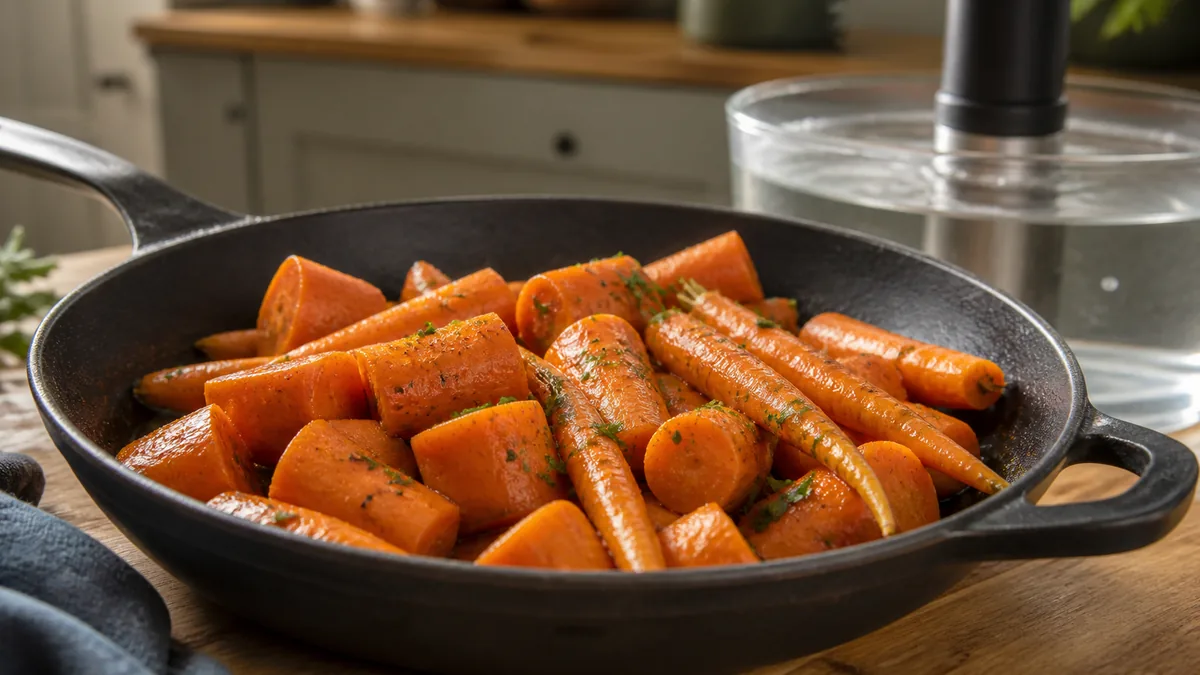
The useful sequence is simple: confirm that your carrots fit the supported shape, cook the stated formula, then reduce the bag juices into a glaze. The temperature is high for a reason, but it is not a magic pectin threshold or a promise that every carrot will soften at the same rate.
Fast schedule: what this recipe covers
| Carrots in scope | Bath | Cook target | Finish |
|---|---|---|---|
| Peeled or well-scrubbed small whole carrots, or peeled medium/large carrots cut into 1-inch chunks | 183°F (84°C) | Until fully tender, about 1 hour | Reduce all bag contents into a butter-sugar glaze |
Pass the shape-and-state gate before setting the timer
A headline time is only useful when the carrot geometry and starting state match the recipe behind it. Use this gate before you preheat the bath; it is the part that prevents a reasonable-looking recipe from becoming an unsupported guess.
| Your carrots | Use the 183°F, about-1-hour path? | What to do |
|---|---|---|
| Peeled or well-scrubbed small whole carrots | Yes | Use the stated recipe path. |
| Peeled medium/large carrots cut into 1-inch chunks | Yes | Use the stated recipe path. |
| Thin coins or narrow batons | No automatic transfer | Find guidance written for that geometry. |
| Large whole mature carrots | No automatic transfer | The diameter is outside the locked recipe scope. |
| Frozen or pre-cooked carrots | No | The starting state differs; use separate evidence. |
| Mixed sizes or crowded layers | Resize or repack first | Use similar-size pieces and avoid a crowded clump. |
Keeping the pieces similar in size is a practical way to keep the pouch from becoming a clump. A single practical layer also avoids a crowded bag; it is workflow guidance, not a separately validated cooking-time calculation.
Why carrots use a 183°F (84°C) bath
Carrot texture changes with both temperature and time. Research on cooked carrots describes temperature-dependent softening and pectin/cell-wall changes; one study examined texture degradation from 80°C to 110°C, while earlier work found that softening also varied by carrot variety and heat treatment. See Peng et al. and Paulus and Saguy.
That explains why this recipe’s 183°F (84°C) setpoint is much higher than a typical meat bath. It is a source-supported culinary setting within a range where carrot texture changes materially, not the exact temperature at which pectin suddenly switches on. Carrot variety and size can still affect texture, so about 1 hour is recipe guidance rather than a guarantee of identical results for every in-scope carrot.
Ingredients, washing, and packaging
For 1 pound (454 g) of peeled or well-scrubbed small whole carrots, or peeled medium/large carrots cut into 1-inch chunks, use 30 g unsalted butter, 12 g sugar, and 1/2 teaspoon kosher salt. Ground black pepper and 1 tablespoon (15 ml) chopped parsley are optional additions after cooking. These quantities come from the Serious Eats recipe, also published by Anova.
- Wash before peeling or cutting. Rinse carrots under running water; if you will leave small carrots whole with their skins on, scrub them well. The FDA advises against using soap, detergent, or commercial produce wash. Washing reduces bacteria but does not eliminate it. Discard rotten carrots and cut away damaged areas. FDA produce-handling guidance
- Choose the pouch by its instructions. Use a sealed pouch whose manufacturer permits the intended temperature, duration, fill, and sealing method. Do not assume that a generic zip-top or freezer bag is authorized; for example, Ziploc’s current FAQ directs sous vide use to its Endurables line. Check the instructions for the exact pouch you own and use this site’s water-displacement packaging guidance only when that method is allowed for it.
- Pack to avoid a clump. Add the carrots, butter, sugar, and salt, seal according to the pouch maker’s instructions, and arrange the carrots in a practical single layer when possible.
If your question is about bag material rather than the closure method, see the site’s sous vide bag safety guide. That decision is separate from whether a particular pouch is authorized for this cook.
Cook, then turn the bag juices into a glaze
- Preheat the bath. Set the circulator to 183°F (84°C) and let the water reach the setpoint before adding the sealed pouch. If you are new to the setup, this beginner’s guide to sous vide covers the basic water-bath workflow.
- Cook until fully tender. Submerge the pouch as its maker directs and cook the supported carrot shapes until fully tender, about 1 hour. The source recipe provides no alternate schedule or fixed extension for this guide.
- Reduce everything in the pouch. Transfer the carrots and all bag contents to a heavy-bottomed skillet. Cook over high heat, stirring constantly, for about 2 minutes, until the liquid reduces into a glaze. The timing and finish follow the recipe method.
- Correct a greasy glaze carefully. If the glaze separates and looks greasy, add water 1 teaspoon at a time and shake the skillet to help it come back together, as directed in the source recipe. This is a recipe-specific correction, not a guarantee that every broken glaze will recover.
Add pepper or parsley, if using, after the glaze is formed and serve the carrots right away.
What this guide does not cover
This is deliberately a narrow recipe path: peeled or well-scrubbed small whole carrots, or peeled medium/large carrots cut into 1-inch chunks; a preheated 183°F (84°C) bath; cooking until fully tender, about 1 hour; and immediate skillet finishing. It does not provide an alternate schedule or fixed extension, or a schedule for frozen carrots, thin cuts, thick whole carrots, cook-chill storage, or reheating.
The schedule is designed for culinary tenderness. It is not presented as a validated pasteurization process, a shelf-stability process, or a universal holding window. If your carrots do not pass the shape-and-state gate, resize them to the supported forms or pause until you have guidance that matches their geometry and starting state.
Sources and methodology
This guide is research-based; no original kitchen testing was conducted. We used the Serious Eats recipe as the primary culinary source, the Anova version that also publishes the recipe, FDA guidance for produce handling, and peer-reviewed studies for the texture explanation. Sources were checked August 8, 2026.
- Serious Eats: Sous Vide Glazed Carrots Recipe
- Anova Culinary: Sous Vide Glazed Carrots
- FDA: Selecting and Serving Produce Safely
- Peng et al.: Kinetics of carrot texture degradation under pasteurization conditions
- Paulus and Saguy: Effect of Heat Treatment on the Quality of Cooked Carrots
- Ziploc FAQ: Current sous vide product guidance
Use the shape gate as your last check: when the carrots are peeled or well-scrubbed small whole carrots, or peeled medium/large carrots cut into 1-inch chunks, this recipe gives you one complete cook-and-glaze path. When they are not, the right next step is different guidance, not a guessed time.