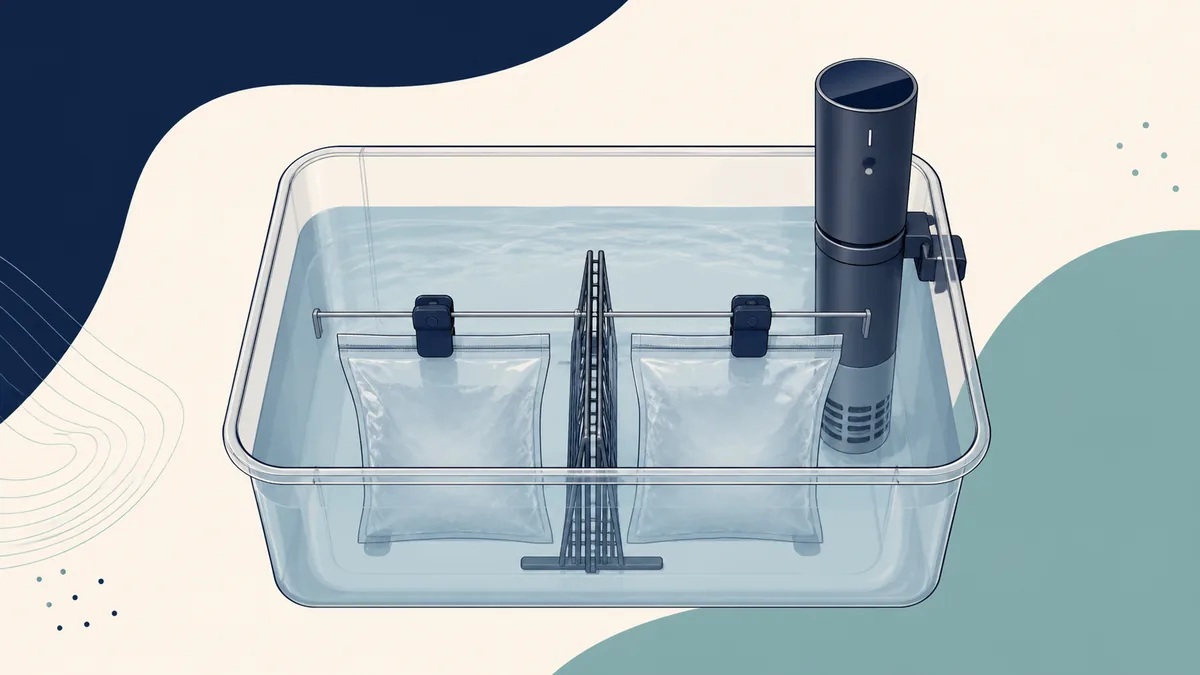
What racks, weights, and clips can—and cannot—solve
These accessories solve position problems, not every sous vide problem. A rack may keep pouches apart. A weight may hold a pouch below the waterline. A clip may keep a sealed edge from moving around the rim. Those functions are different, and combining them does not create a universal safe setup.
The useful question is not “Which accessory is best?” It is “What must this accessory do in this bath without blocking the circulator or stressing the bag?” That distinction keeps a flotation fix from becoming a circulation or food-safety mistake.
- Retention: keeps a pouch from drifting, rising, or folding into another pouch.
- Separation: preserves space between pouches so water can move around them.
- Edge control: keeps a pouch positioned at a rim or approved support point.
- Clearance: leaves the intake, outlet, pump path, lid, vessel, and other limits within exact instructions.
A restraint does not validate the cooking schedule. Submersion is not equivalent to pasteurization, doneness, or safe handling. Keep food-specific time, temperature, thickness, starting-state, chilling, storage, and reheating decisions in the applicable food-safety guidance rather than using an accessory as a substitute.
If your immediate problem is a bag that already floats, start with the sous vide bag floating troubleshooting guide. If vessel size or lid fit is the problem, compare sous vide container options. Before transferring any food-specific schedule, use the sous vide compatibility checklist to confirm its assumptions.
Six-gate compatibility matrix
Run every candidate setup through all six gates. One failed gate is enough to reject the object or change the arrangement. A rack, clip, or weight is not “compatible” because it fits physically; compatibility means it passes each relevant question for the exact setup.
| Gate | Question | Pass condition | Stop or change setup when |
|---|---|---|---|
| 1. Retention | Does it address the actual movement problem? | Its intended function matches floating, overlap, drift, or edge movement. | It is being asked to solve a different problem, such as a leak or failed seal. |
| 2. Circulation | Can water still follow the model’s intake and outlet path? | Exact model instructions allow the vessel, loading, placement, and accessory arrangement. | The object covers an intake, outlet, pump path, or required water area, or the manual is unclear. |
| 3. Bag integrity | Can contact puncture, abrade, compress, open, or heat-stress the pouch? | Contact points and loading are permitted for the exact bag and setup, with no sharp, rough, crushing, or seal-stressing contact. | Any damage, leak, water ingress, opened seal, or credible risk cannot be ruled out. |
| 4. Food contact | Is contact with hot bath water or the bag authorized? | Exact product documentation or an appropriate regulatory/intended-use basis covers the actual material and conditions. | Evidence is only a generic “stainless steel,” “silicone,” “plastic,” or “rubber” label. |
| 5. Geometry | Does it fit this circulator, vessel, lid, bag shape, and loading? | Current instructions match the exact model, variant, vessel, and arrangement. | Fit depends on an unverified dimension, universal clearance assumption, or different model. |
| 6. Cleaning and inspection | Can you inspect and clean every contact surface? | The item’s instructions support cleaning, and its surfaces remain intact and accessible. | Cracks, corrosion, trapped residue, damaged coating, inaccessible joints, or unknown care limits remain. |
Decision: use the setup only when all gates pass. If the function is useful but geometry, material, or loading is unknown, change the setup or verify the exact instructions. If the bag may be compromised, stop; do not use restraint to continue a questionable cook.
Choose by problem, not by accessory name
Bags float or rise
First separate an intact pouch-position problem from a bag-integrity problem. If the pouch is visibly intact but moves, a retention method may be relevant only after the circulator manual, container limits, bag instructions, and contact conditions pass the six gates.
A weight that merely forces a pouch down can create a new failure: concentrated pressure, abrasion, a puncture point, or blocked flow. Do not infer that heavier is better. No universal safe weight can be established across bags, food shapes, vessels, and circulators.
Bags overlap or crowd each other
A rack may help with separation, but separation alone does not prove adequate circulation. Check the exact manual for water level, vessel limits, loading, placement, and flow path. Do not publish or rely on a universal bag count, rack dimension, or clearance distance.
If the rack turns a loose arrangement into a tightly packed wall, it may defeat its purpose. Change food placement, vessel choice, or loading when the manufacturer’s flow limits cannot be met. A larger-looking accessory is not automatically a better one.
A bag needs edge retention
A clip may retain a bag at a container edge, but clip force, heat exposure, rim fit, and seal stress depend on exact design and placement. Treat a clip as an edge-retention device only when the current instructions authorize that use. Never seal the bag to a rack or clip, clamp across a seal without permission, or let a hard edge carry pressure against the pouch.
Model-specific manual boundary
Manufacturer instructions control the details this guide cannot generalize. Before using any named or generic accessory, identify the exact circulator model and variant, container or lid, bag type, food shape, and intended contact points. Then check the current instructions for minimum and maximum water levels, vessel limits, circulation path, placement, loading, accessory restrictions, and cleaning.
An instruction for one Anova model, one Breville Joule model, one PolyScience model, or one manufacturer-approved accessory does not transfer to another model or to a household object. A model’s magnetic foot, approved rack, or supplied clip is evidence about that documented setup only. It is not evidence for universal rack, clip, weight, force, clearance, or container compatibility.
- Find the exact model number, not only the brand family.
- Use the current manual or support page for that model.
- Match the documented vessel and accessory arrangement to your actual setup.
- Stop and verify when the instructions do not address the contact, loading, or placement you need.
Food-contact and bag-damage stop rules
Food-contact suitability is an exact product and intended-use question. A generic material label is not enough. “Stainless steel,” “silicone,” “plastic,” and “rubber” describe broad material categories, not the complete formulation, finish, additives, temperature range, or intended contact conditions. FDA food-contact status likewise depends on the substance, intended use, and conditions of use.
Reject unknown rocks, magnets, plates, spoons, binder clips, and other improvised objects unless their actual material, intended use, condition, and setup are documented for the conditions involved. Do not turn a familiar kitchen object into a safety recommendation based on appearance or habit.
Stop the setup if a rack, clip, or weight punctures, abrades, sharply compresses, opens, or leaks the pouch. Stop as well when water entered the bag or ingress cannot be ruled out. Restraint controls position; it does not repair a compromised bag or restore unknown food-safety history. Apply the applicable food-safety handling rule instead of trying to salvage the cook by adding more weight or another clip.
A practical setup check before heating
- Describe the failure. Record whether bags float, overlap, drift, fold, press against the vessel, or move toward the circulator.
- Map contact. Mark every place the accessory, bag, container, lid, and circulator touch or could touch.
- Read exact instructions. Confirm water level, vessel, flow path, placement, loading, accessory use, and cleaning requirements for current models.
- Inspect the bag path. Remove sharp, rough, crushing, seal-contact, or pinch points. Do not improvise a load or force limit.
- Confirm material scope. Require product-specific documentation or suitable regulatory/intended-use support for hot-water and bag-contact conditions.
- Run a dry arrangement check. With the bath unheated and according to model instructions, confirm the pouch can remain positioned without obstructing flow. This is an arrangement check, not a cooking test.
- Make the decision. Use only if every gate passes; otherwise change the setup or stop and verify.
Do not use this checklist to invent a dimension, bag count, weight, clearance, or clip force. Those values belong to the exact manufacturer documentation, if documented at all.
What this guide does not validate
This article does not validate a cooking schedule, pasteurization target, doneness result, storage period, reheating method, or vulnerable-person guidance. It does not establish that a bag material or accessory is universally food-contact suitable. It does not test a rack, weight, clip, circulator, container, or bag.
We did not independently test these setups. This is a research-based compatibility framework built from official manufacturer support/manual sources, FDA food-contact guidance, USDA FSIS food-safety boundaries, and the project’s locked scope. Named models and accessories require a fresh exact-model review before any specific compatibility claim is added.
Sources and methodology
Research checked August 22, 2026. Controlling source families include Anova support and manuals, Anova product and accessory documentation, the Breville Joule CS10001 product page and manual, PolyScience support, FDA Food Contact Substances, FDA regulatory-status guidance, 21 CFR Part 177, and USDA FSIS food-safety basics. Source scope does not support universal accessory specifications or product roundup claims.