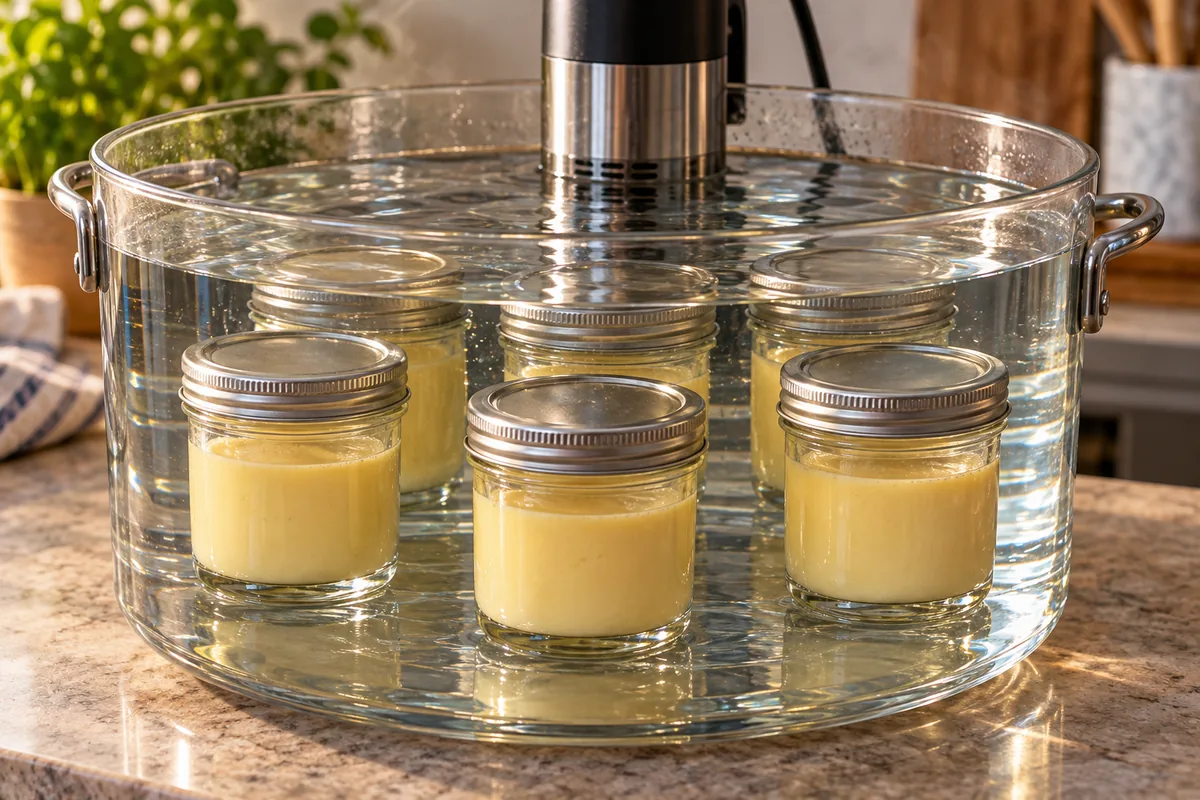
The Reliable Sous Vide Egg Bites Setup
Egg bites are not shell eggs cooked at a low temperature. They are a blended egg-and-dairy custard cooked inside small jars. Jar size, fill level, lid tension, and bath temperature work as one system, so changing one part can change the result.
| Decision | Use this setup | Why it matters |
|---|---|---|
| Container | Six intact 4-ounce (125 ml) canning jars with two-piece lids | The cited 172°F schedule is tied to this small-jar format. |
| Batch | Six eggs, divided evenly | Works out to roughly one egg per jar before dairy and fillings. |
| Bath | 172°F (77.8°C) | Both Anova and Cambro publish this setting for 4-ounce jar egg bites. |
| Time | 60 minutes after jars enter the preheated bath | Matches the cited jar recipes; do not transfer it automatically to larger jars or molds. |
| Lid | Fingertip-tight, not wrench-tight | Allows expanding air to vent around the lid instead of building pressure. |
| Fill | Even portions with visible room below the rim | Egg mixture expands as it sets; overfilling creates mess and uneven portions. |
If you are new to water-bath cooking, our sous vide beginner’s guide explains circulation, preheating, and bath setup. For this recipe, choose a container deep enough to cover the filled jars without exceeding your circulator’s maximum water line.
Ingredients for Six 4-Ounce Jars
- 6 large eggs
- 1/2 cup finely shredded Gruyere cheese
- 1/4 cup cottage cheese
- 1/4 teaspoon fine salt
- 3 slices cooked bacon, chopped (optional)
- Neutral oil or butter for a very light coating inside the jars
This base follows the proportions in an Anova egg-bites recipe. Gruyere brings a nutty flavor; cottage cheese blends into the eggs and softens the finished set. Bacon is optional. If you replace it, keep add-ins finely chopped, cooked, cooled, and modest so every jar still receives a similar amount of egg mixture.
Jar Check Before You Cook
Use intact 4-ounce jars, clean rims, and lids that sit evenly. This guide does not rely on a jar manufacturer’s approval of sous vide cooking. Anova’s published egg-bite directions warn that overtightening can prevent pressure release and contribute to breakage; use fingertip-tight rings instead.
- Use small canning jars. The published schedule uses 4-ounce jars. A 12-ounce jar has different heat-transfer behavior and is not a direct substitute.
- Keep the jar setup consistent. Divide the mixture evenly, leave visible headspace, and do not apply this schedule to a materially different starting condition or fill.
- Check lids and rims. Clean rims help the lid sit evenly. Replace bent lids or lids that do not close correctly.
- Make space in the bath. Water should circulate around the jars. Do not wedge them tightly against the circulator.
Need a larger vessel for six jars? Use our sous vide container guide to check capacity and circulator fit, then follow the appliance’s water-level limits.
How to Make Sous Vide Egg Bites in Jars
- Preheat the water bath. Set the circulator to 172°F (77.8°C). Make sure the final water level will remain between the appliance’s minimum and maximum marks after the jars are added.
- Prepare the jars. Lightly grease the inside of six clean 4-ounce canning jars. This will not guarantee a perfect release, but it reduces sticking.
- Add solid fillings. Divide cooked bacon or another cooked, cooled add-in among the jars. Keep the amounts similar so the egg base fills and heats consistently.
- Blend the base. Process eggs, Gruyere, cottage cheese, and salt until smooth. Stop once combined; whipping in excessive air can produce a foamy top.
- Fill evenly. Pour the mixture among the six jars. Leave visible headspace rather than filling to the rim. Wipe the rims clean.
- Close fingertip-tight. Center each flat lid, add the ring, and turn it only until resistance is met with your fingertips. Anova specifically warns that overtightening can prevent pressure release and contribute to jar breakage.
- Cook for 60 minutes. Lower the jars carefully into the preheated bath and keep them fully submerged. Start the timer once all jars are in. This is the published recipe schedule for this jar format; it is not a guarantee that every center has reached the endpoint.
- Verify every jar before serving. Lift jars with tongs or a jar lifter and place them on a towel or rack. Use a food thermometer whose manufacturer instructions say it can measure shallow or thin foods at the depth of an egg bite. Follow its required insertion depth, placing the full sensing area in the center or thickest portion without touching the glass. If the full sensing area cannot fit inside the egg bite, use a suitable thin-food thermometer instead. Wash the probe with hot, soapy water or clean it according to its manufacturer instructions before the first check and between jars. Open and check every jar; USDA guidance says egg dishes should be checked in several places and the center should reach 160°F (71.1°C). Serve only jars that meet that endpoint. If a jar is below 160°F, transfer its contents to a microwave-safe dish. For this conservative recovery method, follow the FDA’s microwave controls for egg-containing foods: cover the dish to retain surface moisture, and stir or rotate it midway through microwave cooking. Continue until all parts reach at least 165°F (73.9°C), verifying several locations including the center with the same thermometer-placement rules. Then let the dish stand covered for 2 minutes before serving. Do not reseal and re-submerge an opened jar.
Texture Control Without Inventing a New Schedule
The 172°F bath and 60-minute time are the source-matched starting point for this method. Change texture through the mixture, not by improvising a lower temperature or shorter cook, and keep the 160°F center check as the release criterion for each served jar.
| Result | Adjustment | Boundary |
|---|---|---|
| Smoother, uniform custard | Blend eggs and cheese until no cottage-cheese curds remain | Avoid prolonged high-speed blending that creates a thick foam cap. |
| Firmer bite | Keep add-ins modest and divide the egg base evenly | Do not solve a loose set by overfilling jars or overtightening lids. |
| Easier release | Grease the jar lightly and loosen the edge with a thin knife | Serve from the jar if a clean release matters less than easy cleanup. |
| More flavor | Add a small amount of cooked bacon, sauteed vegetables, herbs, or seasoning | Large or wet add-ins create uneven portions and watery pockets. |
This article deliberately does not give a silicone-mold schedule. In its egg FAQ, ChefSteps notes user interest in silicone molds but says it did not test how changing the container affects cook time. A jar schedule should not be presented as validated for an open mold with different geometry.
Troubleshooting Egg Bites
| Problem | Likely cause | Next-batch fix |
|---|---|---|
| Jar breaks in the bath | A damaged setup or a ring tightened too hard can create a glass and contamination hazard | Stop the cook and discard food from the affected bath as a conservative glass-fragment precaution. Do not taste or salvage it. Use intact jars and fingertip-tight lids for the next batch. |
| Egg bites stick | Uncoated glass or trying to force out a delicate custard | Grease lightly, run a thin knife around the edge, or eat directly from the jar. |
| Watery pockets | Too many moist vegetables or unevenly distributed add-ins | Cook and cool vegetables first, drain them well, and use less per jar. |
| Foamy or pitted top | Too much air blended into the mixture | Blend only until smooth, then let large bubbles settle before filling. |
| Different textures across jars | Uneven filling, crowded circulation, or mismatched jar sizes | Use the same 4-ounce jars, portion evenly, and leave water space around each jar. |
| Center below 160°F | Uneven filling, a changed starting condition, poor circulation, or setup drift | Do not serve that jar. Recheck the other jars individually with a clean shallow-food thermometer whose full sensing area reaches the center without touching glass. For microwave recovery, transfer the low jar’s contents to a microwave-safe dish, cover it, and stir or rotate midway through cooking. Heat until all parts reach at least 165°F, verify several locations including the center, then let the dish stand covered for 2 minutes before serving. |
Serving, Cooling, Storage, and Reheating
For immediate service, let jars stand on a towel until safe to handle. Eat from the jar or loosen the edge with a thin knife and invert onto a heat-safe plate. If you want browning, remove the egg bite from the glass before using a broiler or torch.
For leftovers, the FDA’s consumer egg-safety guidance says to refrigerate cooked egg dishes within two hours, or within one hour when ambient temperature is above 90°F (32.2°C). Refrigerate and use within 3 to 4 days. Reheat leftovers thoroughly to 165°F (73.9°C). Remove the metal lid before any microwave reheating, and never microwave a sealed jar.
This guide does not claim a 5-to-7-day refrigerator life or a freezer duration. Those longer storage windows were not established by the evidence used for this workflow.
Egg Bites vs. Sous Vide Shell Eggs
Shell eggs use lower bath temperatures to create specific yolk and white textures. Egg bites use a blended custard in jars at 172°F. The two methods have different geometry and goals, so their schedules are not interchangeable. For soft-, poached-, and hard-cooked eggs in the shell, use our separate sous vide eggs temperature and time guide.
Sources and Scope
- Anova Culinary: Egg Bites — ingredients, 4-ounce jars, 172°F, 60 minutes, and fingertip-tight lids.
- Anova Culinary: Bacon & Gruyere Egg Bites — confirms six 4-ounce jars and the same time-temperature path.
- Cambro: Sous Vide Egg Bites — approximately one egg per 4-ounce jar, headspace, just-tight lids, 172°F for one hour.
- ChefSteps: Sous Vide Egg FAQ — sticking options and untested container-change limitation.
- FDA: What You Need to Know About Egg Safety — 160°F egg-dish endpoint, two-hour refrigeration rule, 3-to-4-day storage, and 165°F reheating guidance.
- FDA: Assuring the Safety of Eggs and Menu and Deli Items Made From Raw Shell Eggs — food-service microwave controls adopted here as a conservative recovery method.
- USDA FSIS: Food Thermometers — check egg dishes in several places and verify 160°F at the center.
This is evidence-informed editorial guidance, not a claim of a Perfect Sous Vide test kitchen trial. Published recipe schedules establish the method; FDA and USDA guidance supply the conservative endpoint, microwave-recovery, thermometer, and storage boundaries.
Featured image: AI-generated illustrative image; not a cooking-test photograph.