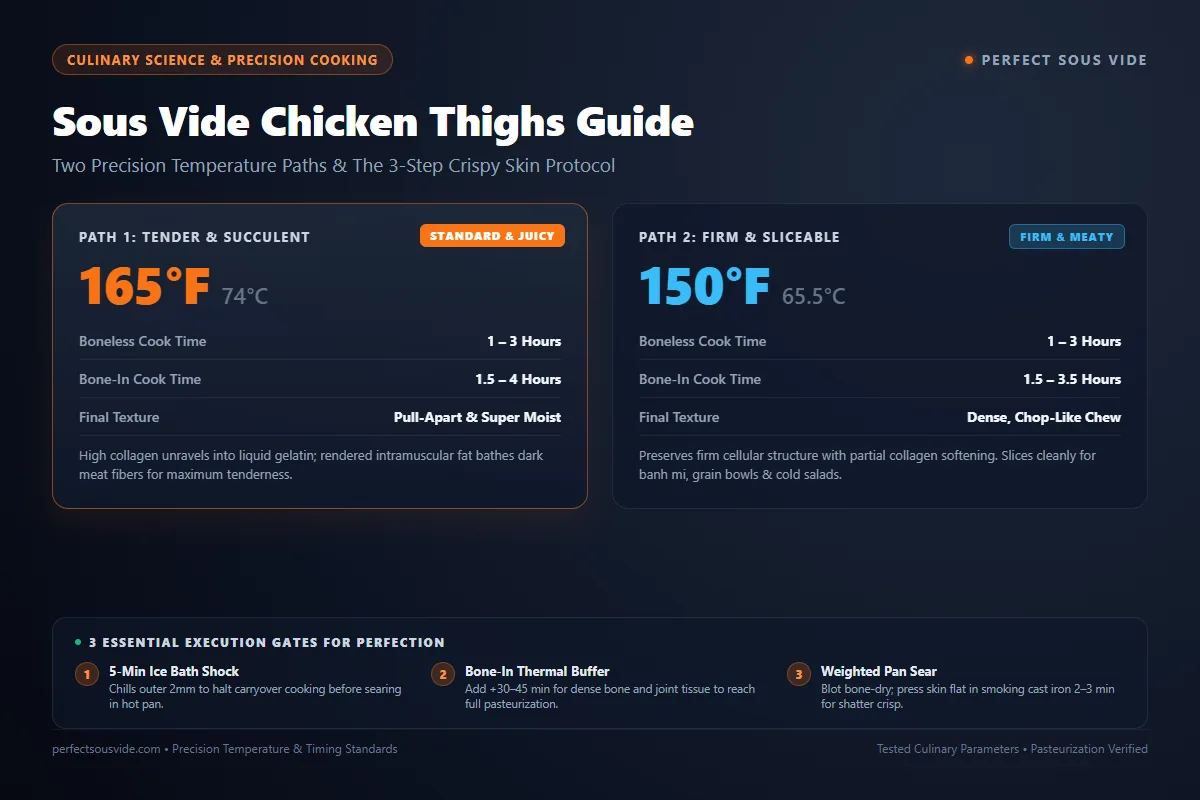
The Science of Dark Meat: Why Chicken Thighs Need 165°F (Not 140°F)
A common mistake among cooks transitioning from chicken breast to chicken thighs is applying the same low water bath temperatures. When cooking lean white meat, your primary culinary objective is preserving intracellular water; cooking chicken breast above 150°F causes delicate muscle fibers to contract violently and squeeze out cellular moisture, resulting in stringy dryness. As outlined in our sous vide chicken breast temperature guide, white meat thrives in the 140°F to 149°F window.
Chicken thighs behave in fundamentally different ways because avian anatomy divides muscle by physical workload:
- Slow-Twitch Red Muscle Fibers: Chicken breast consists of fast-twitch white fibers (pectoralis major) used only for short bursts of flight. Thighs and drumsticks are endurance locomotive muscles composed of slow-twitch fibers packed with iron-dense myoglobin and mitochondria. Dark meat has higher natural fat content and structural density.
- Higher Collagen Density: Chicken thighs contain three to five times more connective tissue (primarily Type I and Type III collagen) than breast meat. Below 140°F (60°C), this collagen remains rigid and gristly. If cooked at white-meat temperatures, chicken thighs emerge rubbery, chewy, and unappealingly gelatinous around the tendons.
- Thermal Collagen Denaturation: When water bath temperatures cross 150°F (65.5°C), the hydrogen bonds holding the collagen triple-helix begin to unravel. At 165°F (74°C), collagen breaks down rapidly into liquid gelatin while intramuscular fat melts, lubricating muscle bundles from within and producing extraordinarily succulent meat.
Texture Breakdown by Temperature
- 150°F (65.5°C) — Firm, Chop-Like, Ultra-Juicy: Connective tissue softens partially while retaining cellular moisture. The meat has a firm, resilient chew similar to a heritage pork chop. It slices cleanly with a chef’s knife, making it exceptional for cold chicken salads, banh mi, and grain bowls.
- 165°F (74°C) — Succulent, Pull-Apart Tender (Recommended): Collagen melts completely into savory gelatin, and intramuscular fat fully renders. Individual meat fibers separate easily with a fork while staying thoroughly moist. This is the gold standard for traditional roast chicken flavor, barbecue, and curries.
- 170°F (76.5°C) — Braise-Style, Fall-Apart Shreds: Maximum connective tissue breakdown occurs. The meat yields effortlessly into fine shreds under zero fork resistance. Ideal for chicken tacos, enchiladas, pot pies, and pulled chicken sandwiches.
The Over-Cooking Threshold: Why More Time Harms Texture
While sous vide offers a forgiving cooking window, chicken thighs are not immune to over-exposure. Holding chicken thighs in a 165°F bath longer than 4 hours causes extensive proteolysis. Muscle fibers lose their structural cohesion, degrading into a mushy, chalky paste. For optimal bite and moisture retention, keep cook times strictly between 1 and 3 hours for boneless cuts and 1.5 to 4 hours for bone-in cuts.
Sous Vide Chicken Thighs Time and Temperature Master Chart
Cooking times are calibrated for fresh or thawed poultry placed into a preheated, circulating water bath starting from refrigerator temperature (38°F–41°F / 3°C–5°C). Ensure bags are arranged in a flat, single layer with space between pouches for unrestricted water circulation.
| Cut Geometry | 150°F (65.5°C) Firm & Meaty | 165°F (74°C) Tender & Succulent | 170°F (76.5°C) Fall-Apart Shredded | Best Culinary Application |
|---|---|---|---|---|
| Boneless, Skinless Thighs | 1.5 – 3.0 Hours | 1.0 – 2.5 Hours | 1.5 – 3.0 Hours | Meal prep, stir-fries, noodle bowls, cold salads |
| Bone-In, Skin-On Thighs | 2.0 – 4.0 Hours | 1.5 – 3.5 Hours | 2.5 – 4.0 Hours | Pan-seared crispy skin dinners, roast platters |
| Frozen Boneless Thighs | 2.0 – 3.5 Hours | 1.5 – 3.0 Hours | 2.0 – 3.5 Hours | Direct weeknight cooking with zero defrosting |
| Frozen Bone-In Thighs | 2.5 – 4.5 Hours | 2.25 – 4.0 Hours | 3.0 – 4.5 Hours | Bulk batch cooking directly from the freezer |
Bone-In vs. Boneless: Thermal Lag and Bone Marrow Science
Selecting bone-in versus boneless chicken thighs alters both cooking kinetics and finished presentation in two distinct ways.
Thermal Insulation of the Femur Bone
Poultry bone is a composite material composed of dense collagen matrix and calcium phosphate minerals. Heat transfers through dense avian bone significantly slower than through water-rich muscle tissue. The meat immediately adjacent to the femur bone experiences a thermal lag of 30 to 45 minutes compared to boneless meat of identical thickness. As outlined in our sous vide thickness checklist, measuring thickness accurately is essential for heat penetration. For bone-in thighs, always extend your minimum bath duration by at least 30 minutes to guarantee complete pathogen reduction at the core.
The Bone Marrow Discoloration Effect (Why Safe Meat Looks Pink)
Home cooks frequently inspect bone-in sous vide chicken thighs, spot a dark red or deep purple ring directly touching the bone, and mistakenly conclude the poultry is raw. This visual artifact is known as bone marrow pigment leaching.
Modern commercial broilers are harvested young, typically between 6 and 8 weeks of age. Their bones are porous and incompletely calcified. During multi-hour sous vide cooking, hemoglobin and myoglobin within the rich marrow cavity leach outward through the porous bone structure, staining adjacent meat fibers. If your chicken thighs have cooked to the verified time and temperature parameters listed in our chart, the meat is 100% pasteurized and safe to consume. Color is not a reliable indicator of poultry doneness; thermal lethality and cumulative time are.
The 3-Step Crispy Skin Protocol: Eliminating Rubbery Bag Skin
The primary critique of sous vide poultry with skin is that it emerges from the bag pale, gelatinous, and flabby. Inside a vacuum pouch, rendered fat and water vapor cannot escape. The skin braises in its own trapped steam, preventing any crispness from developing. Traditional attempts to brown sous vide skin directly out of the bag fail because the meat underneath is already hot; hitting it with high pan heat drives the interior past 180°F, creating a dry, grey overcooked band before the skin turns crisp.
To produce shatteringly crisp skin without overcooking the succulent dark meat beneath, execute our three-step finishing protocol.
Step 1: The Chill-Before-Sear Thermal Buffer
Directly transferring chicken thighs from a 165°F water bath into a smoking-hot skillet leaves zero margin for error. To create a protective thermal cushion:
- Ice Bath Shock: Plunge the sealed pouch directly into a bowl of ice water for 5 to 8 minutes. This rapidly cools the outer 2 to 3 millimeters of meat down to approximately 90°F–100°F while keeping the core warm.
- Refrigeration Option: Alternatively, remove thighs from the bag, place them skin-side up on a wire rack set over a rimmed baking sheet, and refrigerate uncovered for 15 minutes. The circulating dry air cools the surface while simultaneously dehydrating the skin.
Step 2: Aggressive Moisture Removal
Water is the natural enemy of browning. Surface moisture absorbs heat energy and boils into steam at 212°F (100°C), preventing the skin from reaching the 280°F to 330°F (140°C–165°C) threshold required for the Maillard reaction. Use multiple layers of heavy paper towels to press firmly against every crevice of the skin until the surface is completely matte, non-tacky, and dry.
Step 3: The Weighted Cast-Iron Pan Sear
Chicken skin naturally shrinks and curls when exposed to sudden high heat, creating uneven contact pockets where skin remains pale and soggy. Counteract this with even pressure:
- Preheat a heavy cast-iron skillet over medium-high heat until a high-smoke-point oil (avocado oil or clarified butter/ghee) begins to shimmer.
- Place the dried thighs skin-side down into the hot fat.
- Immediately place a flat spatula, a chef’s bacon press, or a small saucepan weighted with a can on top of the thighs to ensure 100% skin-to-iron contact.
- Sear undisturbed for 2 to 3 minutes until the skin turns deep golden-brown and blistered.
- Flip the thighs and sear the flesh side for only 30 seconds to warm the bottom without driving heat back into the meat. Transfer immediately to a cutting board.
Alternative Method: Air Fryer Finishing
If you prefer hands-off crisping without stovetop oil spatter, use an air fryer. As demonstrated in our guide on finishing sous vide chicken in an air fryer, preheat the air fryer to 400°F (200°C). Lightly mist the chilled, dried chicken thighs with cooking spray and air fry skin-side up for 4 to 5 minutes until crisp and crackling.
Step-by-Step Cooking Workflow
Follow this end-to-end operational sequence for reliable results every time you cook:
- Preheat the Water Bath: Fill your sous vide container with warm tap water and set your immersion circulator to 165°F (74°C) for tender, juicy thighs, or 150°F (65.5°C) for firm, sliceable texture.
- Season the Poultry: Trim away excessive dangling flaps of waxy yellow fat. Season all surfaces generously with kosher salt, freshly ground black pepper, and optional dry aromatics (garlic powder, smoked paprika, dried thyme). If using wet seasonings, review our guide on sous vide marinades: what works to avoid surface mushiness. Note: Avoid placing raw garlic cloves inside the pouch; under low sous vide temperatures, raw alliums fail to soften and impart a harsh, sulfurous bite.
- Package in a Single Layer: Place thighs side-by-side in vacuum pouches or heavy-duty gallon freezer bags. Do not overlap or stack pieces on top of each other, as stacked meat doubles effective thickness and slows thermal penetration. If using zipper-lock bags, submerge the pouch slowly in water to push out trapped air using the water displacement method. Seal tightly.
- Submerge and Anchor: Lower pouches into the circulating bath. If poultry pouches begin lifting to the surface due to trapped air or steam, consult our guide on how to prevent sous vide bag floating and anchor the pouches using stainless sous vide weights or a submerged rack. Cook according to cut thickness (1–2.5 hours for boneless; 1.5–3.5 hours for bone-in).
- Execute the Thermal Shock: Remove the pouches from the bath. Transfer immediately to a bowl of ice water for 5 to 8 minutes to cool the skin.
- Reserve the Pouch Drippings: Cut open the bag and pour all accumulated liquid into a small saucepan. Do not discard this liquid; it is packed with melted gelatin and savory juices.
- Dry and Sear: Blot the skin thoroughly with paper towels. Sear skin-side down in a hot cast-iron skillet for 2 to 3 minutes under gentle weight, then flip for 30 seconds.
- Mount the 3-Minute Pan Sauce: While the chicken rests, place the saucepan with reserved bag drippings over medium heat. Simmer for 2 minutes until reduced by half. Remove from heat, whisk in 1 teaspoon of Dijon mustard and 1 tablespoon of cold unsalted butter until smooth and glossy. Spoon over the seared thighs and serve immediately.
Cooking Chicken Thighs from Frozen: Safe Protocols
One of the greatest practical conveniences of sous vide cooking is preparing poultry directly from the freezer without a prior 24-hour refrigerator thaw. Water is a vastly superior thermal conductor compared to ambient air, allowing frozen poultry to pass through the danger zone quickly.
When cooking frozen chicken thighs, observe these critical boundaries observe these critical thermal boundaries:
- Single-Layer Freeze Required: Poultry must be pre-frozen individually in flat single layers. Never attempt to cook a frozen, solid 3-pound block of clustered raw thighs; the center will take hours to reach pasteurization temperature, creating severe pathogen risk.
- Timing Offsets: To account for the phase change from ice to liquid water and subsequent core heating, add 30 minutes for boneless thighs and 45 minutes for bone-in thighs to the standard cooking times.
- Water Bath Temperature: Keep your bath set to your standard target (165°F or 150°F). Drop the frozen, sealed pouches straight into the preheated water.
Food Safety and Pasteurization Standards
Poultry food safety is governed by thermal lethality kinetics. The United States Department of Agriculture Food Safety and Inspection Service (USDA-FSIS) establishes that safe poultry requires a minimum 7.0-log10 reduction of Salmonella and a 6.0-log10 reduction of Listeria monocytogenes.
The familiar USDA guideline of 165°F (74°C) represents an instantaneous pathogen kill (<1 second). However, bacterial destruction is a function of both temperature and cumulative time. Under Dr. Douglas Baldwin's published thermal models, chicken held at lower temperatures achieves identical pathogen lethality once the coldest geometric center of the meat reaches target temperature for the required duration:
- At 150°F (65.6°C): Holding poultry for 2.7 minutes at the core achieves full 7-log10 pasteurization.
- At 155°F (68.3°C): Holding poultry for 45 seconds at the core achieves full pasteurization.
- At 160°F (71.1°C): Holding poultry for 14 seconds at the core achieves full pasteurization.
- At 165°F (73.9°C): Pathogen destruction is instantaneous.
The Safety Floor: Never set your poultry water bath below 135°F (57.2°C). Water temperatures between 40°F and 130°F inhabit the bacterial danger zone where spore-forming pathogens like Clostridium perfringens can multiply during extended multi-hour cooks.
Frequently Asked Questions
Why do chicken thighs require higher temperatures than chicken breasts in sous vide?
Chicken thighs are rich in slow-twitch red muscle fibers and heavy collagen connective tissue. While lean chicken breast dries out above 150°F (65.5°C), chicken thighs need 165°F (74°C) to break down collagen into succulent gelatin and render intramuscular fat veins. Cooking thighs at breast temperatures leaves them rubbery, tough, and gristly.
How do you get crispy skin on sous vide chicken thighs?
Because sous vide steams the skin inside the sealed pouch, you must use a three-step finishing process: 1) Shock the sealed pouch in an ice bath for 5 to 8 minutes to cool the surface, 2) Blot the skin completely dry with paper towels until non-tacky, and 3) Sear skin-side down in a hot cast-iron skillet with a little oil under a weight for 2 to 3 minutes until deep golden and crisp. The ice bath buffer prevents the hot skillet from overcooking the tender meat inside.
Can you cook frozen chicken thighs directly in sous vide?
Yes. As long as the thighs are frozen flat in single layers, you can drop them straight into a preheated 165°F (74°C) water bath. Simply add 30 minutes for boneless thighs or 45 minutes for bone-in thighs to account for the extra time needed to thaw and reach core temperature.
Why is the meat near the chicken bone pink or purple after sous vide?
Young commercial chickens have porous, incompletely calcified bones. During extended low-temperature cooking, pigment from the bone marrow leaches through the bone wall into adjacent meat fibers. If your thighs cooked for the required pasteurization time at 150°F–165°F, this discoloration is completely harmless and does not indicate raw chicken.