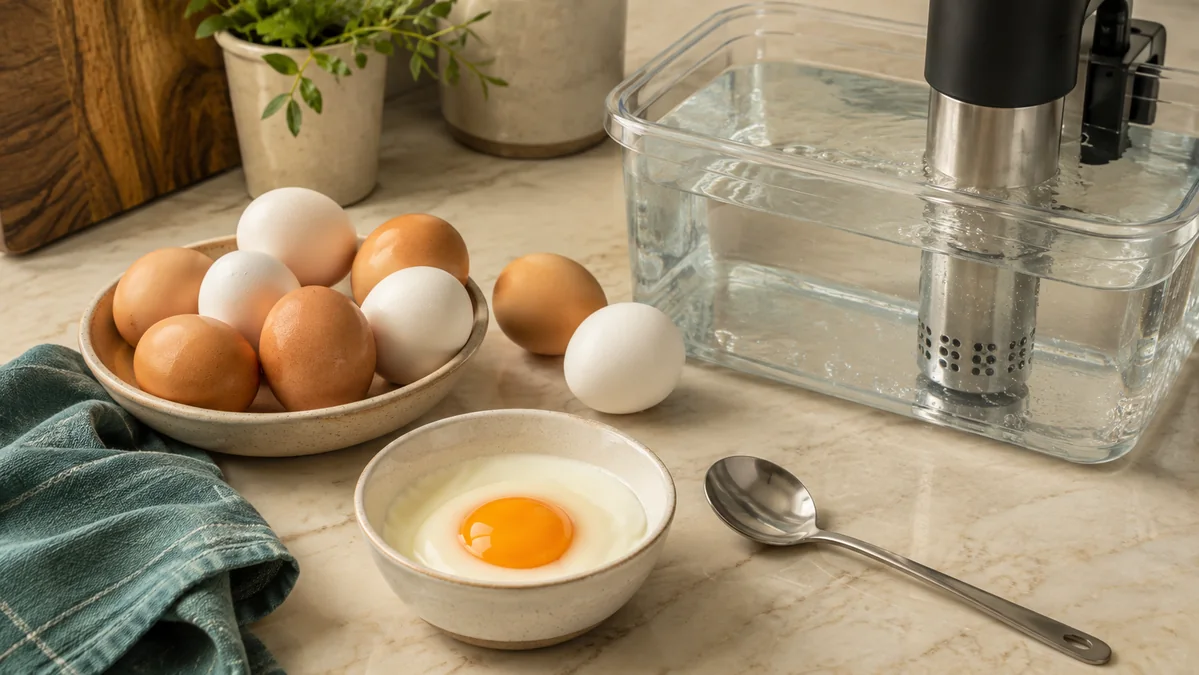
Choose your sous vide egg temperature and time
| Serving goal | Bath temperature | Time | Expected texture | Safety meaning |
|---|---|---|---|---|
| Onsen-style | 145°F / 63°C | 45 min | Barely set white; liquid yolk | Undercooked texture; not presented as pasteurized |
| Onsen-style with thicker yolk | 145°F / 63°C | 60 min | Similar delicate white; thicker yolk | Undercooked texture; not presented as pasteurized |
| Custardy “perfect egg” | 148°F / 64.5°C | 45–60 min | Custardy white and yolk | Texture schedule; no pasteurization claim |
| Firm, moist hard-cooked style | 165°F / 74°C | 40 min | Firm white; firm, moist yolk | Firmer result; still follow FDA handling advice |
This table applies to clean, uncracked, refrigerated large chicken eggs placed into a fully preheated circulating bath. Extra-large, jumbo, duck, quail, room-temperature, cracked, or previously frozen eggs can heat and set differently. Egg age and extended holding can also change the result.
The 145°F schedules and the 165°F schedule come from Anova’s shell-egg guide. The 148°F schedule comes from Douglas Baldwin’s “Perfect Egg” guidance. They remain paired here exactly as published; changing either time or temperature creates a different process.
Why egg whites and yolks set differently
An egg does not turn from raw to firm at one temperature. Its yolk and its different white layers thicken at different rates. At 145°F, the yolk can become spoonable while part of the white remains loose and watery. More time at the same temperature thickens the yolk more noticeably than the delicate white. Raising the bath temperature produces a firmer white.
That difference explains why a 145°F egg may look less like a traditionally poached egg than expected. The tight white around the yolk can set softly while the loose outer white remains fluid. This is normal for the schedule, not proof that the circulator failed.
How to cook eggs in the shell
- Choose clean, uncracked refrigerated large eggs.
- Preheat the circulating water bath fully to your selected temperature.
- Lower eggs gently into the water with a spoon. Eggs need no bag or vacuum sealer.
- Start the timer when the eggs enter the stabilized bath. Leave room for water to circulate.
- Remove each egg at the exact scheduled time.
- For an onsen-style egg, crack it into a small bowl first. Drain loose white if desired.
- For a firm egg you plan to peel, chill it promptly in ice water. Low-temperature eggs may still resist clean peeling.
- Serve promptly unless you are following separate authoritative cooling and storage guidance.
New to circulator setup? This beginner’s guide to sous vide explains bath temperature and circulation. If you are choosing a vessel that keeps the eggs submerged while leaving room for circulation, see the sous vide container guide; container choice does not change the egg schedule. Unlike bagged foods, intact shell eggs go directly into the water, so this method needs neither a bag nor a sealer.
Onsen-style is not the same as traditionally poached
A sous vide poached-style egg is usually cooked in its shell, then cracked for serving. At 145°F, expect a delicate egg that spreads more than a conventionally poached egg. For a neater plate, crack it into a bowl, let the watery loose white drain away, and transfer the tighter white and yolk with a spoon.
If you want a more opaque exterior, a brief finish in gently simmering water can set the outside further. Treat that as a finishing step, not part of the listed schedule: extra heat changes the white and can begin thickening the yolk.
Texture precision does not prove pasteurization
Raw or undercooked shell eggs may contain Salmonella. The FDA advises cooking eggs until both yolk and white are firm and using pasteurized eggs or egg products for recipes served raw or undercooked. Pregnant people, young children, older adults, and immunocompromised people face greater risk from foodborne illness.
The four texture schedules above are not presented as validated pasteurization schedules. A precise water temperature alone does not establish equivalent pathogen reduction; egg size, starting temperature, heating time, equipment performance, and process validation matter.
A separate technical in-shell process
Baldwin reports an in-shell process of 135°F (57°C) for at least 1 hour 15 minutes, based on research he cites by Schuman and colleagues. This is a separate technical schedule, not a substitute time for any row in the texture table and not a claim of FDA-approved commercial equivalence.
The USDA notes that pasteurizing shell eggs at home is difficult and that commercial processors use controlled equipment and processes. For a vulnerable diner who wants a raw-like or undercooked texture, choose commercially pasteurized shell eggs or pasteurized egg products instead of relying on a home texture schedule.
Troubleshoot common egg results
| Problem | Likely cause | What to do next |
|---|---|---|
| Watery loose white | Normal at 145°F because the egg has loose and tight white layers | Crack into a bowl and drain the loose white; use a brief simmering-water finish if desired |
| Yolk is thicker than expected | Egg stayed in the bath too long | Use an exact timer and remove promptly |
| Shell cracks in the bath | Existing damage, impact, or thermal stress | Start with uncracked eggs and lower them gently with a spoon |
| Egg is hard to peel | Low-temperature setting can leave the white attached to the shell | Serve soft eggs from a bowl; chill firm eggs promptly, without expecting perfect peeling |
| Eggs in one batch differ | Size, age, or starting temperature varies | Keep those variables consistent and test one egg before a large batch |
Use this final decision check
- Want a liquid yolk and delicate white? Use 145°F for 45 minutes.
- Want a thicker onsen-style yolk? Keep 145°F and extend to 60 minutes.
- Want a custardy white and yolk? Use 148°F for 45–60 minutes.
- Want a firm white and firm, moist yolk? Use 165°F for 40 minutes.
- Serving a vulnerable diner? Follow FDA advice and use commercially pasteurized eggs or egg products for raw-like or undercooked preparations.
This research-based guide compares FDA and USDA egg-safety guidance with published Anova and Baldwin shell-egg schedules. It reports no original cooking test. Sources were checked August 2, 2026.