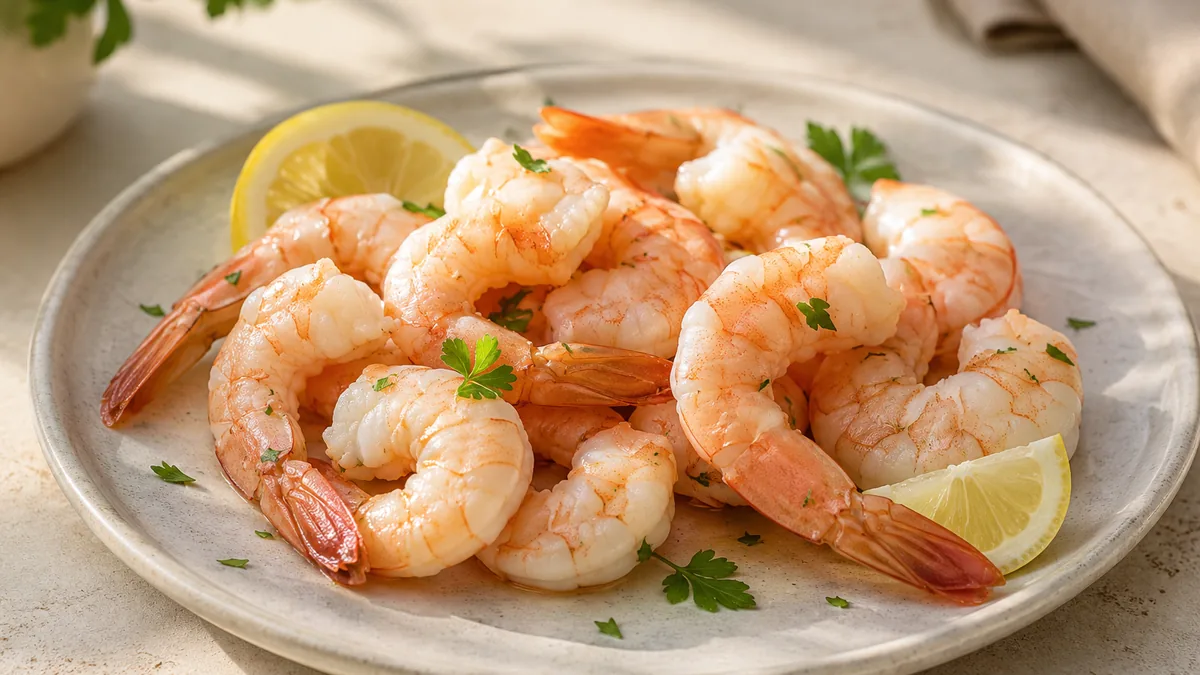
Anova’s sous vide shrimp texture temperatures
Anova’s official shrimp guide is the source for every temperature, time, and texture word in this table. It reports testing temperatures from 115°F to 150°F in 5°F steps and describes 125–140°F as its preferred range. This is descriptive manufacturer evidence, not Perfect Sous Vide’s recommendation. Anova does not disclose shrimp species, count, thickness, starting state, pathogen target, center-temperature history, or test protocol. The listed settings may leave shrimp raw or undercooked and may not adequately reduce pathogens for any diner. Read Anova’s shrimp guide.
| Anova bath temperature | Anova texture label | Anova stated time | Evidence limit |
|---|---|---|---|
| 125°F / 52°C | Translucent or semi-raw; soft and buttery | 20 minutes to 1 hour | No validated pathogen-reduction process |
| 130°F / 54°C | Nearly opaque; very tender with a hint of firmness | 20 minutes to 1 hour | No validated pathogen-reduction process |
| 135°F / 57°C | Barely opaque; moist, juicy, and tender | 20 minutes to 1 hour | No validated pathogen-reduction process |
| 140°F / 60°C | Traditional poached texture; bouncy, snappy, juicy bite | 20 minutes to 1 hour | No validated pathogen-reduction process |
Texture and safety answer different questions. “Semi-raw,” “nearly opaque,” and “poached” are Anova texture labels. They do not establish pathogen reduction or a food-safety endpoint, and undercooked-seafood risk applies to all diners.
How to read these texture bands without treating them as safety guidance
Use this decision matrix before acting on the table. It separates descriptive texture evidence from the conservative internal-temperature route and turns missing safety evidence into a clear stop, not guessed extra minutes.
| Your situation | What the evidence establishes | Risk-informed action |
|---|---|---|
| You are considering an Anova 125–140°F texture setting | Manufacturer texture description only; shrimp may remain raw or undercooked, and pathogen reduction is not validated | Do not treat the table as safety guidance. Undercooked-seafood risk applies to every diner. |
| You need a conservative endpoint | The low-temperature table does not establish it | Use the separate FDA-based internal-temperature boundary below. |
| Pregnant diner, child under 5, older adult, or weakened immune system | These groups face greater consequences from foodborne illness | Do not use the lower-temperature texture table; follow conservative official guidance or appropriate clinician/public-health advice. |
| Serving immediately | Immediate service limits this article’s storage scope only | Do not treat serving now as a lethality, pathogen-reduction, or safety control. |
| Frozen-solid, stacked, mixed-size, or count-based timing question | No validated timer is available here | Use another fully cooked method or a separately validated process for the exact batch. |
| Storage, reheating, leftovers, or meal prep | Outside this cook-now-only scope | Do not extend this table into a cook-chill or storage plan. |
Raw or undercooked seafood can carry foodborne-illness risk for anyone. FDA identifies pregnant people, young children, older adults, and people with weakened immune systems as groups at greater risk and advises them to avoid raw or partially cooked seafood. Their consequences may be greater, but the underlying undercooked-seafood risk is not limited to those groups. FDA guidance for people at risk of foodborne illness.
FDA-based safety limit: internal temperature, not a bath timer
For a conservative boundary, the thickest shrimp must reach an internal 145°F (63°C) and hold for 15 seconds. FDA’s consumer seafood guidance and USDA’s safe-temperature chart both use 145°F for seafood; FDA Food Code 2022 specifies 145°F for 15 seconds for covered fish and intact-meat foods. Food Code is a model code for food establishments, not a validated home sous-vide shrimp schedule. FDA seafood guidance; USDA safe-temperature chart; FDA Food Code 2022, section 3-401.11.
Do not translate this boundary into “145°F bath for 15 seconds.” This article does not provide a time-to-center calculation for shrimp, and it does not give credit for a sear, carryover cooking, pink color, opacity, or a bath display.
If you are comparing how another seafood guide separates culinary texture from process-dependent safety timing, see this sous vide salmon temperature and time guide. Shrimp still needs shrimp-specific validation; a fish table is not a substitute.
Shell-on shrimp: one narrow Anova adjustment
Anova permits shell-on shrimp and says to add five minutes to its 20-minute minimum cooking time. Keep that wording narrow: it is Anova’s adjustment to its minimum texture time, not a five-minute addition to every duration, a rule for every shell thickness, or a safety validation. Anova also instructs cooks to press shrimp into a single layer in the bag.
Need a practical bag setup? This guide to sous vide without a vacuum sealer explains water-displacement bagging. It does not expand the shrimp timing or safety limits here.
Why there is no universal sous vide shrimp timer
Heating time changes with thickness, shape, starting state, and bag loading. Shrimp labels such as “large” or “jumbo” do not supply a measured geometry, and no source in this guide validates a conversion from count, frozen start, or shell state into a universal sous vide time. Shrimp research also shows that time and temperature affect texture outcomes, but its product-specific study conditions do not transfer into a home 125–140°F schedule. Read the whiteleg shrimp study.
Immediate service limits scope; it does not establish safety
Immediate service is only a scope boundary: this article does not give frozen-start timing, storage, leftover, chilling, or reheating instructions. Serving shrimp now does not validate lethality, establish adequate pathogen reduction, or make an undercooked result safe. FDA does provide handling guidance for frozen seafood—thaw in a refrigerator overnight or in a sealed package under cold water, and cook immediately after microwave thawing—but that guidance does not validate a specific Anova time for a defined shrimp. FDA frozen seafood handling guidance. This guide is research-based and reports no original cooking tests.