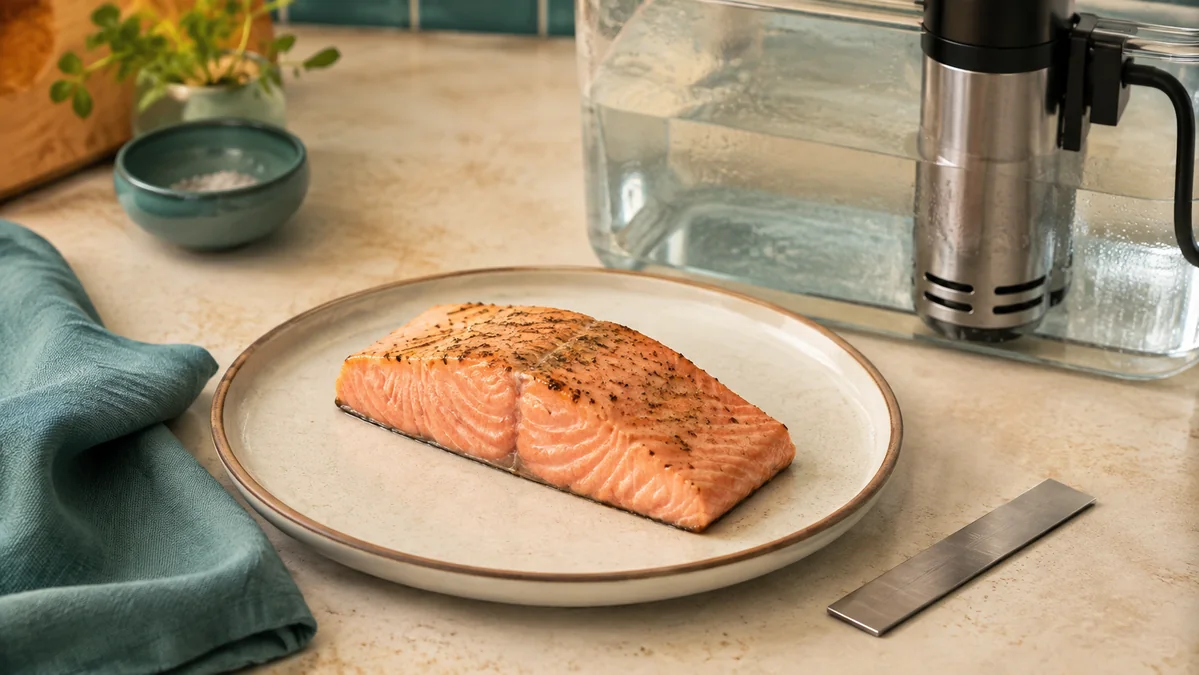
Choose salmon temperature by texture
| Bath temperature | Expected texture | Texture-path timing boundary | Safety meaning |
|---|---|---|---|
| 110°F / 43°C | Very soft and translucent | 30–45 min only for a thawed thin fillet; not a thickness guarantee | Not pasteurized; skip for vulnerable diners |
| 120°F / 49°C | Soft and moist with a translucent center | 30–45 min only for a thawed thin fillet; not a thickness guarantee | Short schedule is not pasteurization |
| 125°F / 52°C | Tender, moist, and lightly flaky | 30–45 min only for a thawed thin fillet; not a thickness guarantee | Lead texture choice; not pasteurized by this short schedule |
| 130°F / 54°C | Firmer and flakier | 30–45 min only for a thawed thin fillet; not a thickness guarantee | Not covered by Baldwin’s pasteurization table |
| 140°F / 60°C | Firm and conventionally cooked | 30–45 min only for a thawed thin fillet; not a thickness guarantee | Use thickness table for pasteurization |
| 145°F / 63°C | Firmest option in this guide | Center must reach 145°F and hold 15 sec | FDA Food Code benchmark |
Temperature changes the texture you are aiming for; thickness and starting condition determine how long the center takes to approach the bath temperature. Anova’s 30–45 minute culinary range is useful only as a thin-fillet recipe schedule, not as proof that a portion of a stated thickness has heated through. If your salmon is not clearly thin, use documented thickness-aware guidance rather than stretching this short range.
The texture descriptions draw on Anova’s salmon temperature guide and Baldwin’s salmon guidance; they are not Perfect Sous Vide test results.
Choose one of two time paths
Path 1: Cook for texture and serve immediately
Use this path only for an intact, thawed thin fillet when your priority is a specific texture. Choose a bath temperature from the first table and use the cited 30–45 minute culinary schedule only within that narrow thin-fillet scope. It is a recipe timing range, not a promise that the center of a measured thickness has reached or nearly reached the bath temperature. Serve promptly, and do not describe this short schedule as pasteurization.
Path 2: Use a thickness-based pasteurization schedule
Use this path when pathogen reduction is part of the cooking goal. Measure the thickest point, select a listed bath temperature, then use the total bath time in the next table. If your portion or setup falls outside the table assumptions, do not guess or interpolate.
For pregnant people, older adults, young children, or immunocompromised diners: do not serve salmon cooked only by an underpasteurized texture schedule.
Pasteurization times for thawed fatty fish
| Thickness | 131°F / 55°C | 136.5°F / 58°C | 140°F / 60°C |
|---|---|---|---|
| 20 mm / 0.8 in | 4 hr 45 min | 2 hr | 1 hr 15 min |
| 25 mm / 1.0 in | 5 hr | 2 hr 15 min | 1 hr 30 min |
| 30 mm / 1.2 in | 5 hr 15 min | 2 hr 30 min | 2 hr |
| 35 mm / 1.4 in | 5 hr 30 min | 3 hr | 2 hr 15 min |
| 40 mm / 1.6 in | 6 hr | 3 hr 15 min | 2 hr 30 min |
What these times mean: These are total bath times adapted from Baldwin’s Table 3.1 for fatty fish. They assume fish starting at 41°F (5°C), a circulating bath, a fully submerged non-overlapping bag, Baldwin’s 2:3:5 box model, and a one-million-to-one reduction in Listeria monocytogenes. Do not extrapolate below 131°F (55°C) or beyond the displayed thicknesses.
Measure the thickest part of the portion. If the measurement falls between rows, use the next thicker listed row rather than shortening the time. A whole side, unusually shaped piece, or portion thicker than 40 mm (1.6 inches) is outside this table.
Parasite control is a separate question
Bacterial pasteurization time does not prove parasite destruction. Short cooks at 110–130°F (43–54°C) do not meet the FDA parasite-destruction freezing schedules.
- Freeze at -4°F (-20°C) or below for 7 days total.
- Freeze at -31°F (-35°C) or below until solid, then hold at that temperature or below for 15 hours.
- Freeze at -31°F (-35°C) or below until solid, then hold at -4°F (-20°C) or below for 24 hours.
A package marked “previously frozen” does not document that one of these schedules was met. A home freezer may also lack reliable temperature records. If parasite control matters for the fish you bought, obtain documented supplier information or choose a cooking endpoint appropriate to your risk tolerance and diner.
Prepare, bag, and cook the salmon
- Choose intact portions of similar thickness. Remove pin bones and measure the thickest point.
- Optional: salt lightly for 20–30 minutes in the refrigerator, then pat dry. This can firm the surface and reduce visible white albumin.
- Bag each portion in one layer. Use gentle vacuum pressure, or follow the water-displacement method to avoid crushing delicate fish.
- Preheat a circulating bath and fully submerge the bag without overlap. Keep water moving around every side.
- Cook using either the texture path or the applicable pasteurization table—not a hybrid guess between them.
- Lift the fish carefully onto a tray, open the bag, and move the portion with a wide spatula.
- Pat dry. For skin-on salmon, sear the skin side quickly in a hot pan, then serve immediately.
Use a heat-suitable food bag and follow its manufacturer’s temperature limits. For material questions, see our guide to sous vide bag safety. If you are new to bath setup and circulation, start with the beginner’s guide to sous vide.
Frozen salmon: thaw for these schedules
Do not add a universal frozen-time bonus to either table. The short texture schedule is scoped to thawed portions, and Baldwin’s pasteurization table starts at 41°F (5°C). Thaw salmon under refrigeration, measure it, then apply the relevant path only if all other assumptions fit.
Fix common sous vide salmon problems
| Problem | Likely cause | Next adjustment |
|---|---|---|
| White albumin on surface | Higher heat, longer cooking, or no pre-salting | Try a lower texture temperature or a short refrigerated dry brine |
| Mushy texture | Bath temperature too low or unnecessary holding | Raise the bath by 5°F and avoid extending texture cooks |
| Fish breaks during transfer | Delicate low-temperature texture | Open the bag on a tray and use a wide spatula |
| Rubbery skin | Moisture remained before finishing | Dry thoroughly and sear skin-side only |
| Uneven center | Unequal thickness, overlap, or poor circulation | Bag portions separately in one layer and restore water flow |
Before you start
- Decide whether your goal is thin-fillet texture cooking or thickness-based pasteurization.
- Use the 30–45 minute range only for a thawed thin fillet; it has no stated 1–1.5-inch allowance.
- Measure the thickest point. If the fish is not clearly thin, do not stretch the short texture schedule.
- Keep portions separate, fully submerged, and surrounded by circulating water.
- Do not use the simple schedule for stuffed, rolled, injected, minced, heavily scored, frozen, thick, or whole-side salmon.
- Serve texture-cooked salmon immediately; this guide does not provide a casual vacuum-bag storage schedule.
Cooking shrimp instead? Use the sous vide shrimp guide to compare manufacturer texture observations with separate safety limits.
Sources
- FDA Food Code, section 3-401.11
- FDA Fish and Fishery Products Hazards and Controls Guidance, Chapter 5
- Douglas Baldwin, A Practical Guide to Sous Vide Cooking
- Anova Culinary, Sous Vide Salmon Guide
This research-based guide compares FDA fish-safety guidance, Baldwin’s published thermal tables, and Anova’s culinary temperature guidance. It reports no original cooking test. Sources were checked August 2, 2026.