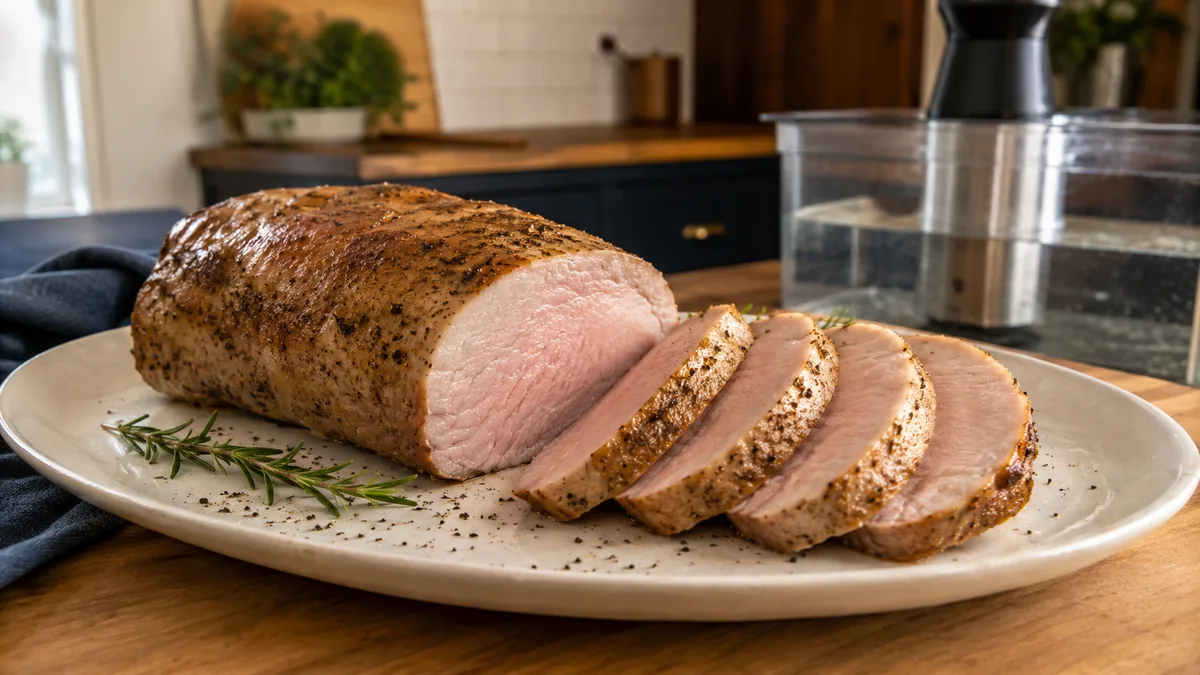
If the exact starting condition is unknown, do not use the selected table. A refrigerator setting or the fact that pork feels cold does not establish that its coldest point begins at exactly 41°F (5°C). If the center may be colder, do not leave the pork at room temperature, infer its center temperature from the refrigerator setting, or add guessed minutes. Use separately validated guidance, or follow USDA’s thermometer-verified 145°F (62.8°C) endpoint followed by at least a 3-minute rest.
First, confirm that the cut is pork loin
A pork loin roast is not pork tenderloin, and neither should be treated as a thick pork chop. The National Pork Board’s cut reference lists loin roast and tenderloin as different cuts and notes that loin roast may be sold bone-in or boneless. For this table, the package must say pork loin or pork loin roast, and the prepared piece must be boneless.
| Package or prepared cut | Correct route |
|---|---|
| Boneless pork loin or pork loin roast | Continue to the processing and geometry checks below |
| Pork tenderloin | Use the sous vide pork tenderloin guide |
| Pork chops | Use the sous vide pork chops guide |
| Raw pork spare ribs | Use the sous vide pork spare ribs guide |
| Bone-in, rolled, tied, stuffed, injected, enhanced, or mechanically tenderized pork | Do not use this table; find guidance for that exact product and preparation |
Package weight cannot rescue a wrong cut. If the label says tenderloin or chops, route to that cut’s guide before choosing a temperature or time.
Choose the temperature by the result you want
The temperature sets a culinary direction; the thickness table supplies the corresponding total time. Two peer-reviewed studies of 25 mm pork-loin slices found that cooking loss generally rose as temperature or treatment time increased, while lower-temperature treatments retained more moisture and redness. Results around 59–60°C were favorable in those specific experiments. See the 2024 pork-loin study and 2022 pork-loin study.
Those studies support the direction of the tradeoff, not a guaranteed color, tenderness, or juiciness in a thicker roast section. Their samples were 25 mm slices, and the 2022 study began its experimental treatment after the sample core had reached bath temperature. Do not borrow the studies’ treatment durations as total cook times for this guide.
| Bath setting | Evidence-bounded direction | Best starting point for | Main limitation |
|---|---|---|---|
| 140°F / 60°C | Pinker, lower-temperature path; the cited studies support favorable results around 59–60°C | A cook prioritizing moisture retention and comfortable with a pinker center | Requires the complete cumulative time below; study texture is directional, not a promise |
| 145.5°F / 63°C | Less-red, more conventionally cooked direction | A cook who does not want a noticeably pink center but still wants precise sous vide control | This exact 63°C column is not the same instruction as USDA’s separate 145°F-plus-rest endpoint |
| 151°F / 66°C | Hottest and least-pink direction in this guide | A cook prioritizing a firmer, more conventional appearance | Higher-temperature treatments generally showed more cooking loss; an individual result is not guaranteed |
Use a more conservative route for higher-risk diners. The FDA identifies pregnant people, children under five, adults 65 and older, and people with weakened immune systems as more likely to become seriously ill from foodborne illness. Do not treat this guide’s 140°F (60°C) path as their default. Use USDA’s thermometer-verified 145°F (62.8°C) endpoint plus at least a 3-minute rest, or follow advice from their clinician or public-health authority. This guide does not provide individual medical advice.
Do not choose temperature by color alone. At lower temperatures, the safety process is cumulative and depends on time, starting condition, thickness, geometry, and circulation. If you prefer the simpler government endpoint, use USDA’s 145°F (62.8°C) internal temperature followed by at least a 3-minute rest rather than treating the table’s 145.5°F column as a restatement of that rule.
Will your piece fit this table?
Maximum thickness is necessary, but it is not enough. For meat thicker than 30 mm, Baldwin’s Table 5.1 uses a β value of 0.28 to simulate the heating speed of a 2:3:5 box. In plain language, the model relates all three dimensions: thickness, width, and length. This guide turns that relationship into a screening envelope so you can reject shapes the table does not support.
- Set the final cooking shape first. Portion the loin before measuring. Do not roll, fold, or tie it afterward.
- Sort the three dimensions. Call the shortest dimension thickness, the middle dimension width, and the longest dimension length. Measure the maximum thickness at the thickest point.
- Round up only within the selected 35–70 mm range. If a measurement in that range falls between displayed rows, use the next thicker row. A 58 mm piece uses the 60 mm row. A piece under 35 mm is outside this table and must not be silently rounded to 35 mm.
- Build the screen from that row. For rounded thickness T, width must not exceed approximately 1.5T, and length must not exceed approximately 2.5T.
- Reject a failed shape. If width or length exceeds the envelope, portion the loin into smaller uniform sections and remeasure all three dimensions. If the shape remains markedly irregular, use different validated guidance.
The under-35-mm boundary is not arbitrary rounding. In Baldwin’s model, β is 0 through 30 mm and changes to 0.28 above 30 mm; this guide selected only rows above that change for its 2:3:5 screen. For a thinner piece, use separately validated thinner-piece guidance. The pork-chops guide is an option only when the package label says pork chops and that guide’s published thickness and shape scope also fit.
| Rounded thickness T | Approximate maximum width | Approximate maximum length | Screening envelope |
|---|---|---|---|
| 35 mm | 52.5 mm | 87.5 mm | 35 × 52.5 × 87.5 mm |
| 50 mm | 75 mm | 125 mm | 50 × 75 × 125 mm |
| 60 mm | 90 mm | 150 mm | 60 × 90 × 150 mm |
| 70 mm | 105 mm | 175 mm | 70 × 105 × 175 mm |
Use the locked time table only when every statement below is true:
- The package says pork loin or pork loin roast, not tenderloin, chops, shoulder, or another cut.
- The prepared section is boneless, intact, unstuffed, not tied or rolled, not injected or enhanced, and not mechanically tenderized.
- The meat is completely thawed, and its coldest point is established at exactly 41°F (5°C) rather than inferred from a refrigerator setting. Unknown or possibly colder fails this gate.
- Maximum thickness after preparation is 35–70 mm and rounds to a displayed row; a thinner piece fails rather than rounding to 35 mm.
- Width and length pass the approximate 2:3:5 screen.
- One uniform section is sealed per bag; bags are fully submerged, separated, and do not block circulation in a preheated bath.
- You will finish and serve the pork now; this guide does not provide cook-chill, storage, or reheating instructions.
Reject the table when in doubt. Baldwin supplies no tolerance for deciding how closely an irregular roast must resemble the model. This envelope is a transparent screen derived from 2:3:5 proportions, not validation for every piece that appears to fit.
Sous vide pork loin time by thickness
The entries below come directly from Baldwin’s public Table 5.1. They are total times from placing the bag into a fully preheated bath, not holding times added after warm-up. Under the source model, the schedules target at least a 3,000,000:1 reduction in Salmonella for thawed meat whose coldest point starts at exactly 41°F (5°C). Ordinary refrigeration alone does not establish that starting condition.
| Maximum thickness | 140°F / 60°C | 145.5°F / 63°C | 151°F / 66°C |
|---|---|---|---|
| 35 mm / 1.4 in | 1 hr 45 min | 1 hr 30 min | 1 hr 15 min |
| 40 mm / 1.6 in | 2 hr | 1 hr 45 min | 1 hr 30 min |
| 45 mm / 1.8 in | 2 hr 15 min | 2 hr | 1 hr 45 min |
| 50 mm / 2.0 in | 2 hr 30 min | 2 hr 15 min | 2 hr |
| 55 mm / 2.2 in | 3 hr | 2 hr 30 min | 2 hr 15 min |
| 60 mm / 2.4 in | 3 hr 15 min | 2 hr 45 min | 2 hr 30 min |
| 65 mm / 2.6 in | 3 hr 45 min | 3 hr 15 min | 2 hr 45 min |
| 70 mm / 2.75 in | 4 hr | 3 hr 30 min | 3 hr 15 min |
Read the table with all six rules attached:
- Start state: The coldest point starts at exactly 41°F (5°C). If that is unknown or the center may be colder, reject this selected table; do not warm the pork at room temperature or invent extra minutes. Use separately validated guidance or USDA’s thermometer-verified endpoint linked above.
- Total time: Start the clock when the bag enters a fully preheated circulating bath; do not add the displayed time after the center warms.
- Reduction target: The source model includes at least a 3,000,000:1 Salmonella reduction under its assumptions.
- Geometry: These selected rows are above 30 mm and use β=0.28 for the 2:3:5-box heating model. Baldwin uses β=0 through 30 mm, so the selected geometry route does not extend across the thinner boundary.
- Row selection: For a measurement from 35 through 70 mm, measure maximum thickness in the piece’s shortest dimension and round up to the next displayed row. Never round down or interpolate; never round a piece under 35 mm up to the first row.
- Exclusions: Do not use the values for an unknown or possibly colder start, under-35-mm or over-70-mm thickness, frozen, bone-in, tied, rolled, stuffed, injected, enhanced, mechanically tenderized, markedly irregular, crowded, or cook-chill cases.
Worked pass/fail example: 58 × 84 × 142 mm
- The prepared section measures 58 mm thick × 84 mm wide × 142 mm long.
- Round 58 mm up to the 60 mm row. Do not use 55 mm.
- The 60 mm screening envelope is approximately 60 × 90 × 150 mm.
- The actual 84 mm width is below 90 mm, and the 142 mm length is below 150 mm, so this piece passes the screen.
- At 140°F / 60°C, the 60 mm row gives 3 hr 15 min total.
| Measured piece | 60 mm envelope check | Decision |
|---|---|---|
| 58 × 84 × 142 mm | 84 ≤ 90 mm and 142 ≤ 150 mm | Pass the screen; use the 60 mm row |
| 58 × 84 × 210 mm | 210 mm exceeds the approximately 150 mm length limit | Fail; cut crosswise into shorter uniform sections, then remeasure each one |
The failed 210 mm piece does not become compatible by adding an intuitive time bonus. Its thickness still points to the 60 mm row, but its length falls outside the modeled proportions. Portioning and remeasuring changes the geometry; guessing by weight does not.
Prepare, bag, and cook the compatible section
What you need
- One thawed, boneless pork-loin section that passes every compatibility check
- Immersion circulator and a container with enough room for unobstructed water flow
- Ruler or calipers that can measure millimeters
- One suitable sous vide bag per section
- Kosher salt, black pepper, and optional dry herbs or spices
- A small amount of neutral high-heat oil for finishing
Cook-now workflow
- Check the label and processing state. Stop if the cut or any processing detail falls outside this guide.
- Confirm the source starting condition. The coldest point must be established at exactly 41°F (5°C). If it is unknown or possibly colder, stop and use the alternative route above; do not warm the pork at room temperature or add guessed minutes.
- Portion and measure before seasoning. Record thickness, width, and length in the shape that will enter the bag. Reject thickness below 35 mm or above 70 mm. Within that range, round thickness up, run the 2:3:5 screen, and select the table row.
- Preheat to the exact chosen setting. Use 140°F / 60°C, 145.5°F / 63°C, or 151°F / 66°C; do not silently round the Fahrenheit display to another setting.
- Season and seal. Apply salt, pepper, and optional dry seasoning. Seal one section per bag in a single, uncrowded layer.
- Submerge without obstructing flow. Keep each bag fully under water, separated from other bags, and clear of the circulator intake or outlet.
- Start the total-time clock. Begin when the bag enters the fully preheated bath. Cook for the complete time at the intersection of the rounded-up thickness row and selected temperature column.
- Remove and dry. Open the bag without splashing, discard or separately handle the liquid, and dry every exterior surface thoroughly.
- Finish and serve. Brown briefly over very high heat, slice across the grain, and serve immediately.
A vacuum sealer is not required if a zipper bag can be closed securely and kept submerged. Follow the water-displacement steps in this guide to sous vide without a vacuum sealer. Changing the bagging method does not expand the cut, thickness, geometry, or circulation limits.
If circulator setup or bath terminology is unfamiliar, review the beginner’s guide to sous vide before starting. Basic setup knowledge does not replace this article’s measurement and compatibility checks.
Sear for browning, not for center pasteurization
Bagged pork emerges with a moist exterior, and moisture slows surface browning. Blot every side thoroughly, apply a small amount of neutral high-heat oil, and use a very hot pan or grill with brief contact. No universal number of searing seconds is given because burner, pan, grill, and surface moisture differ.
Searing is a surface-finishing step. It does not correct a center that received too little cumulative time, had the wrong starting condition, or fell outside the modeled geometry. After browning, slice across the grain and serve now; do not infer a chilled-storage or reheating plan from the cook-now table.
When the table is not the answer
| Condition | Why this table cannot answer it | Next action |
|---|---|---|
| Exact 41°F (5°C) coldest-point start is unknown or the center may be colder | Ordinary refrigeration does not establish the source’s exact start | Do not warm at room temperature or guess extra minutes; use separately validated guidance or USDA’s thermometer-verified 145°F endpoint plus at least a 3-minute rest |
| Thinner than 35 mm | No selected row applies, and Baldwin’s β changes through 30 mm | Do not round to 35 mm; use separately validated thinner-piece guidance. Use the pork-chops guide only when its label and published scope fit |
| Frozen or partly frozen | Starting state differs from the thawed 41°F (5°C) model | Thaw completely, then establish an eligible start and repeat every gate. Do not add a guessed frozen-time bonus |
| Bone-in | Bone and surrounding geometry are outside the locked scope | Find separately validated bone-in guidance |
| Rolled, tied, folded, or stuffed | The center and heat path no longer match the prepared-section model | Use guidance validated for that exact preparation |
| Injected, enhanced, solution-added, or mechanically tenderized | Product assumptions differ from a plain intact section | Follow authoritative, product-specific guidance |
| Thicker than 70 mm | The table has no thicker row | Cut along the length to create thinner, uniform sections and remeasure all dimensions, or use other validated guidance |
| Too wide, too long, or markedly irregular | The piece fails the approximate 2:3:5 geometry screen | Portion into uniform sections that pass and remeasure, or reject the table |
| Overlapping, touching, floating bags or blocked circulation | The heating assumptions require separated bags and circulating water | Correct the arrangement before timing; do not assume a surface sear repairs an under-timed center |
| Using 140°F (60°C) as the default for an FDA higher-risk diner | Higher-risk groups are more likely to become seriously ill from foodborne illness | Use USDA’s thermometer-verified 145°F endpoint plus at least a 3-minute rest, or follow their clinician or public-health authority’s advice |
| Cooking now for later chilled storage or reheating | Cooling, storage, and reheating controls are not provided here | Use separate authoritative cook-chill and storage guidance |
A large whole loin roast often fails because its shortest dimension exceeds 70 mm or its other dimensions exceed the screening envelope. Do not extend the last row by intuition. Reduce the dimension that fails—cut crosswise for excess length or along the length for excess thickness—then treat every new section as a new measurement problem.
Troubleshoot the result by checking the failed assumption
| What you notice | What to check | What to change |
|---|---|---|
| The exact starting center condition is unknown | Whether the coldest point is established at exactly 41°F (5°C), not merely refrigerator-cold | Reject this table. Do not warm at room temperature or add minutes; use separately validated guidance or the USDA thermometer endpoint and rest route |
| The piece is thinner than 35 mm | The first selected row and the β change through 30 mm | Do not round to 35 mm. Use separately validated thinner-piece guidance; use the pork-chops guide only if label and scope fit |
| You chose time by pounds | Maximum thickness, width, and length were never recorded | Reject the weight-based timer; measure all three dimensions and run the screen |
| The center looks pinker than expected | Exact bath setting, total time, exact 41°F start, rounded-up row, geometry, and circulation | Do not use color as the safety calculation. If appearance is the only issue and every assumption was met, choose 63°C or 66°C next time |
| The result is uneven | Irregular thickness, touching bags, overlap, floating, or blocked water flow | Make sections more uniform and keep every bag separated and fully submerged |
| Browning is weak | Surface moisture and finishing heat | Dry more thoroughly and use a hotter surface rather than extending moderate-heat contact |
| A gray or dry outer band develops | Finishing contact was prolonged, often because a wet surface browned slowly | Dry first and shorten high-heat finishing contact |
| The whole roast is too large | Which dimension fails: thickness, width, or length | Portion to reduce the failed dimension, remeasure each section, and use no time until a section passes |
| The diner is in an FDA higher-risk group | Whether the 140°F path was being treated as a universal default | Use the USDA thermometer-verified 145°F endpoint and at least a 3-minute rest, or follow their clinician or public-health authority’s advice |
Sources and methodology
This is a research-based guide; it does not report original cooking or tasting tests. USDA guidance supplies the simple pork endpoint, FDA guidance defines the higher-risk groups routed away from the 140°F default, Baldwin supplies the cumulative total-time table and heating model, and pork-loin studies inform only the bounded temperature tradeoffs. Sources were checked August 10, 2026.
- USDA FSIS Safe Temperature Chart — thermometer-verified 145°F (62.8°C) endpoint plus at least a 3-minute rest for raw pork steaks, chops, and roasts.
- FDA, People at Risk of Foodborne Illness — groups more likely to become seriously ill from foodborne illness.
- National Pork Board pork loin roast reference — cut identity and distinction from tenderloin.
- Douglas Baldwin, A Practical Guide to Sous Vide Cooking — Table 5.1 total times, exact starting condition, β boundary, pathogen-reduction target, bag spacing, and 2:3:5-box model.
- Kurp and Danowska-Oziewicz (2024) — 25 mm pork-loin evidence on cooking loss, redness, texture, and sensory direction.
- Kurp, Danowska-Oziewicz, and Kłębukowska (2022) — 25 mm pork-loin evidence on physicochemical, microbiological, and sensory changes; treatment duration is not reused as total time here.