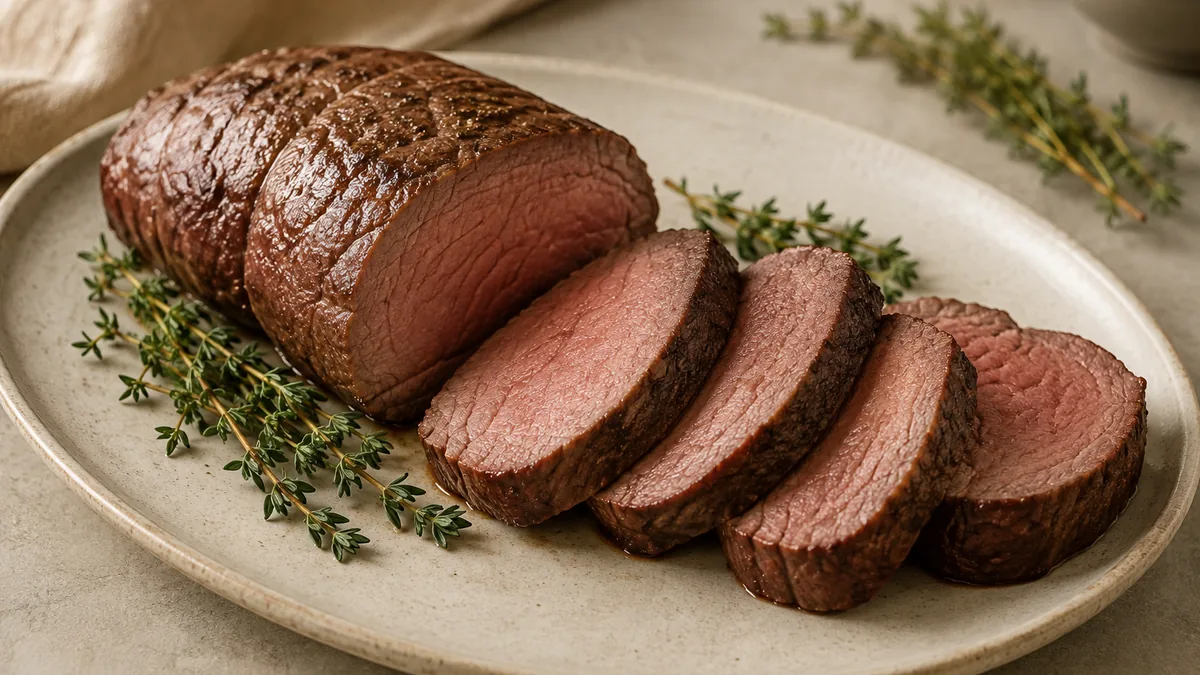
Start with form. A uniform filet mignon portion can resemble slab-like geometry used in cited time tables. A whole trimmed tenderloin is usually tapered and more cylindrical, so coldest-point heating can differ. Need setup help first? Read sous vide basics; this guide focuses on tenderloin decisions.
First decision: uniform filets or a tapered roast?
Use thickness table only for individual portions that are intact, thawed, non-overlapping, and reasonably uniform through cross-section. Measure full food thickness through the thickest part of the portion, along its shortest cross-sectional dimension. Do not measure only from surface to center. This full thickness controls table row; total weight does not.
- Uniform filet portions: Measure, choose bath temperature, then use matching total-time row if every table condition fits.
- Whole tapered tenderloin: Do not borrow a filet time. Tying can help handling, but it does not turn a tapered roast into a slab. Use a geometry-specific, validated method before making a pasteurization claim for the roast.
- Irregular or treated meat: Route out of this table if meat is mechanically tenderized, injected, rolled, stuffed, ground, frozen, overlapping, or has unknown starting temperature.
This prevents a common error: treating “tenderloin” as one timing category. Baldwin’s sous vide guide models specified shapes and starting conditions; it does not provide one universal schedule for every tenderloin form.
Choose temperature for doneness, not for time alone
Bath temperature sets tenderloin’s final doneness. Time still matters because center heating and pathogen reduction are separate processes. A portion can approach bath temperature before it completes a source-matched pasteurization schedule.
| Preference | Bath range | Meaning |
|---|---|---|
| Rare | 125–128°F / 52–53°C | Texture choice. Do not call it pasteurized from temperature alone. |
| Medium-rare | 129–134°F / 54–57°C | Texture choice. Use matching time-and-geometry schedule for pathogen reduction. |
| Medium | 135–144°F / 57–62°C | Texture choice. Time and stated conditions still matter. |
| USDA whole-cut endpoint | 145°F / 62.8°C, then 3-minute rest | USDA whole-cut endpoint; not proof every lower-temperature bath is equivalent. |
USDA FSIS lists 145°F / 62.8°C plus a three-minute rest for whole cuts of beef. That endpoint can guide a conventional whole-cut decision. It does not validate a lower sous vide bath or replace a time-temperature schedule built for its own geometry and starting conditions.
How long to sous vide filet mignon portions
These are total pasteurization times, not extra holds after heating. They come from Baldwin Table 5.1 for thawed, slab-like beef starting at 41°F / 5°C; table includes heating. Keep portions separated so water circulates around them. Do not add a second “hold” by guessing from a heat-up estimate.
| Measured thickness | 131°F / 55°C | 140°F / 60°C | 145.5°F / 63°C |
|---|---|---|---|
| 1.0 in / 25 mm | 2¾ hr | 1½ hr | 1¼ hr |
| 1.2 in / 30 mm | 3 hr | 1½ hr | 1¼ hr |
| 1.4 in / 35 mm | 3¼ hr | 1¾ hr | 1½ hr |
| 1.6 in / 40 mm | 3½ hr | 2 hr | 1¾ hr |
| 1.8 in / 45 mm | 4 hr | 2¼ hr | 2 hr |
| 2.0 in / 50 mm | 4½ hr | 2½ hr | 2¼ hr |
145.5°F / 63°C preserves source temperature. It is not a replacement label for USDA’s 145°F / 62.8°C endpoint. For steak choices outside tenderloin form and geometry, use this site’s broader sous vide steak temperature guide.
Measure, choose, verify: tenderloin geometry checklist
Use this decision tool to turn a temperature preference into a source-matched cook plan.
- Identify form. Is it one uniform filet portion or a tapered roast? Only uniform portions move to table.
- Read label. Stop if it says mechanically tenderized, blade tenderized, needle tenderized, injected, or contains a treatment outside this guide.
- Measure full thickness. With ruler or calipers, measure full food thickness through the thickest part of the portion, along its shortest cross-sectional dimension. Do not measure only from surface to center, and do not time by ounces.
- Confirm starting state. Table assumes thawed meat starting at 41°F / 5°C. Frozen timing is outside scope.
- Choose bath. Select doneness first, then find thickness row in same bath column.
- Choose cook-now or cook-chill. Serve after searing, or use controlled cooling workflow below. Do not let finished portions sit while deciding.
Row-selection example: A uniform filet measuring 2.0 inches / 50 mm in full thickness uses 50 mm row. At 131°F / 55°C, that row is 4½ hours total—not 2¾ hours from 25 mm row.
If portions finish unevenly, first check geometry, thickness, bag overlap, starting state, and water circulation. Do not “correct” an uncertain batch with invented extra time. For setup choices, see choosing sous vide bags and a sous vide container setup.
Bag, cook, dry, and sear
- Bag portions in single layer. Keep them fully submerged and leave enough space for moving water.
- Cook at chosen bath temperature for total time matching measured thickness and every stated table condition.
- Remove portions and dry surface thoroughly. Moisture fights browning and can steam surface in skillet.
- Sear briefly in very hot pan, on grill, or with another high-heat finishing method. Turn as needed for crust without continuing to cook center more than necessary.
Brief searing is quality step. It improves browning, but it cannot substitute for center heating or a pasteurization schedule. That is evidence-based editorial inference from USDA endpoint guidance and Baldwin’s separate heating and pasteurization tables, not a cooking test.
Safety boundaries: treated beef, lower baths, and storage
Mechanically tenderized beef has a separate handling boundary because blade or needle treatment can move surface bacteria inward. If label identifies mechanically tenderized beef, follow package and label directions rather than using this intact-whole-muscle table. USDA explains this distinction in its mechanically tenderized beef guidance.
Do not use lower-temperature schedules here as special reassurance for pregnant people, young children, older adults, or people with weakened immune systems. They depend on stated geometry and process assumptions. Choose more conservative official guidance for diners who need it, and do not infer equivalence from rosy color, clear bag juices, or a dark crust.
Cook now versus cook-chill
For cook-now, move from bath to drying and searing, then serve. For cook-chill, keep portions sealed and cool promptly in ice water. Baldwin’s cooling model assumes an ice-water bath containing at least half ice and models cooling sealed, slab-like food to 41°F / 5°C. Refrigerate or freeze promptly after cooling; this guide does not supply a home storage-duration schedule.
FDA Food Code 2022 sets cooling limits of 135°F to 70°F within two hours and 70°F to 41°F within a total of six hours for applicable food-service operations. Read Food Code 2022 for scope and exact language; it is a model food code, not a universal home sous vide storage table.
What this guide does not time
- Frozen tenderloin portions.
- Whole tapered or cylindrical tenderloin roast pasteurization.
- Portions thicker than 2.0 inches / 50 mm.
- Mechanically tenderized, injected, blade- or needle-treated, ground, rolled, or stuffed beef.
- Overlapping bags, irregular pieces, or meat with unknown start temperature.
These exclusions are not minor caveats. They change heat-flow or food-safety assumptions. A whole tenderloin deserves its own validated schedule rather than a confident-looking filet conversion. For another tenderloin-shaped cut with different characteristics, see our pork tenderloin time and temperature guide; do not transfer its schedule to beef.
Sources and evidence scope
This research-based guide does not claim independent cooking tests. It synthesizes USDA FSIS guidance, FDA Food Code 2022, and Douglas Baldwin’s published sous vide tables. Sources checked August 11, 2026; timing claims remain limited to conditions stated beside table.