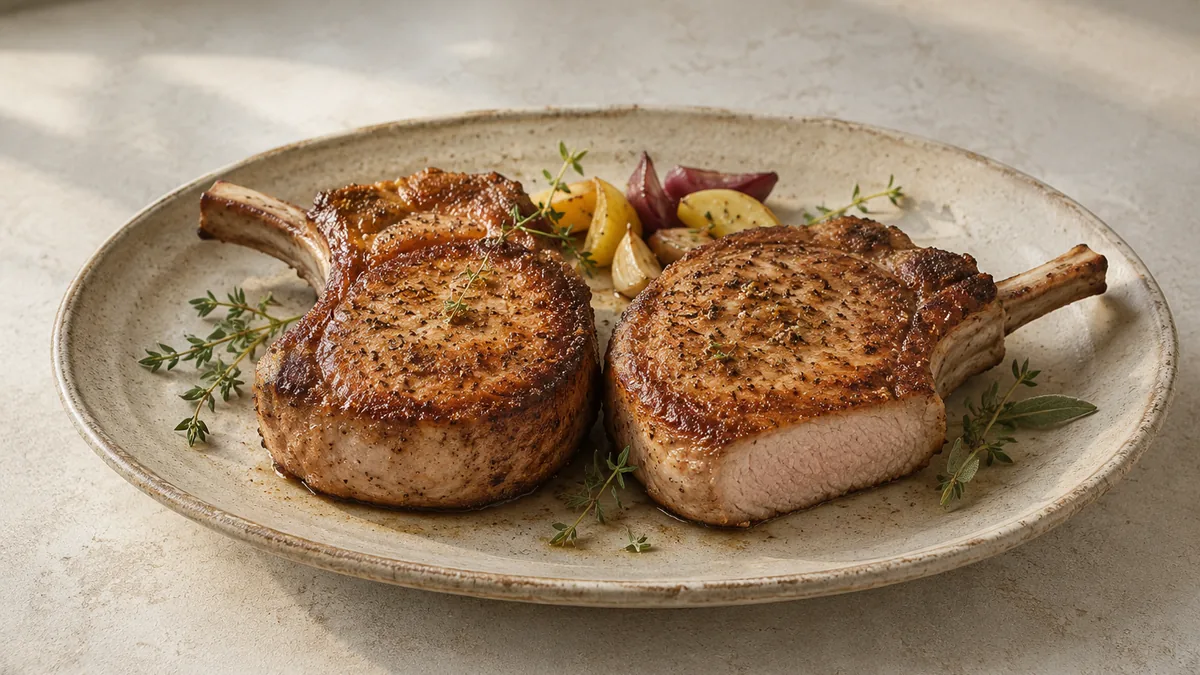
For a thawed pork chop measuring 20–30 mm thick, choose an exact bath setting: 140°F (60°C) for tender, juicy, meaty pork; 145.5°F (63°C) for a firmer middle option; or 151°F (66°C) for quite firm pork. Measure the shortest dimension through the thickest meat, round up to the next 20, 25, or 30 mm row, and cook for that row’s total time. Dry completely and sear fast. This guide does not provide timing for chops thicker than 30 mm.
Choose Texture and Set the Exact Bath Temperature
| Circulator setting | What to expect | Use this path when |
|---|---|---|
| 140°F (60°C) | Anova describes pork at this setting as tender, juicy, and meaty. | You prefer the softest, juiciest option covered by this table. |
| 145.5°F (63°C) | Firmer than the 140°F path and less firm than the 151°F path. This is an editorial comparison, not a tested texture claim. | You want an exact Baldwin table setting near the USDA’s separate 145°F endpoint guidance. |
| 151°F (66°C) | Anova’s nearby 150°F guidance describes pork as quite firm and beginning to dry out. | You prefer a firmer result and accept less juiciness. |
These numbers are water-bath settings, not temperatures to subtract from or add to. The timing table below uses the same bath-temperature columns printed in Douglas Baldwin’s current Table 5.1. Anova supplies culinary texture context; Baldwin supplies the thickness-based total times.
Confirm That Your Chop Fits the Timing Table
- Package label: Use this guide for pork chops. If the cut is labeled tenderloin or loin roast, use the pork tenderloin guide or another cut-specific process.
- Starting state: The chop must be thawed and start at about 41°F (5°C).
- Form: The meat must be intact and unstuffed, not rolled or tied.
- Thickness: Measure the shortest heating dimension through the thickest meat, excluding any bone projection. This guide provides an executable path only when that measurement is 20–30 mm.
- Shape: For pieces up to 30 mm, Baldwin uses a slab-like model. Reject a chop with a large thickness change, deep curve, separated lobes, or another shape that makes one slab thickness misleading.
- Circulation: Water must move around every bag; bags cannot overlap or press together.
If any check fails, do not repair the mismatch with an invented time penalty. Correct the start state or bag spacing, or use guidance validated for the actual thickness and shape.
Sous Vide Pork Chop Time by Thickness
Times below are direct entries from Baldwin’s Practical Guide to Sous Vide Cooking, Table 5.1, checked August 3, 2026. They are total bath times for thawed meat starting at 41°F (5°C). Baldwin models thicknesses up to 30 mm as slab-like. Above 30 mm, he uses a different geometry model that this guide does not operationalize. The table therefore stops at 30 mm. Do not add a separate warm-up or holding period.
| Measured thickness | 140°F (60°C) bath | 145.5°F (63°C) bath | 151°F (66°C) bath |
|---|---|---|---|
| 20 mm / 0.79 in — actionable slab row | 1 hr 15 min | 55 min | 45 min |
| 25 mm / 0.98 in — actionable slab row | 1 hr 30 min | 1 hr 15 min | 55 min |
| 30 mm / 1.18 in — actionable slab row | 1 hr 30 min | 1 hr 15 min | 1 hr 15 min |
For 20–30 mm chops, round up and never interpolate. A 23 mm chop uses the 25 mm row; a 28 mm chop uses the 30 mm row. If the chop measures more than 30 mm, use guidance validated for that thicker geometry instead of extending this table.
Worked Example: A 28 mm Thawed Boneless Chop
- Check the cut and state: The package says pork chop; the chop is thawed, intact, unstuffed, and has a fairly even slab-like meat section.
- Measure: The shortest dimension through the thickest meat is 28 mm. Ignore length, weight, and any bone projection.
- Select the row: Round 28 mm up to the actionable 30 mm slab row.
- Choose texture and set the bath: For the tender, juicy, meaty path, set the circulator to exactly 140°F (60°C).
- Cook the total time: Use the 30 mm × 140°F cell: 1 hour 30 minutes total in the bath.
- Protect circulation: Submerge the sealed chop without stacking bags or blocking the circulator.
- Prepare the surface: Remove the chop and blot every surface dry. Moisture delays browning.
- Sear: Use very high heat for a brief sear on both sides and the fat edge. Stop when browned; a long sear can overcook the outer band.
Need bagging setup help? See the beginner’s sous vide guide or the water-displacement method.
Bone-In, Frozen, and Other Exclusions
Bone-in: Bone itself does not justify a universal extra-time rule. A bone-in chop may use an actionable 20–30 mm row only when the meat section has fairly even thickness, fits the slab-like model, and can be measured without counting a projecting bone. Exclude thicker, deeply curved, tomahawk-style, or otherwise irregular bone-in pieces from this guide.
Frozen: Baldwin’s table is for thawed meat starting at 41°F (5°C), and his heating discussion shows frozen food takes longer. This guide therefore uses a thaw-first rule rather than an unsupported fixed add-on. Stuffed, rolled, tied, mechanically tenderized, and cook-chill preparations also need separate validated guidance.
Safety: Endpoint Guidance Is Not the Timing Method
USDA FSIS guidance lists 145°F (62.8°C) followed by a 3-minute rest for pork steaks, chops, and roasts. That conventional endpoint is separate from the process used in this guide: a thick chop needs enough total time for heat to reach the center and for the source’s pathogen-reduction target to accumulate. Setting a bath to a number does not make the center reach it instantly, and searing does not replace the bath time.
Finish Without Undoing the Texture Choice
Open the bag, discard the liquid unless using it in a separately cooked sauce, and dry the chop thoroughly. Sear over very high heat only long enough to brown the exterior. If you need more searing control, brief immediate surface cooling before drying and searing can slow edge overcooking; this is a finishing step, not storage or cook-chill guidance.
Troubleshooting
| Result | Likely cause | Next cook |
|---|---|---|
| Interior firmer than wanted | Bath temperature selected a firmer texture | Choose a lower exact bath setting; do not shorten a verified minimum time to chase tenderness. |
| Gray or dry outer band | Sear ran too long or surface was wet | Dry more thoroughly and use higher heat for less time. |
| Uneven results across several chops | Different actionable thicknesses or blocked circulation | Measure each 20–30 mm chop, use the next listed slab row for each, and space bags apart. |
| Chop looks pinker than expected | Color varies and does not prove whether the process was adequate | Check bath setting, measured thickness, start state, selected actionable row, and full elapsed time rather than judging safety by color. |
| Chop measures more than 30 mm or is hard to measure consistently | Piece falls outside this guide’s operational slab scope | Do not extend this table or assign an arbitrary extra time; use guidance validated for the actual geometry. |
This research-based guide uses USDA guidance, Douglas Baldwin’s technical tables, and Anova’s culinary guide. It was not independently tested. Sources were checked August 3, 2026.