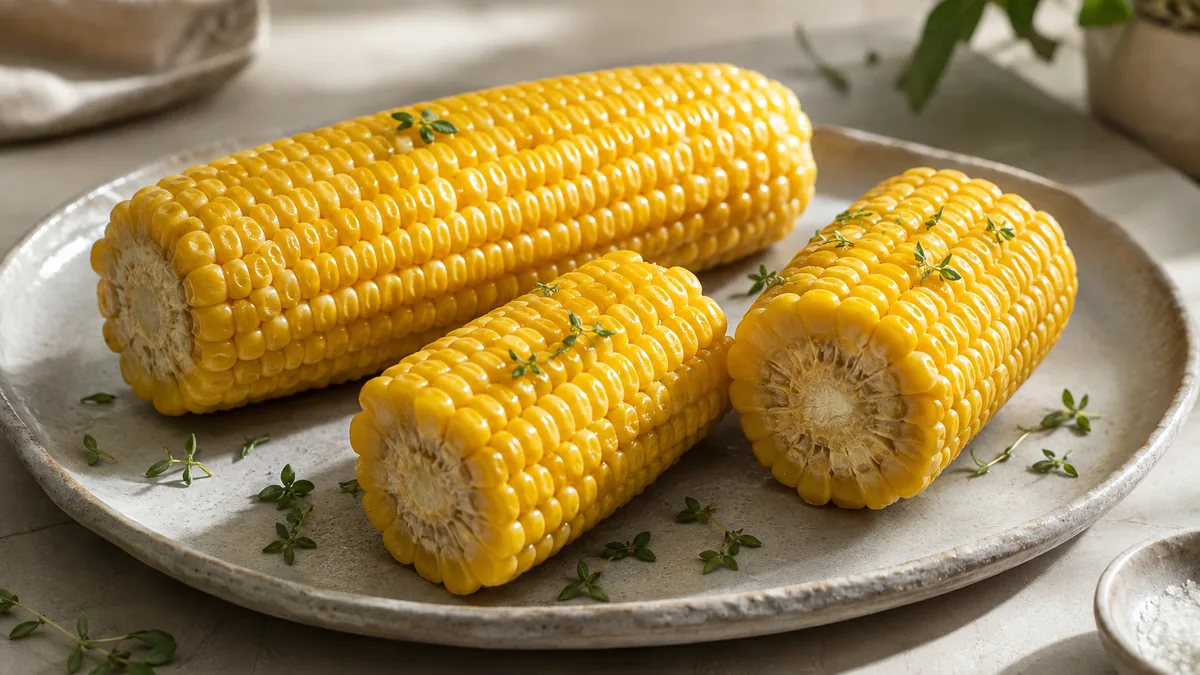
These are recipe instructions for fresh corn, not a universal food-safety, storage, or reheating schedule. This guide is research-based; it does not claim an original cooking test.
Choose your corn path first
| What you have | Use this named recipe path | Bath and time | Bagging details from source |
|---|---|---|---|
| Two whole, shucked ears | Anova self-buttering corn | 181.4°F (83°C) for 30 minutes | Butter and salt in a vacuum bag |
| Shucked ears cut in half | Anova honey-miso butter corn | 183°F (83.9°C) for 30 minutes | Butter each piece; vacuum or resealable zip bag |
Geometry-and-recipe path gate: keep whole ears on whole-ear recipe path. Keep halved ears on halved-ear recipe path. Do not turn two recipes into a temperature range or transfer a schedule after changing cut, bagging method, batch size, or starting condition. Sources here do not establish those substitutions.
Prep fresh corn for immediate service
- Use fresh corn on cob. Remove husks and silk before bagging, as both Anova recipes direct.
- Wash corn under running water before prep. FDA advises against soap, detergent, or commercial produce wash; washing reduces, but does not eliminate, bacteria.
- Pick one recipe path below before seasoning and bagging. This avoids mixing instructions from unlike recipes.
- Plan to remove corn from bag and serve after cooking. This article does not provide a hold, chill, storage, or reheat method.
Need help sealing a resealable bag for another recipe? See this separate guide to sous vide without a vacuum sealer. For corn’s whole-ear path, follow source’s vacuum-bag wording rather than assuming every bagging method transfers.
Whole shucked ears: 181.4°F for 30 minutes
Use this path when you have two whole ears of fresh, shucked corn. Anova’s self-buttering corn recipe specifies butter and salt with corn in a vacuum bag, then 181.4°F (83°C) for 30 minutes. Remove corn and serve.
- Shuck two fresh ears and remove silk.
- Place ears with butter and salt in a vacuum bag; seal.
- Cook at 181.4°F (83°C) for 30 minutes.
- Remove from bag and serve immediately.
Do not use this source as proof for: halved ears, a resealable bag, frozen corn, corn cooked in its husk, a larger load, or a different starting temperature. Those conditions are not established by this recipe.
Halved ears: 183°F for 30 minutes
Use this path when you cut fresh, shucked ears in half. Anova’s honey-miso butter corn recipe calls for four ears cut in half, butter on each piece, and 183°F (83.9°C) for 30 minutes. It permits either a vacuum bag or a resealable zip bag.
- Shuck four fresh ears, remove silk, and cut each ear in half.
- Butter each corn piece and bag it using source’s vacuum-bag or resealable-zip-bag option.
- Cook at 183°F (83.9°C) for 30 minutes.
- Serve, or use one optional finish below.
This recipe includes honey-miso butter. If you use a different seasoning, that is a flavor choice, not evidence that recipe’s schedule transfers to other geometry or cooking conditions.
Finish only within recipe scope
Immediate service is enough for both paths. For halved honey-miso corn, Anova also lists a brief optional high-heat finish with a torch, grill, broiler, or Searzall. Treat those as serving options from that specific recipe, not required steps or proof of a different doneness target.
Why not use one corn temperature range?
Recipe pages disagree in ways that matter. One Anova recipe is for whole ears at 181.4°F (83°C) for 30 minutes; another is for halved ears at 183°F (83.9°C) for 30 minutes. A third Anova community recipe lists 184°F (84.4°C) for 35 minutes, but gives limited geometry and load context. It is separate limitation evidence, not a ranked option or reason to average recipes.
A specialist reference also gives its author’s 183–185°F (83.9–85°C), 15–25-minute guidance and notes that sweetness, tenderness, and seasoning can affect timing. That context shows why corn recipes vary; it does not replace named Anova instructions with a universal chart. See Amazing Food Made Easy’s corn reference for its separate author guidance.
Vegetable schedules also remain ingredient-specific. Compare dedicated guides for sous vide carrots, sous vide potatoes, and sous vide asparagus rather than carrying a corn timer into another vegetable.
What this guide does not cover
This guide intentionally stops at fresh, shucked corn for immediate service. Available sources do not establish a schedule here for frozen or husk-on corn, different cob sizes, refrigerator-cold starting state, stacked or large loads, storage, reheating, vulnerable populations, or universal pathogen reduction. Do not treat either recipe temperature and time as a pasteurization claim.
If you are learning method fundamentals, read our sous vide basics guide. It covers technique context without changing corn’s source-matched paths.