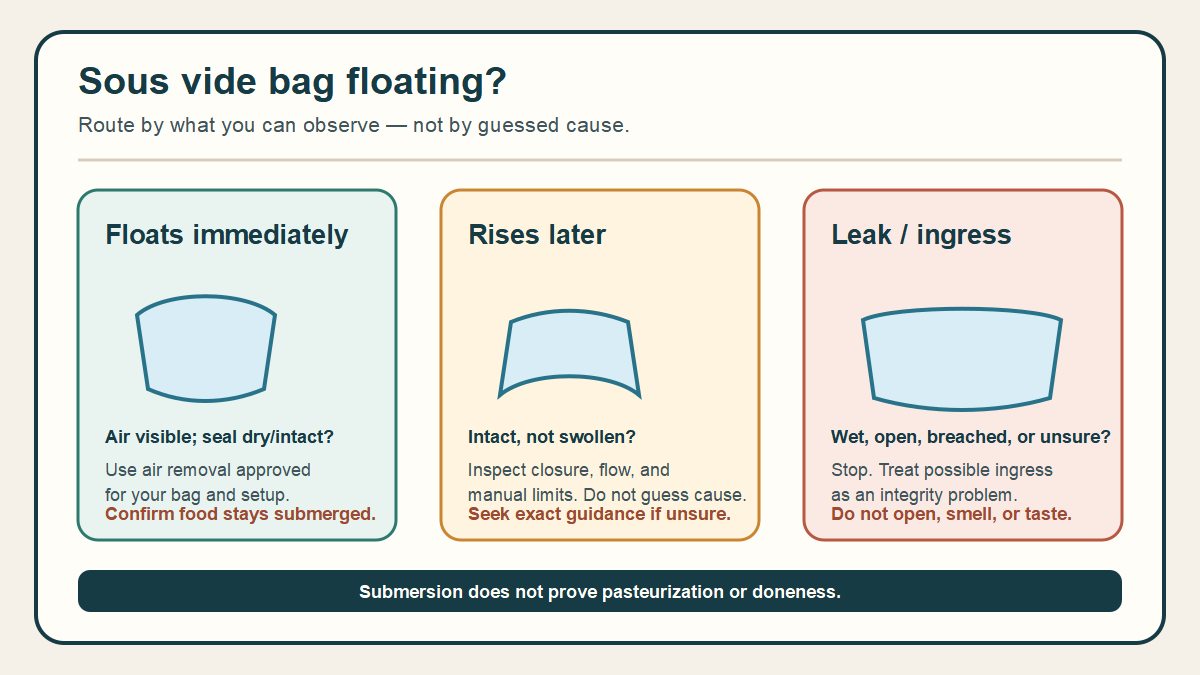
This guide separates an immediate, visible-air problem from later changes and possible leaks. It does not recommend a generic restraint, accessory, or bag type. Use the racks, weights, and clips compatibility guide to screen those choices against exact instructions for your bag, container, and circulator.
Start with what you can observe
| What you observe | Next action | Do not assume |
|---|---|---|
| Bag floats immediately; visible air; seal is dry and intact | Fix now. Use an authorized air-removal method, then check food submersion and water flow. | That clipping bag’s top solves submersion or clearance. |
| Bag rises later; pouch looks intact and is not swollen | Seek exact guidance if needed. Inspect exterior closure, seam, flow, and manual limits. Use an approved correction only when exact instructions support it. | Why it rose, or that elapsed cooking time remains valid. |
| Pouch balloons or swells | Stop. Do not puncture, vent, open, smell, or taste it to identify cause. Follow leak/uncertainty branch. | That swelling proves steam, spoilage, or any other single cause. |
| Closure is wet or open; seam is split; pouch is punctured; bath water entered or cannot be ruled out | Stop. Control possible contamination. Rebag and restart or recalculate only from known, validated food-specific history; discard if history is unknown. | That heating bath water repaired contamination or preserved process credit. |
| Food is not submerged or water flow is blocked | Fix now only with an exact manufacturer-approved setup. | That any household object is a safe restraint. |
| Food is submerged after a valid correction and flow is open | Continue the existing validated food-specific plan. | That submersion proves doneness, pasteurization, or safety. |
If the bag floats immediately, deal with retained air
Visible air can make a pouch buoyant and reduce contact with circulating water. That matters because trapped air insulates compared with water contact. An immediate float with a dry, intact seal is the narrow case where air removal is a reasonable first correction.
Use only a method your exact bag maker permits. For Anova’s water-displacement method, lower a nearly closed pouch into cool water or water that has not heated yet, use water pressure to push air upward, and seal before the closure enters the water. Keep the opening dry while sealing. Our water-displacement guide explains that technique and its bag-specific limits.
- Check the food itself is below the waterline after sealing.
- Check water can still circulate around the pouch.
- Check your circulator manual before using any lid, rack, clip, or restraint supplied for that model.
A clip used to keep a sealed top above the bath in Anova’s workflow is not proof that food stays submerged, and it is not a universal submersion device. Do not turn an air-removal fix into an improvised restraint setup.
If the bag rises later, do not diagnose cause by appearance
A bag that was stable and later rises has changed condition, but sight alone cannot tell you why. Residual headspace, heating-related vapor expansion, food-released gas, microbial gas, seal movement or failure, and other causes are possible categories. None can be confirmed from float height or appearance alone.
Douglas Baldwin notes water-vapor ballooning at higher cooking temperatures in his technical guide. That describes one possible mechanism in that stated context; it does not mean every later-floating or swollen pouch contains water vapor, nor does it settle food safety.
Pause active correction. Inspect only what is observable from outside: closure, seams, punctures, whether food remains submerged, whether pouches are tightly packed or overlapping, and whether flow stays open. Do not puncture, vent, open, smell, or taste a pouch to identify what caused a rise. If submersion cannot be restored with a setup approved by the exact manufacturer instructions, stop and seek exact bag or equipment guidance.
Water ingress or seal uncertainty means stop
Stop the cook when a closure is wet or open, a seam has split, a pouch is punctured, bath water is inside, or you cannot rule out ingress. Do not assume a second bag repairs a compromised process.
If raw juices may have escaped, replace the bath water. Clean the container and circulator parts that were wetted only as the exact manufacturer instructions allow, then use a clean approved pouch. This is contamination control, not a claim that the food is ready to continue.
Recovery is conditional. Rebag, restart, or recalculate only when you know the food’s validated, food-specific time-temperature history and can apply a validated plan. If that history is unknown, discard the food. No universal restart formula fits every food, thickness, starting state, target, handling path, or storage plan.
Keep water moving without inventing a restraint
Full submersion improves thermal contact, but circulation still needs room around the pouch. Do not tightly pack or overlap pouches. Exact intake and outlet clearance, water level, lid use, rack fit, and accessory compatibility come from your circulator’s manual, not a generic rule.
Use a restraint, rack, or accessory only when it is approved by the exact bag, container, or circulator manufacturer for your setup. It must not puncture or damage the closure, create food-contact uncertainty, contact heater or electrical parts, block flow, or breach water-level or evaporation limits. If no approved setup restores submersion, stop and seek exact guidance rather than improvising with household objects.
Choosing compatible hardware is separate from solving a floating bag. Our sous vide container guide covers container-selection considerations; it does not make a container accessory approved for every circulator or bag.
Submersion is not a food-safety result
A properly submerged pouch has better water contact. It does not prove pasteurization, establish doneness, or restore a cook interrupted by an uncertain leak. Food safety still depends on food type, thickness and shape, fresh or frozen starting state, bath temperature, time at temperature, validated target, and any chilling, storage, or reheating plan.
For broader method and food-specific safety context, see our beginner’s guide to sous vide. If your question is whether a particular bag is appropriate for sous vide, follow its maker’s current instructions; our bag-safety guide explains why material and use limits are product-specific.
Sources and methodology
This is a research-based troubleshooting guide, not hands-on testing. It uses Anova’s accessible water-displacement guidance and Douglas Baldwin’s technical discussion of air, submersion, circulation, and high-temperature water-vapor ballooning. The stop-and-recovery boundaries in this guide remain limited to the locked research synthesis; they do not provide a universal salvage formula.