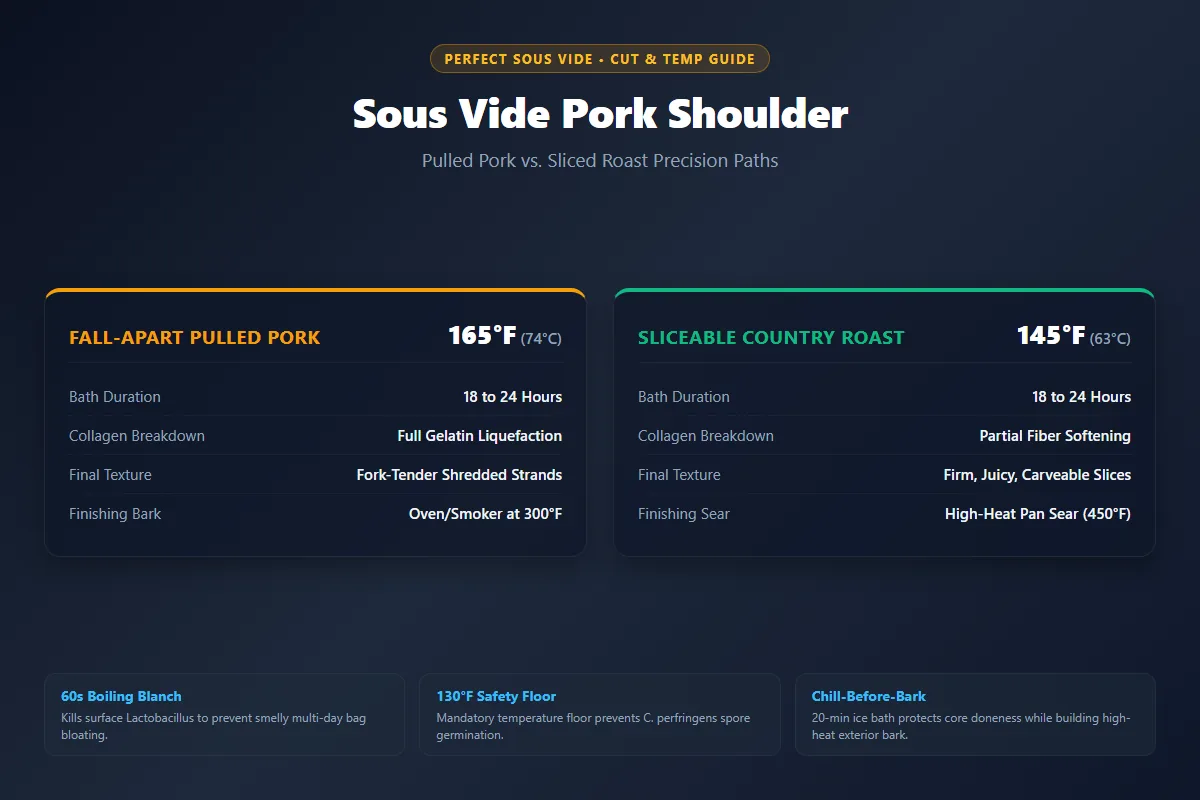
The Two-Path Temperature and Texture Framework
Unlike tender cuts such as tenderloin or loin chops, pork shoulder is heavily laced with dense collagen, elastin, and intramuscular fat. Cooking time in a sous vide bath does not simply heat the meat to a target core temperature; it drives a time-dependent biochemical reaction that melts tough connective tissue into succulent gelatin. Depending on your target temperature, you produce two entirely distinct culinary outcomes.
| Cooking Path | Bath Temp | Cook Time | Meat Texture | Ideal Application |
|---|---|---|---|---|
| Traditional Pulled Pork | 165°F (74°C) | 18–24 hours | Fall-apart tender, shreddable with forks, fully melted collagen | BBQ pulled pork sandwiches, tacos, carnitas bowls |
| Carveable Country Roast | 145°F (63°C) | 18–24 hours | Firm, exceptionally juicy, slices cleanly into thin ribbons | Porchetta-style roasts, Cuban sandwiches, dinner plates |
| Firm Steak-Like Cut | 138°F (59°C) | 24 hours | Dense, toothsome, pink center, requires thin carving | Specialty cured roasts (advanced cooks only) |
The 165°F (74°C) Path: Traditional Pulled Pork
At 165°F, thermal energy rapidly denatures Type I collagen, breaking triple-helix protein structures down into liquid gelatin over 18 to 24 hours. Intramuscular fat veins render completely, basting the muscle fascicles from within. When the roast finishes cooking, individual muscle fibers pull apart under gentle fork pressure with zero resistance. If your goal is Carolina or Texas-style shredded barbecue tossed in a vinegar or sweet sauce, 165°F is the definitive benchmark.
The 145°F (63°C) Path: Sliced Pork Roast
At 145°F, pork shoulder achieves an unexpected transformation that traditional smokers and ovens cannot replicate without drying the cut. The temperature is high enough to soften connective tissue gently over 24 hours, yet cool enough that muscle cell walls do not violently contract and expel their intracellular moisture. The meat emerges pale pink, moist, and structurally sound. It will not shred; instead, you carve it across the grain into clean, uniform slices reminiscent of artisan porchetta or prime cured ham.
The Over-Tenderization Hazard: Why More Time Is Not Better
A common pitfall among home cooks is assuming a 36- or 48-hour bath will make pulled pork even better. It does not. At 165°F, cooking beyond 24 to 28 hours causes structural proteolysis: myosin and actin proteins degrade entirely, causing the meat fibers to lose all tensile definition. The result is a mealy, mushy paste with the mouthfeel of commercial canned hash. Cap your cook at 24 hours for optimal fiber integrity.
Pork Shoulder Anatomy: Boston Butt vs. Picnic Shoulder
In North American retail meat markets, “pork shoulder” refers to two anatomically distinct cuts taken from the forequarter of the hog:
- Boston Butt (Pork Butt): Sourced from the upper shoulder adjacent to the spine and neck. It contains the blade bone (scapula) and the heavily marbled serratus ventralis muscle group. Boston butt features a consistent rectangular shape, deep intramuscular marbling, and a manageable fat cap. It is the premier cut for sous vide pulled pork.
- Picnic Shoulder (Picnic Roast): Sourced from the lower arm portion above the hock. It has a triangular shape, higher proportion of bone, tendons, and is frequently packaged with thick pig skin attached. While delicious, the skin must be trimmed off or heavily scored prior to bagging, as rubbery boiled skin impedes bark formation.
When purchasing a whole bone-in butt (typically 6 to 9 pounds), you can cook it whole if your bath container permits, or halve it along the bone seam into two uniform 3-to-4-pound roasts. Halving reduces thermal penetration lag, speeds core pasteurization, and doubles the surface area available for bark seasoning.
Fat Cap Trimming Guidelines
Pork butts usually carry an exterior fat cap up to 1/2-inch thick. In an authentic smoker, excess fat renders outward; in an airtight sous vide pouch, rendered fat simply pools in the bag without evaporating. Use a sharp boning knife to trim the hard, waxy exterior fat down to an even 1/4-inch (6 mm) layer. Do not scalp the roast entirely lean; retaining a modest fat layer protects the outer meat fibers during high-temperature oven or smoker bark finishing.
The 60-Second Boiling Blanch Shield: Odor Prevention
The single most alarming surprise during an overnight pork shoulder cook is waking up to a ballooned, taut cooking pouch that emits a pungent, sour, cheese-like odor. Home cooks frequently assume the meat has spoiled and discard an expensive roast. In reality, the culprit is harmless surface Lactobacillus bacteria.
Lactic acid bacteria naturally reside on the skin and surface of fresh pork. They thrive in oxygen-depleted, warm environments (between 120°F and 140°F) and are resistant to moderate heat. During the initial hours while a heavy 7-pound roast warms up, surviving surface bacteria ferment meat sugars into lactic acid and release carbon dioxide gas. While non-toxic, the resulting sour odor permeates the meat and ruins the dining experience.
Step-by-Step Blanching Protocol
- Bring a large stockpot of clean water to a vigorous rolling boil (212°F / 100°C).
- Using sturdy stainless tongs, lower the whole, raw, untrimmed pork shoulder into the boiling water.
- Hold the meat fully submersed for exactly 60 seconds. The exterior will flash-turn opaque grey-white, indicating instant surface thermal lethality.
- Remove the roast and transfer it to a clean wire rack set over a baking sheet.
- Pat the surface completely dry with paper towels before trimming the fat cap and applying spice rubs.
This 60-second flash-pasteurization destroys surface microbes instantaneously without cooking internal muscle tissue, guaranteeing a sweet-smelling, gas-free bag throughout the 24-hour cook.
Seasoning, Bagging, and Flotation Control
Seasoning for long-cook pork shoulder requires a disciplined approach. Do not use fresh raw garlic or onion pastes; at low oxygen and extended temperatures, raw alliums can develop sharp, unpalatable off-flavors. Instead, use coarse dry barbecue seasonings:
- Base Seasoning Ratio: Apply 1.0% to 1.25% coarse kosher salt by weight across the meat. Combine with coarse black pepper, smoked paprika, granulated garlic, ground mustard, and a small pinch of dark brown sugar.
- Liquid Smoke (Optional): If finishing the pork in a kitchen oven rather than an outdoor charcoal smoker, add 4 to 6 drops of natural hickory or applewood liquid smoke directly into the bag to replicate authentic wood-fired aroma.
Bagging Large Roasts
A 7-pound Boston butt pushes the physical limits of standard 8-inch vacuum bags. Use heavy-duty, commercial-grade 11-inch or 15-inch rolls with reinforced 3-to-4-mil wall thickness. For dependable sealing without seam leakage during 24-hour immersion, choose an edge sealer equipped with liquid detection and double-weld sealing bars from our tested guide on best vacuum sealers for sous vide. If your roast exceeds your vacuum sealer channel, you can safely use heavy-duty gallon-sized zipper bags via the water displacement method.
Combating Bag Flotation
Large cuts of pork shoulder are notoriously prone to floating. Intramuscular fat expansion, micro-air pockets within the blade bone cavity, and residual water vapor create buoyant forces that push the top half of the roast above the water line. Unsubmerged meat remains in the microbial danger zone. To diagnose and secure buoyant pouches, review our troubleshooting guide on sous vide bag floating and anchor the bag using stainless steel accessories from our roundup on sous vide weights and racks.
Water Bath Management: Evaporation Control
At 165°F (74°C), water evaporation is aggressive. An uncovered 12-quart plastic water bath can lose more than 1.5 gallons of water over an 18-to-24-hour cycle. When the water level drops below the minimum sensor line on your immersion circulator, the device triggers an emergency audio alarm and cuts power to the heating element. If this occurs overnight, the bath cools into the microbial danger zone for hours, spoiling the meat.
Ensure foolproof long-cook security by pairing your circulator with dedicated hardware:
- Container Sizing: Use an insulated 12-to-18-quart polycarbonate vessel from our curated review of large sous vide containers to maintain generous water circulation around the thick meat block.
- Lid Insulation: Seal the bath opening with a fitted silicone container lid, floating hollow sous vide insulation balls, or multiple overlapping layers of heavy plastic wrap sealed against the circulator clamp.
- Mid-Cook Inspection: Check the water level at the 12-hour mark. If topping off is required, add pre-heated kettle water at 165°F to prevent thermal bath drop.
The Chill-Before-Bark Finishing Protocol
When pork shoulder emerges from a 165°F water bath, its exterior is wet, grey, and completely devoid of textural contrast. To serve authentic barbecue, you must create a dark, crackling crust (“bark”). However, subjecting steaming hot meat directly to a 450°F oven creates an irreversible defect: the outer inch of meat cooks well past 185°F, producing a dry, stringy grey ring.
The solution is the Chill-Before-Bark Protocol, which uses thermal inertia to protect the core while you blast the surface.
Step-by-Step Bark Protocol
- Ice Bath Shock: Remove the sealed bag from the 165°F water bath and submerge it in an ice-water bath for 20 to 30 minutes. This drops the exterior surface temperature below 100°F while keeping the center comfortably warm.
- Reserve Bag Purge: Cut the corner of the pouch and pour all rendered cooking juices into a bowl (do not discard; see sauce protocol below).
- Dehydrate the Surface: Transfer the pork to a rimmed baking sheet fitted with a wire rack. Pat the entire roast vigorously with paper towels until completely dry to the touch.
- Apply Bark Rub: Dust the exterior with a fresh layer of dry rub (paprika, black pepper, brown sugar, garlic powder) to form the bark foundation.
- High-Heat Finishing:
- Oven Method: Preheat your kitchen oven to 450°F (232°C) convection. Roast the pork on the wire rack for 15 to 20 minutes until the exterior bubbles, deepens to mahogany brown, and crisps.
- Smoker Method: Fire your outdoor smoker to 275°F (135°C) with hickory or fruitwood. Smoke for 45 to 60 minutes until a firm, fragrant bark forms.
Liquid Gold: Converting Bag Purge into BBQ Sauce
A 7-pound pork shoulder expels between 1.5 and 2.5 cups of liquid purge during a 24-hour bath. Discarding this liquid wastes intense pork flavor and pure liquid gelatin extracted from melted connective tissue. Transforming it into an emulsified finishing sauce takes five minutes:
- Pour the hot bag juices into a fat separator, or chill the liquid in the freezer for 15 minutes until the yellow lard solidifies on top. Skim and discard the excess fat.
- Transfer the clarified gelatin broth to a medium saucepan set over medium-high heat.
- Add 1/4 cup of raw apple cider vinegar, 2 tablespoons of brown sugar or honey, 1 teaspoon of Worcestershire sauce, and 1/2 cup of your favorite barbecue sauce.
- Simmer vigorously for 6 to 8 minutes until the liquid reduces by roughly 40% and coats the back of a spoon.
- After shredding the pork shoulder with two forks, ladle 1/2 to 3/4 cup of the hot reduced glaze directly over the warm shredded meat and toss gently. The gelatin coats every fiber, locking in moisture and delivering unmatched richness.
Critical Food Safety Boundaries
Because pork shoulder cooks over extended 18-to-24-hour cycles, home cooks must respect established thermal safety guidelines outlined by food microbiologist Douglas Baldwin and the USDA Food Safety and Inspection Service (FSIS):
- The Absolute Thermal Floor: Never operate a sous vide bath below 130°F (54.4°C) for pork shoulder cooks. Holding meat in the temperature danger zone (40°F to 130°F) for longer than 4 hours permits spore-forming pathogens like Clostridium perfringens to germinate and produce dangerous enterotoxins that survive light reheating.
- Thawed-Start Only: Never cook a thick, whole 5-to-8-pound frozen pork shoulder directly from the freezer. Due to dense thermal inertia, the center of a frozen multi-pound roast can take 5 to 7 hours to surpass 130°F, creating a severe microbiological hazard. Always thaw completely in the refrigerator before bagging. For complete thermal guidelines across meat geometries, consult our sous vide thickness checklist.
- Safe Meal Prep & Storage: If cooking pork shoulder in advance for later gatherings, do not let the finished bag cool slowly at room temperature. Submerge the sealed bag in a 50/50 ice-water slurry for at least 1 hour until the core drops below 40°F (4°C). Store refrigerated for up to 5 days, or freeze sealed for up to 6 months. Reheat in a 145°F water bath for 1.5 hours before serving.
Comparing Pork Shoulder to Other Cuts and Methods
To understand where pork shoulder fits within your broader culinary repertoire, contrast its behavior with other cuts:
- Sous Vide vs. Slow Cooker: When comparing sous vide vs slow cooker, slow cookers boil meat at 200°F–210°F, resulting in stringy, dry fibers swimming in diluted broth. Sous vide at 165°F melts collagen while keeping muscle fibers plump and un-scooted.
- Shoulder vs. Pork Loin: Pork shoulder requires 18 to 24 hours to break down connective tissue. By contrast, center-cut loin is lean and tender; subjecting loin to a 24-hour cook turns it to chalk. For proper loin timing, see our guide on sous vide pork loin.
- Shoulder vs. Pork Ribs: While both are barbecue cuts, pork ribs feature thin meat over curved bone racks that tenderize in 12 to 24 hours depending on cut style. Review our detailed benchmarks in the sous vide ribs guide.