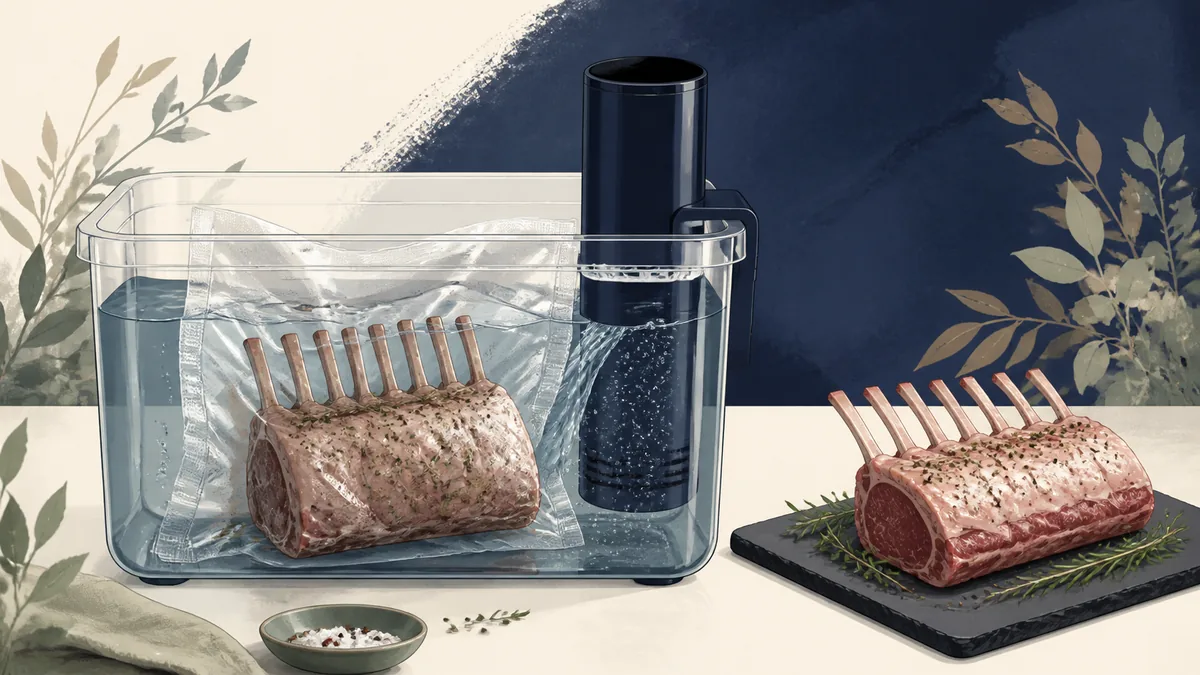
Quick answer: choose texture first
Use this guide only for a normal bone-in rack that starts refrigerated or fully thawed, stays in one continuous bath, and will be served immediately. Confirm the cut before you transfer any schedule: a rack is not a steak, and it is not a leg of lamb. Thickness, shape, starting temperature, and handling history affect how a piece heats through.
| Texture target | Anova temperature | Anova recipe time | Use this lane when |
|---|---|---|---|
| Very rare to rare | 115–124°F (46–51°C) | 1–2.5 hours | You want a distinctly red center. |
| Medium-rare | 125–134°F (52–57°C) | 1–4 hours | You want a pink, tender center. |
| Medium | 135–144°F (57–62°C) | 1–4 hours | You prefer less red and firmer meat. |
| Medium-well | 145–154°F (63–67°C) | 1–4 hours | You want only slight pinkness. |
| Well done | 155°F (69°C) and up | 1–4 hours | You want no pink center. |
Important limit: Anova warns that its medium-rare guidance below 130°F (54.4°C) should not run longer than 2.5 hours. Keep that as an attributed manufacturer warning, not as proof that 2.5 hours pasteurizes every rack. A validated pathogen-reduction process needs matching time at temperature after the coldest point heats through, with the rack’s geometry and start state accounted for.
Check rack identity and geometry
Before bagging, identify a bone-in rack rather than a separate lamb cut. Measure the thickest section of meat and record it. That measurement is a scope check, not permission to interpolate a thickness chart: the available rack recipe does not provide a universal thickness-to-time matrix.
- Start state: refrigerated or fully thawed. This article does not provide a frozen-start adjustment.
- Bath: one continuous cook. Do not split the schedule across baths or assume an interrupted cook follows the same guidance.
- Shape: ordinary bone-in rack geometry. A materially different, unusually thick, rolled, stuffed, or irregular piece falls outside this schedule’s established scope.
- Service: dry, brown, carve, and serve immediately. This article does not provide storage, cook-chill, or reheating instructions.
Anova gives about 45 minutes as a minimum for smaller New Zealand or Australian racks and 1 hour as a minimum for larger American racks. Keep those regional and size descriptions attached to the manufacturer source. Do not convert them into a weight rule or use them to replace the geometry check.
Trim, bag, and cook
Trim loose fat and connective tissue that would interfere with browning. Frenching the rib bones is optional: it changes presentation and can make the meat easier to brown around the bones, but it is not a safety control and does not establish a different cooking time.
Season and seal the rack in a suitable sous vide bag. Keep the meat arranged so the pouch does not fold the rack into a materially different shape. Use a rack, weight, or clip only when it maintains full submersion without blocking circulation; the separate racks, weights, and clips compatibility guide covers that equipment decision.
Set the bath to the selected Anova texture temperature. Use the manufacturer time band only within this article’s scope: refrigerated or thawed, bone-in rack, measured thickest section, continuous bath, and immediate service. If any of those conditions changes, stop rather than silently extending the recipe.
Dry, brown, and serve
Remove the rack from the bag and dry its surface carefully. Surface moisture slows browning and encourages steaming, so use clean towels and take time around the fat cap and between the bones.
- Heat a pan until it is hot enough to brown the surface promptly.
- Place the rack in the pan and turn it to brown the meat, fat cap, and accessible edges.
- Use visual browning as the finish cue. Anova’s stated method browns each side in less than a minute, but that is method-specific, not a universal sear duration.
- Carve between the bones and serve immediately. Anova allows an optional rest of up to 10 minutes in its recipe; that is a serving instruction, not storage guidance.
Keep the sear short enough to add color without turning a carefully selected low-temperature center into a different doneness target. A hot pan, dry surface, and deliberate turning matter more than a stopwatch.
Decision boundary: which guide applies?
| If you are cooking | Use | Do not transfer |
|---|---|---|
| Bone-in rack of lamb for immediate service | This rack guide | Do not use steak or lamb-leg timing. |
| Individual beef steak | Sous Vide Steak Time & Temperature Guide | Do not treat a rack’s bones and shape as steak geometry. |
| Lamb leg or another large roast | Future lamb-leg guide when its evidence is available | Do not use this rack schedule or invent a weight conversion. |
| Unusual thickness, frozen start, storage, reheating, or higher-risk diner | Stop and find separately validated guidance | Do not extend, interpolate, or relabel this recipe as a safety process. |
Stop checklist before you start
- Rack is bone-in and matches ordinary rack geometry.
- Rack is refrigerated or fully thawed.
- Thickest meat section is measured and recorded.
- Texture target is selected from Anova’s attributed band.
- Continuous bath and immediate service are planned.
- You are not relying on this article for frozen timing, pasteurization, storage, reheating, or vulnerable-diner guidance.
If any checklist item fails, stop. The missing evidence is not a reason to guess at extra time, import a steak schedule, or treat a texture choice as a validated safety endpoint.
Sources and methodology
This research-based guide uses Anova’s rack-of-lamb recipe for the attributed texture bands, minimum recipe times, under-130°F warning, drying, browning, and immediate-service workflow. Douglas Baldwin’s technical reference supports the geometry and starting-state boundary. The FDA Food Code is process context for food establishments, not validation of Anova’s home recipe. We did not independently test this cook.