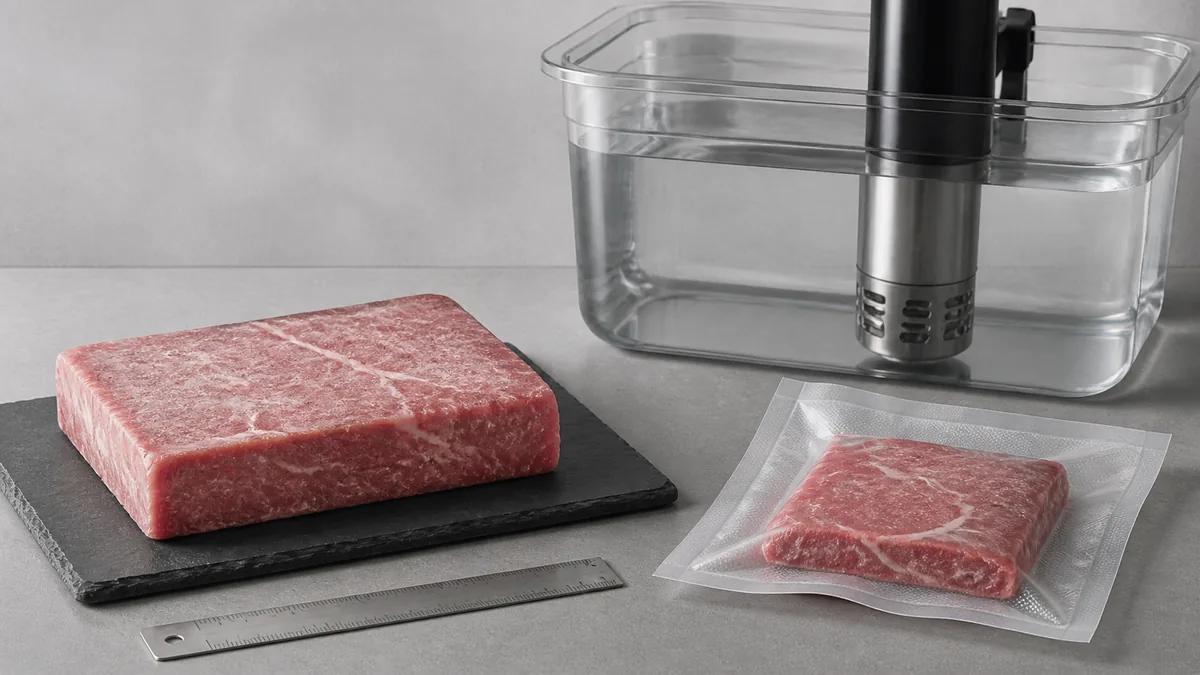
Quick decision: use, thaw, or stop
This guide applies only when every condition below is true: the food is raw and frozen solid; it starts at approximately 0°F (-18°C); it is one intact, whole-muscle beef or pork piece; it has slab-like geometry with measurable maximum thickness; it will stay in one circulating bath; and it will be served immediately after cooking. This is cook-serve guidance, not a cook-chill or cook-freeze process.
| Your food or plan | Decision | Reason |
|---|---|---|
| Frozen-solid, raw, intact beef or pork slab | Potentially compatible | Measure thickness and match Baldwin’s frozen meat geometry assumptions. |
| Partially thawed, refrigerated, warm, or unknown start | Stop | The frozen table assumes approximately 0°F (-18°C); a different start needs different evidence. |
| Chicken, turkey, fish, seafood, or vegetables | Do not transfer this guide | No general frozen-start schedule is established here for those categories. |
| Ground, injected, mechanically tenderized, rolled, stuffed, formed, processed, bone-in, irregular, or stacked food | Stop | Geometry or internal-penetration assumptions do not match this scope. |
| Storage, cook-chill, freezing after cooking, or reheating | Stop | Those are separate validated processes, not raw frozen-start cook-serve guidance. |
For a cut-specific thawed reference, use the relevant sous vide steak temperature guide or pork tenderloin time and temperature guide. Do not add frozen heat-up time to those thawed pasteurization tables.
Heat-up time is not pasteurization time
Frozen food first needs time for its coldest point to approach bath temperature. Baldwin’s Table 2.3 estimates that heat-up period for frozen meat by thickness and shape. It assumes approximately 0°F (-18°C) food, a circulating bath from 110°F to 175°F (45°C to 80°C), and the listed slab, cylinder, or sphere geometry.
That estimate answers one question: when should the center be close to the bath temperature? It does not answer how long the center must remain at a target temperature for a validated pathogen-reduction process. Pasteurization needs its own time-temperature method, including the coldest-point heat-up, thickness, shape, starting state, and target. Adding Table 2.3 to a thawed schedule would create a number the evidence does not validate.
Read Baldwin’s frozen table as a source-scoped engineering estimate, not as a recipe guarantee. Thickness, geometry, bath temperature, circulation, pouch arrangement, and actual starting temperature can change the result. No fixed increment works across all frozen foods.
Frozen-start compatibility matrix
Use this matrix before choosing any time. It separates conditions that resemble Baldwin’s frozen meat table from conditions that require different evidence.
| Check | Within this guide | Outside this guide |
|---|---|---|
| Food class | Intact beef or pork whole-muscle cut | Poultry, fish, seafood, vegetables, ground, processed, or formed food |
| Start | Raw and frozen solid at approximately 0°F (-18°C) | Partially thawed, refrigerated, warm, or unknown |
| Shape | Single-piece, slab-like, measurable thickness | Cylinder, sphere, cube, roast with materially different geometry, bone-in, tied, rolled, stuffed, or irregular |
| Arrangement | One pouch arrangement that stays submerged and allows circulation | Stacked pieces, folded food, blocked circulation, or uncertain submersion |
| Purpose | Cook and serve immediately | Pasteurize for later, chill, freeze, store, or reheat |
| Time meaning | Frozen heat-up estimate only | Total safe-cooking or pasteurization time |
Workflow for an in-scope frozen slab
- Identify the food. Confirm raw, intact beef or pork and exclude internal injection, mechanical tenderization, stuffing, rolling, forming, and processing.
- Confirm the start. Treat the food as out of scope if it is not frozen solid or if its starting temperature is unknown. USDA FSIS safe-thawing guidance keeps food cold, but it does not validate a frozen sous vide schedule.
- Measure the thickest dimension. Record maximum thickness before the piece enters the pouch. Do not use weight as a substitute for thickness.
- Match geometry. Use Baldwin’s frozen estimate only when the piece resembles the table’s supported slab geometry. Do not interpolate across shapes or apply slab values to stacked pieces.
- Set up the bath. Use a circulating bath within Baldwin’s stated 110°F to 175°F (45°C to 80°C) range. Keep the pouch fully submerged without folding the food into a different shape.
- Separate heat-up from safety. Treat the frozen estimate as time for the center to approach bath temperature. Do not relabel it as pasteurization or combine it with a thawed safety table.
- Serve immediately. This article does not establish a storage, chilling, freezing, reheating, or long-hold workflow.
A suitable pouch, seal, weight, rack, or clip depends on its material and exact equipment instructions. Use the sous vide compatibility and thickness checklist for a broader setup check. Equipment that keeps food submerged must not block circulation or turn one slab into a folded or stacked arrangement.
Why “plus 30 minutes” fails
A fixed addition hides variables that matter: a thin steak and a thick pork slab do not heat at the same rate; a flat slab and a cylinder do not present the same distance to the center; and a piece at 0°F does not begin like one that has partially thawed. The same extra 30 minutes can be excessive for one piece and insufficient as a safety process for another.
The practical rule is not “add time.” It is “classify the food, measure the geometry, verify the start state, then use only a source whose time meaning matches your decision.” If any input is unknown, thaw safely and use an applicable thawed guide, or choose another cooking method.
Raw frozen start versus cook-freeze
Do not confuse this workflow with cook-freeze. Baldwin describes cook-freeze as a planned process in which food is sealed, pasteurized, rapidly chilled, and then refrigerated or frozen for later reheating. Raw frozen food placed directly into a bath has not completed those steps. This article gives no cook-chill, storage, or reheating procedure.
Stop checklist
- Food is raw, frozen solid, and started at approximately 0°F (-18°C).
- Food is one intact beef or pork whole-muscle slab.
- Maximum thickness is measured.
- Geometry matches the source table’s slab assumption.
- Pouch remains submerged and circulation remains open.
- Time is being used as heat-up information, not pasteurization time.
- Meal will be served immediately, without storage or reheating.
If one item fails, do not guess. The correct next action is to thaw safely or find guidance validated for that exact food, shape, start state, and service plan.
Sources and method
This research-based guide was checked August 28, 2026. It synthesizes Douglas Baldwin’s technical heating tables with USDA FSIS frozen-food and thawing guidance and the FDA Food Code’s process context. No cooking test was performed. Baldwin’s table is used only for its stated frozen meat heat-up meaning and assumptions.