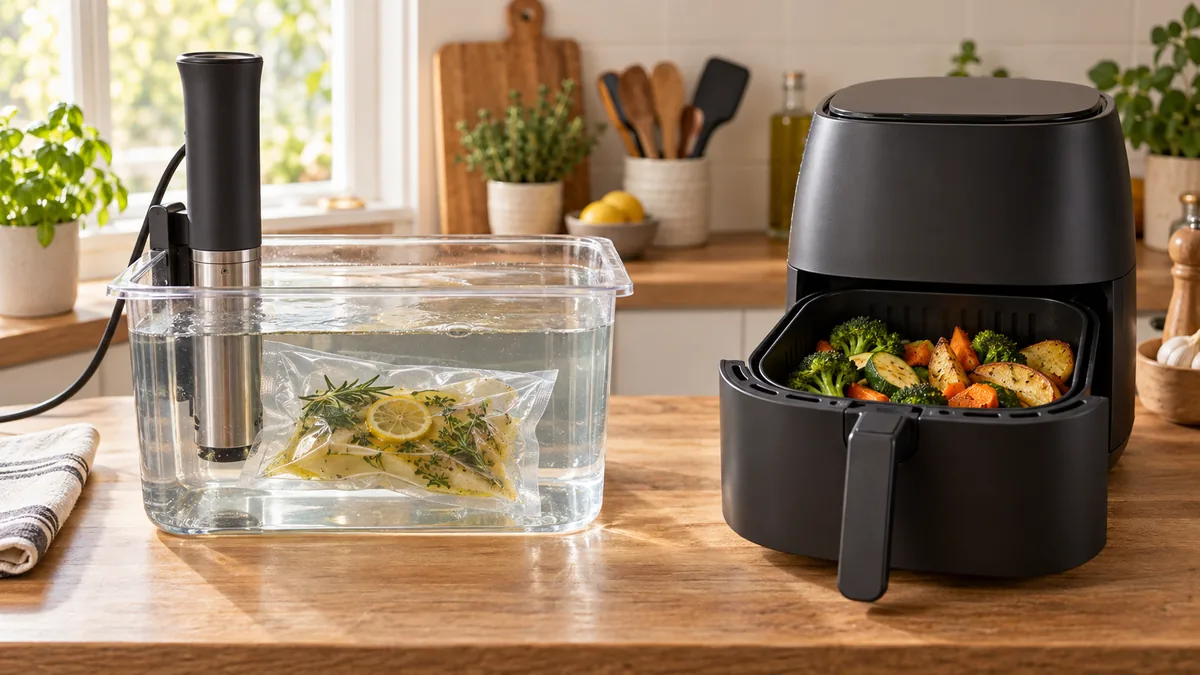
This is a workflow comparison, not a recipe schedule. It does not treat one narrow study, one appliance, or one food as proof that either method always produces a better result.
What each method does
Sous vide is a bag-and-water-bath process
In sous vide, food goes into a sealed pouch and cooks in a temperature-controlled water bath. That is the central distinction: the workflow starts with a bag and a vessel of water, not with food arranged in a basket. The method description alone does not settle whether it is faster, easier to clean, more economical, or better for a particular food.
An air fryer cooks with circulating hot air
An air fryer uses a heating element and fan to circulate hot air around food. Its basket or tray is part of the cooking setup, so how food is arranged is not a cosmetic detail. Overfilling can interfere with even cooking and browning.
Those are different processes, not two settings on the same appliance. Compare the workflow first; leave broad quality claims until you have evidence that matches the food and cooking conditions in front of you.
Workflow constraints that change the choice
Basket layout is an air-fryer constraint
When using an air fryer, look at the food’s layout before choosing the method. If the basket or tray would be crowded, overfilling is already relevant: circulation and browning may not remain even. That is a reason to reconsider the layout, not a blanket rule about batch size or an appliance’s capacity.
Sous vide can require a separate finishing stage
For most meats, plan a grill or hot-skillet sear after sous vide when color and crispness matter. Treat that as a distinct stage in the plan. Do not assume that the water-bath step creates a browned exterior, and do not assume an air fryer is a generally equivalent finish; this article does not have evidence for that claim.
This single question often clarifies the choice: is the meal plan compatible with a bag-and-water-bath stage followed, when relevant, by separate high heat? If not, an air-fryer workflow may be the more practical starting point. That is a workflow judgment, not a claim that it will produce a universally better result.
Why “better results” need food-specific evidence
Cooking studies answer the comparison they actually ran. They do not automatically answer every version of sous vide vs. air fryer.
Tilapia research does not compare air frying
One tilapia study compared sous vide with traditional high-temperature steaming. That work can inform a tilapia-and-steaming question within its treatment conditions. It cannot rank sous vide against air frying, and it cannot be transferred to another fish, a meat cut, or a different cooking setup.
Duck-breast research has its own treatment limits
One duck-breast study evaluated named treatments that included air frying and sous vide. Its findings belong with the portion dimensions, cooking treatments, and outcomes in that study. They are not a universal ranking for other foods, appliance models, or finishing methods.
Before relying on any comparison result, check five things: the food, the comparator, the cooking treatment, the finishing method, and the outcome measured. If those do not match your meal, use a food-specific guide instead of stretching a general comparison past its evidence.
Decision matrix: start with workflow
Use this matrix to choose a starting route. It does not provide cooking settings or food-safety guidance.
| Decision input | Sous vide route | Air-fryer route | Keep in mind |
|---|---|---|---|
| Required process | Use a sealed bag and water bath. | Use circulating hot air around food in a basket or tray. | These are different workflows, not interchangeable labels. |
| Food layout | Basket arrangement is not part of this method. | Arrange food with the basket or tray in mind; do not overfill. | Overfilling can affect even cooking and browning. |
| Exterior after sous vide | Plan separate high heat when a browned exterior matters. | Do not assume air frying is a proven equivalent finishing method. | The supported point is the separate-finish requirement, not a universal substitute. |
| Expected outcome | Find evidence matching food and treatment. | Find evidence matching food and treatment. | Do not transfer results from a different food or protocol. |
| Recipe or safety decision | Use food-specific authoritative guidance. | Use food-specific authoritative guidance. | This comparison deliberately does not provide settings or handling instructions. |
Choose your next guide
If the bag-and-water-bath route is new to you, start with this beginner’s sous vide guide for the basic setup. If the real question is whether sous vide fits a long, hands-off cooking method, read sous vide versus slow cooker instead.