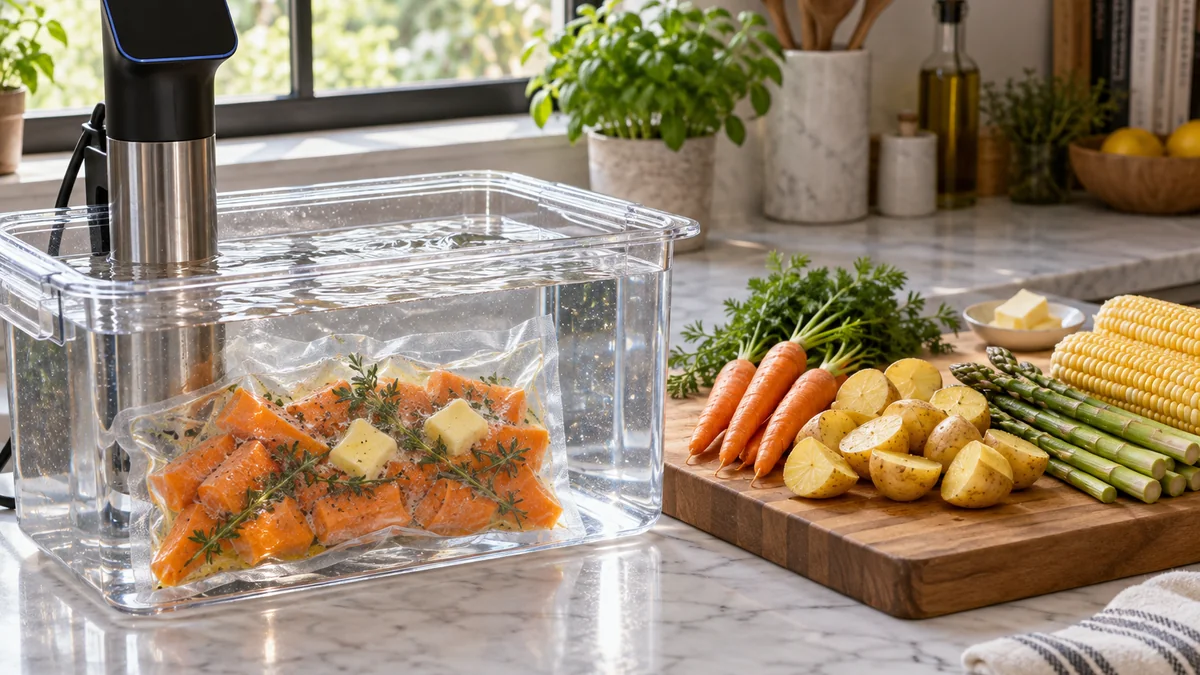
Pick the Vegetable Guide That Matches Your Cook
Cooking vegetables in a sealed water bath reduces leaching of water-soluble compounds and volatile aromatics into discarded cooking water while concentrating natural sugars. However, plant anatomy differs across roots, stalks, and tubers, so an arbitrary temperature cannot produce uniform tenderness. Use the Vegetable Route Selector below to identify whether your produce matches an audited schedule.
| Vegetable / Task | Structural Category | Desired Result | Required Known Conditions | Supported Local Guide | When This Hub Cannot Answer |
|---|---|---|---|---|---|
| Carrots | Root vegetable (pectin-bound walls) | Tender, evenly glazed, concentrated sweetness for immediate service | Fresh, peeled small whole carrots or 1-inch chunks; single-layer pouch with butter and sugar | Sous Vide Carrots | Thin coins, matchsticks, large mature whole carrots, frozen or pre-cooked carrots, overlapping layers. |
| Potatoes | Starchy tuber (high-density starch) | Creamy, fully tender interior without waterlogged edges for immediate service | Fresh small Yukon Gold halves or fingerlings; 1 lb batch weight; single-layer pouch with butter | Sous Vide Potatoes Guide | Large whole baking potatoes, wedges, dice, frozen potatoes, mashed potatoes, sweet potatoes, altered batch load. |
| Asparagus | Fibrous shoot (delicate tips, fibrous stems) | Vibrant green, crisp-tender spears with retained moisture for immediate service | Uniform spear thickness; single-layer bagging; strict alignment with one of two distinct named recipes | Sous Vide Asparagus Guide | Untrimmed woody bases, mixed thick and pencil spears, multi-layer stacking, combining recipe times into a range. |
| Corn on the Cob | Starchy grain / succulent cob | Plump, juicy, sweet kernels for immediate service | Fresh shucked sweet corn; whole ears (2-ear load) or halved ears (4-ear load) in single-layer pouch with butter | Sous Vide Corn on the Cob | Frozen corn, loose cut kernels, ears cooked in husk, batch loads exceeding 4 ears, averaging bath temperatures. |
Limitation Boundary: This selector tests whether a dedicated guide applies to your exact ingredients and equipment setup. It is not an interchangeable cross-vegetable time-and-temperature chart.
Pre-Cook Evidence Transfer Check
Before transferring any water bath temperature or timer setting to your kitchen, verify all nine material parameters listed below. If your ingredients or intended process diverge from any single field, pause: do not guess an extended cooking time or borrow a setting from a different vegetable.
| Check Field | Material Parameter | Why It Dictates Success | Transfer Verification Rule |
|---|---|---|---|
| 1. Botanical Identity | Carrot, potato, asparagus, or sweet corn only | Cellular architecture and hemicellulose composition dictate softening thresholds. | Must match one of the four supported crops exactly. |
| 2. Cut Geometry | Uniform dimensions matching child-guide specifications | Thickness is a primary determinant of core heating time in plant tissue. | Do not substitute coins, cubes, or oversized cuts for specified shapes. |
| 3. Start State | Raw, fresh produce at ambient room or refrigerator temperature | Frozen states substantially increase thermal load and prolong core heating times. | If starting from frozen or pre-cooked produce, stop. |
| 4. Batch Load & Layer | Strict single-layer arrangement within specified weight caps (e.g., 1 lb) | Overlapping pieces create double-thickness thermal barriers that stall softening. | Arrange in a single flat plane; split oversized batches into multiple pouches. |
| 5. Exact Recipe Alignment | Ingredient ratios, added fats, and seasonings specified in child guide | Dissolved salt and sugar alter cell osmotic pressure, while added fats coat food surfaces and eliminate insulating air voids. | Follow the exact recipe path rather than improvising liquid marinades. |
| 6. Pouch Rating | Food-contact pouch validated for temperatures up to 195°F (90°C) | Near-boiling vegetable water baths can soften unsuitable bags or stress seams. | Verify manufacturer rating for high-temperature water-bath submersion. |
| 7. Immediate Service | Table service immediately following bath completion and finishing | These culinary schedules are not validated pasteurization, cook-chill, or preservation processes and do not establish storage stability. | Do not use these settings for cook-chill, canning, or long-term meal prep. |
| 8. Child Guide Link | Active link to verified Perfect Sous Vide single-crop guide | Comprehensive execution, finishing, and seasoning rules reside in the dedicated guide. | Read and follow the full child guide before setting bath controls. |
| 9. Stop Decision | Zero-tolerance pause if any above condition fails to match | Vegetable cooking lacks the forgiving holding windows typical of tough meats. | Obtain condition-matched culinary guidance before heating the water bath. |
Why Vegetables Usually Need Hotter Baths Than Proteins
Delicate asparagus or tender carrots require bath temperatures between 180°F and 190°F (82°C to 88°C), whereas a beef roast cooks to medium-rare at 135°F (57°C). This divergence stems from structural biology: plant cells and animal muscle tissues respond to thermal energy through distinct chemical mechanisms.
Plant cells are not muscle tissue
Animal muscle tissue consists primarily of water and protein filaments—myosin, actin, and collagen. Myosin unfolds around 104°F to 122°F (40°C to 50°C), while collagen conversion to gelatin is a time-and-temperature dependent process that accelerates as temperatures rise above 130°F to 140°F (54°C to 60°C). Heating lean meat beyond 150°F (66°C) aggressively wrings out moisture.
Plant structures, by contrast, derive rigidity from cell walls bound by a gel-like middle lamella. The primary components are cellulose microfibrils, hemicellulose, and insoluble pectin. Cellulose provides structural framing, while pectin acts as intercellular glue. To transform crisp, raw vegetables into a tender state, heat must dissolve or weaken this pectin matrix.
Pectin does not break down at steak or poultry bath temperatures. Culinary source Anova Culinary identifies 183°F (84°C) as a practical threshold where vegetable cell walls begin softening reliably. Similarly, America’s Test Kitchen cooks most vegetables at 185°F (85°C) or higher to weaken pectin. These are observed operating points, not universal switches: below roughly 180°F (82°C), pectin breakdown in dense vegetables proceeds so slowly that pieces can remain undercooked and persistently firm even after extended submersion.
Starch creates a separate problem
Starchy tubers introduce a secondary biochemical factor. Potatoes are packed with microscopic starch granules composed of amylose and amylopectin polymers. In raw potatoes, these granules are crystalline, making the flesh hard and indigestible.
When heated with water, starch granules gelatinize: intermolecular bonds break, absorbing water and forming a smooth gel. Potato starch gelatinization starts around 140°F to 150°F (60°C to 65°C), but full softening of surrounding tuber tissue requires simultaneous pectin dissolution in cell walls at temperatures closer to 190°F (87°C). Applying green-vegetable schedules to potatoes yields an unpleasantly waxy or uneven texture.
“Higher” does not mean “same”
Knowing that vegetables need hotter baths often creates a misconception: assuming that because produce cooks between 180°F and 190°F, any vegetable can be held for an hour. That assumption fails in practice.
While the thermal band is elevated, crops differ in tissue density, moisture, and culinary goals. Tender asparagus cooked at 185°F (85°C) requires only 10 to 14 minutes to reach crisp-tender texture; leaving it submerged for an hour yields drab, stringy mush. Conversely, dense carrots at 183°F (84°C) need a full 60 minutes to dissolve pectin to the core without disintegrating the exterior. High heat explains elevated circulator set points, but exact timing remains dependent on crop, geometry, load, start state, and desired texture.
Operating a water bath at 180°F to 190°F also introduces practical bath management hurdles that cooks rarely encounter during lower-temperature protein cooks. Surface evaporation accelerates rapidly at these elevated temperatures, causing significant thermal loss and steadily lowering container water levels. In an open vessel, high water temperatures drive rapid evaporation that can substantially lower the water line during a 60-minute cycle, risking an automatic low-water circulator shutoff. Covering your container with a fitted lid, a silicone mat, or aluminum foil traps escaping steam, stabilizes bath temperature, and prevents unexpected heater shutdowns.
Why One Sous Vide Vegetable Chart Fails
Generic tables often present sous vide vegetable schedules as a single grid of times and temperatures. While simple, universal charts cause consistent failure in home kitchens. Six physical variables govern whether a schedule succeeds:
- Plant structure differs: Fibrous asparagus shoots, dense carrot roots, and multilayered corn kernels soften under distinct thermal conditions.
- Starch density shifts thermal needs: High-starch tubers require higher water temperatures to achieve gelatinization and pectin dissolution, whereas non-starchy green shoots soften quickly and degrade under prolonged heat.
- Geometry dictates heat transfer: Thermal energy conducts from exterior to core. A slender asparagus spear reaches equilibrium in minutes; a halved potato or thick carrot chunk presents a longer conduction path requiring extended dwell time.
- Start state alters the thermal curve: Fresh produce at room temperature absorbs heat predictably. Frozen vegetables absorb substantial latent heat during phase change, increasing thermal recovery time and prolonging core heating. Fresh schedules fail on frozen goods.
- Load and arrangement create thermal shielding: Food in a strict single layer heats evenly from both sides. Clumped or stacked vegetables multiply effective thickness, blocking heat transfer to center pieces.
- Named recipe conditions travel with the schedule: Added butter, salt, or glazing sugars alter moisture migration and surface thermal contact. Tested schedules apply only when paired with specified ingredients and packaging.
Many online charts label numbers approximate while omitting cut thickness, batch size, or pouch arrangement. Relying on an approximate number without matching geometry and load raises the risk of inconsistent results.
Four Supported Vegetable Routes
To eliminate guesswork and protect culinary quality, Perfect Sous Vide maintains audited guides for four core vegetable preparations. Each summary below outlines condition-bounded parameters and links to the full execution guide.
One distinct advantage of cooking vegetables sous vide is that you can evaluate doneness without piercing or opening the pouch. Around the 50-minute mark for root vegetables or potatoes, use blunt silicone tongs to gently compress a thick piece through the pouch body while keeping the bag submerged—taking care to avoid pinching seams or puncturing the plastic. If the center feels rigid and resistant, cell-wall pectin has not fully softened; return the pouch to the circulating bath. When the piece yields with uniform, tender give—similar to a ripe avocado—the produce is ready for finishing. For asparagus, look for slight flexibility while the spear maintains its straight posture; complete limpness indicates overcooking.
Carrots — small whole or 1-inch chunks
Sous vide concentrates natural carrot sugars and volatile aromatics without leaching them into cooking water. Cooked in a vacuum-sealed bag with butter and sugar, carrots emerge tender and coated in an emulsified glaze base that finishes quickly in a skillet.
Eligibility and settings: Fresh, peeled small whole carrots, or peeled medium/large carrots cut into uniform 1-inch chunks. Cook at 183°F (84°C) for approximately 1 hour until tender. Follow full preparation and finishing steps in our dedicated Sous Vide Carrots guide.
Non-transfer boundary: Do not use this 1-hour timer for thin carrot coins, matchstick batons, large mature whole carrots, or frozen carrots. Thin cuts turn fragile, while dense whole carrots stay woody at the center.
Potatoes — small Yukon Gold halves or fingerlings
Cooking potatoes sous vide yields a creamy, uniform crumb without the waterlogged exterior common to boiling. The sealed pouch ensures butter and seasoning absorb directly into the flesh.
Eligibility and settings: Fresh small Yukon Gold potatoes cut in half, or intact fresh fingerling potatoes. Calibrated for a 1 lb batch load arranged in a single layer with butter. Cook at 190°F (87°C) for exactly 1 hour for immediate service. See full handling instructions in our dedicated Sous Vide Potatoes Guide.
Non-transfer boundary: Cannot be used for large whole russets, wedges, dice, sweet potatoes, or mashed potato pouches. Modifying the 1 lb load or stacking halves causes uneven starch gelatinization.
Asparagus — choose one named recipe, not a range
Asparagus has a narrow window between raw fibrousness and mushy discoloration. Our asparagus guide establishes two distinct named paths based on spear geometry and seasoning.
Path 1: Thick spears with butter and mint. Thick spears arranged in a single layer with butter and mint cook at 185°F (85°C) for 10 to 12 minutes for immediate table service.
Path 2: Green spears with garlic and Parmesan. Standard green spears seasoned with garlic and Parmesan in a single layer cook at 185°F (85°C) for exactly 14 minutes for immediate service.
Review trimming and bagging details in our Sous Vide Asparagus Guide.
Critical boundary: Never combine these separate recipes into an arbitrary “10 to 14 minute” range. Thickness and seasoning chemistry differ; pick one path and follow its specified timer.
Corn on the cob — whole and halved ears stay separate
Sweet corn cooked sous vide retains moisture and cellular turgor, producing plump, sweet kernels bathed in butter without dilution from boiling water.
Whole-ear recipe path: Two fresh, shucked whole ears sealed flat in a vacuum pouch with butter cook at 181.4°F (83°C) for 30 minutes for immediate service.
Halved-ear recipe path: Four fresh, shucked ears cut cleanly in half (eight pieces total) sealed flat with butter cook at 183°F (83.9°C) for 30 minutes for immediate service.
Access sealing tips and serving notes in our Sous Vide Corn on the Cob guide.
Critical boundary: Do not merge whole and halved ear protocols into one temperature range. The altered surface-area-to-volume ratio of halved ears requires its dedicated bath setting.
Prepare and Bag Vegetables Without Changing the Evidence
Proper preparation and packaging are as vital as temperature control. Because vegetables cook at near-boiling temperatures, packaging errors or poor prep habits quickly spoil a cook.
Wash before peeling or cutting
Wash hands thoroughly with soap and warm water for at least 20 seconds before and after handling raw produce. In accordance with FDA produce-handling guidelines, rinse all fresh produce under clean running tap water before peeling or cutting. This prevents surface dirt and bacteria on the peel from transferring onto vegetable flesh via the knife.
Rub soft produce gently under running water; use a clean scrub brush on firm items such as carrots and potatoes. Do not use dish soap, detergent, bleach, or commercial produce washes. Washing does not sterilize produce or validate extended storage; refrigerate washed produce and cooked leftovers promptly under standard safe-handling guidance.
Match cut, load, and one-layer instructions
Maintain consistent cutting dimensions. When a recipe calls for 1-inch carrot chunks or halved small potatoes, keep pieces uniform. Irregular pieces cook at different rates, producing a mix of crunchy and oversoft vegetables in the same bag.
Lay produce completely flat in a single layer. If pieces overlap, effective thickness doubles, delaying heat conduction to the interior. If a batch is too large to fit in a single flat layer, split food across two pouches rather than stacking.
Packaging firm produce also benefits from practical fat placement. Dropping cold butter into the bag as a single large lump props pouch walls apart, trapping residual air pockets that resist vacuum suction and encourage floating. Slicing butter into thin, flat pats and distributing them across the vegetables ensures the pouch seals flat against the food. Once submerged, the butter melts across the vegetable surfaces, displacing insulating air gaps and ensuring direct thermal contact with the pouch walls.
Use a pouch rated for exact temperature and method
Vegetable water baths operate near 190°F (88°C)—much hotter than protein baths. Some lightweight zipper-lock bags or unrated plastic pouches may soften, stretch, or experience seam failure at these elevated temperatures. Always verify that your pouches are explicitly rated by the manufacturer for food-contact cooking up to at least 195°F (90°C).
Fix Floating or Leaking Bags Before Continuing
Floating bags are a frequent issue with sous vide vegetables. Raw produce contains internal air pockets, and water vapor expands rapidly at elevated cooking temperatures, causing pouches to balloon and surface.
At 180°F to 190°F, trapped residual air expands and internal moisture generates steam vapor, causing even tightly sealed bags to puff up slightly like pillows. This thermal vapor expansion is normal and does not necessarily indicate a seal breach. A true failure reveals obvious warning signs: water visibly leaking into the bag, circulator water turning milky or smelling of melted butter, or bubbles actively streaming from a seam. If the pouch is merely expanded from internal steam but completely sealed, do not open it—simply weigh it down to keep the food submerged.
Exposed bag sections sit in ambient air rather than circulating hot water, leaving portions undercooked. For buoyancy causes and submersion solutions, explore our guide on why sous vide bags float. For gear options, consult our racks, weights, and clips compatibility guide.
Never place unapproved household items—such as cutlery, coins, or ceramic mugs—inside the cooking pouch with food. Use dedicated sous vide racks, external food-safe weights, or secure rim clips to keep pouches submerged while maintaining water circulation.
Failure Signal → Next Action
If you encounter unexpected bag behavior or prep anomalies during cooking, consult this practical diagnostic matrix to take immediate corrective action:
| Observable Signal | Underlying Mechanism | Immediate Bounded Action | Prevention Rule |
|---|---|---|---|
| Produce variety or geometry not covered in guides | Cell wall density or heat penetration distance is unknown | Stop cook; do not extrapolate timer; obtain dedicated evidence | Never assume root vegetables and green vegetables share cooking schedules. |
| Pouch balloons and floats to bath surface | Internal produce gases or steam vaporizing at elevated heat | Submerge pouch using an approved sous vide rack or food-safe weight | Pull maximum vacuum; ensure bath water circulates freely around all sides. |
| Pouch seam opens, leaks, or water enters pouch | Water temperature exceeds pouch material rating or seal integrity fails | Stop cooking; if bath water contacted food or pouch leaked, discard contents | Verify pouch thermal certification up to 195°F (90°C) before heating. |
| Vegetable pieces overlap or clump inside pouch | Stacked geometry doubles effective thermal conduction distance | Pause cook; flatten bag into single layer or divide into two pouches | Always vacuum seal vegetables in a strict, single-plane arrangement. |
| Intending to chill, freeze, or store cooked pouch | Culinary tenderness parameters do not ensure anaerobic spore destruction | Serve immediately or cool rapidly following standard safe handling for leftovers | Never use culinary sous vide recipes as validated food preservation schedules. |
| Temptation to average two different recipe times | Blending distinct geometry, seasoning, and texture thresholds | Select one exact recipe protocol; set circulator to that specific timer | Treat each recipe variation as an independent, non-interchangeable system. |
When This Guide Cannot Give You a Schedule
Knowing what a guide excludes is just as important as knowing what it covers. This hub deliberately provides no schedules for scenarios outside audited evidence boundaries:
- Unsupported produce varieties: We do not provide schedules here for broccoli, cauliflower, beets, winter squash, leafy greens, mushrooms, onions, or mixed vegetable medleys.
- Modified geometries: Schedules do not transfer to large whole baking potatoes, paper-thin carrot coins, julienned matchsticks, or thick squash wedges.
- Altered starting states: Do not use these parameters for commercially frozen vegetables, par-cooked produce, or canned items.
- Extended storage and meal prep: These instructions are calibrated exclusively for immediate table service. They do not validate cook-chill protocols, refrigerated meal-prep storage, or home preservation.
- High-risk specialized preparations: Never use these vegetable schedules for garlic confit in oil, herb-infused oils, or home canning workflows, which carry severe anaerobic microbial risks.
- Mixed meat-and-vegetable water bath workflows: Meat and vegetable thermal targets differ substantially (e.g., 130°F to 150°F for common meats versus 180°F to 190°F for vegetable pectin breakdown). Do not use vegetable schedules to time meat, or vice versa; each requires its own temperature and timing process.
- Unrated packaging: Avoid plastic wraps, generic thin zipper bags, or non-certified containers lacking clear thermal ratings for near-boiling water submersion.
Excluding these scenarios does not mean they cannot be cooked sous vide; it simply means they require dedicated, separate evidence rather than guesswork from this hub.
Bottom Line
Achieving consistently tender, vibrant sous vide vegetables requires matching your exact produce cut and batch size to an audited recipe rather than hunting for a universal chart. Check your ingredients against our route selector, package them in a single flat layer inside high-temperature pouches, and execute within our supported carrot, potato, asparagus, or corn guides for more consistent table-ready results.
Sources & Reference Basis
- FDA Food Safety Guidance: Selecting and Serving Produce Safely for produce washing, scrubbing, and cross-contamination prevention standards.
- Anova Culinary: Sous Vide Vegetable Guide for category-level pectin breakdown thresholds and single-layer pouch requirements.
- America’s Test Kitchen: The Science of Sous Vide Vegetables for cellulose, hemicellulose, pectin dissolution, and potato starch gelatinization kinetics.
- Douglas Baldwin: A Practical Guide to Sous Vide Cooking for heat conduction, slab geometry, and thermal equilibrium principles.
- Perfect Sous Vide Audited Guides: Verified single-crop guides for Carrots, Potatoes, Asparagus, Corn on the Cob, Bag Buoyancy, and Equipment Compatibility.