Choose texture without confusing it with safety
Lobster-tail temperature advice answers two different questions. Culinary testing describes how the meat may feel at a bath setting. Food-safety guidance describes an internal endpoint. Treating those as one scale creates a false choice: a lower number does not become a validated safety process because the texture sounds appealing, and the bath display does not prove the center reached an official endpoint.
| Path | What source supports | What it does not establish | Use only when |
|---|---|---|---|
| 120°F / 49°C | Anova describes tail meat as barely set, soft, and lightly translucent. | Pasteurization, FDA equivalence, or suitability for higher-risk diners. | You understand it as source-attributed texture exploration, not safety guidance. |
| 130°F / 54°C | Anova describes a firmer, meaty, tender, and succulent result. | A universal timer, safe-for-all claim, or measured lethality. | Your tail and starting state fit a cited recipe closely enough for a culinary reference. |
| 140°F / 60°C | Anova describes a firmer result closer to traditionally cooked lobster. | The FDA consumer endpoint; food in a 140°F bath cannot reach 145°F internally. | You keep texture guidance separate from conservative safety guidance. |
| 145°F / 63°C internal | FDA says most seafood should reach this internal temperature; firm, pearly, opaque flesh is its lobster doneness cue. | A bath setting or fixed number of sous vide minutes. | You verify the thickest part rather than relying on bath display, color, or timer alone. |
The 120°F, 130°F, and 140°F descriptions come from Anova’s Food Lab lobster guide. They are subjective culinary observations, not a pasteurization or food-safety schedule. The 145°F internal endpoint comes from FDA seafood guidance. If you need conservative guidance, measure the thickest part of the meat. Do not translate “145°F internal” into “set the bath to 145°F for a few minutes.”
What lobster-tail timing can support
Anova reports that a tail from a 1.5-pound whole lobster took about 20 minutes to cook through after its brief parboil-and-shuck preparation. The same guide says holding it for up to about an hour caused little harm in its tests, while substantially longer cooking could make the texture mushy. That is a useful quality window for the source’s example. It is not a rule for every retail tail.
A separate Anova contributor recipe cooks two shell-removed tails with butter and tarragon at 134°F (56°C) for one hour. It does not state tail thickness, species, starting temperature, or a food-safety validation. The two sources do not prove that “20 minutes” and “one hour” are interchangeable. They show why recipe conditions matter.
Source-match checklist
- Starting state: Is the tail thawed, chilled, parboiled, or frozen? Current sources support no direct-from-frozen lobster-tail timer.
- Shell state: Is the meat removed? Shell-on timing and puncture risk are different questions.
- Geometry: Does the source give tail thickness? Whole-lobster weight and retail tail ounces do not describe the coldest-point distance.
- Body part: Is the instruction for tail meat? Claws have different texture behavior and stay outside this guide.
- Goal: Is the number a texture reference, a recipe example, or a validated safety process? These labels are not interchangeable.
- After cooking: Is the food served now? None of the cited culinary examples validates a home cook-chill or storage plan.
If one of these fields does not match, stop treating the cited minutes as a precise instruction. This guide does not fill missing geometry with an ounces chart. That would look useful and be false precision.
Thaw first, then remove the shell
Start with a fresh or fully thawed tail. FDA recommends thawing frozen seafood gradually in the refrigerator overnight. For faster thawing, seal it in a plastic bag and immerse it in cold water; microwave-defrosted seafood should be cooked immediately. Thawing makes the prep predictable, but it does not validate one of the timing examples above. For general frozen-start decisions, use the separate sous vide frozen-food planning guide.
- Keep raw lobster and its juices away from ready-to-eat food. Use a clean board, kitchen shears, and clean hands.
- Cut along the softer underside or edge of the tail shell with kitchen shears. Keep the blade against the shell so it does not slice deeply into the meat.
- Open the shell gradually and ease the meat away rather than pulling hard from one end. Remove loose shell fragments.
- Pat the meat dry before seasoning and bagging. Inspect both meat and work surface for sharp pieces that could reach the pouch.
Anova removes the shell because lobster shells have sharp projections that can puncture a bag and release protein or butter into the bath. Its whole-live-lobster workflow uses a 1- to 1.5-minute boil followed by an ice bath before shucking. That prep detail belongs to that source’s timing example; do not silently add it to a grocery-tail recipe and assume the same starting state.
Bag lobster with butter only for flavor
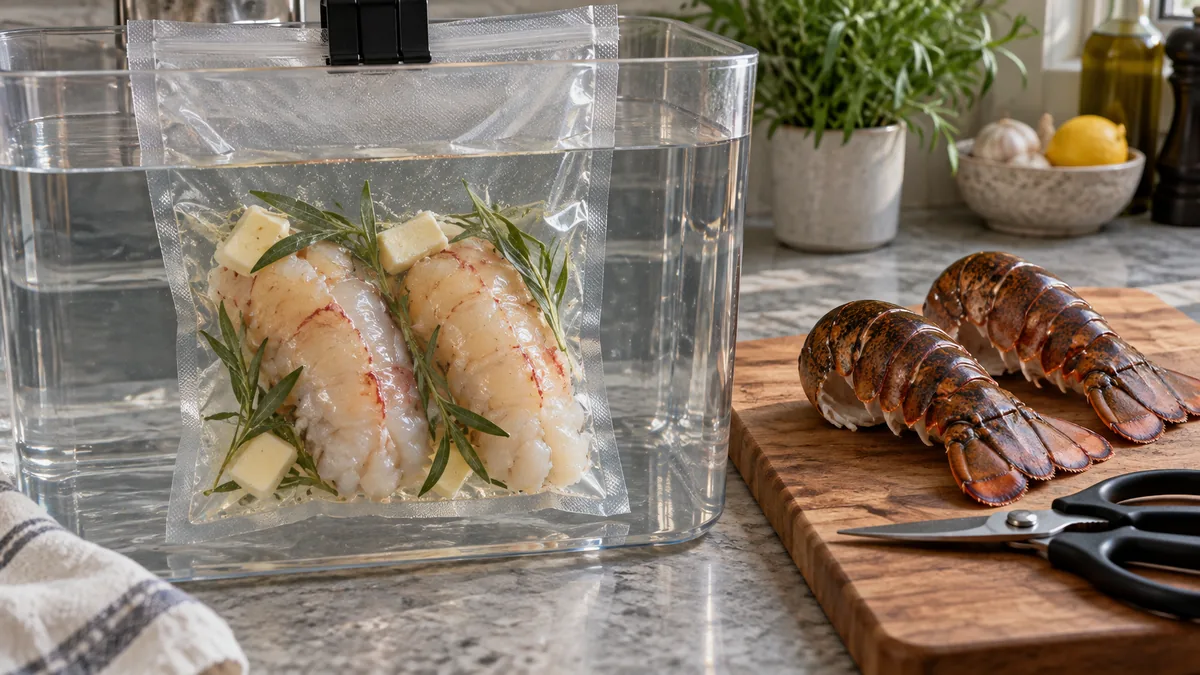
Place shell-removed tails in one layer so water can contact the pouch around each piece. Add butter and a restrained aromatic such as tarragon if that is the flavor you want. Butter is optional. The source describes it clinging to lobster served directly from the bag; this article does not claim that vacuum pressure drives butter or herbs deep into the meat, tenderizes it, or changes food-safety requirements. For that broader mechanism boundary, see what sous vide marinades can and cannot do.
Keep the seal area clean and dry. Anova’s guide uses a heavy-duty zipper-lock or vacuum bag and seals its zipper bag by water displacement. Follow the water-displacement method, keeping the opening above water until closure. If you use a vacuum sealer, follow its exact liquid-handling instructions rather than assuming every machine has a suitable moist setting.
Cook the pouch, then serve now
- Preheat water to the setting used by the source example you have deliberately chosen.
- Lower the sealed, shell-free pouch into the bath. Keep tails in one layer and the closure out of the water if its bag instructions require that.
- Keep the pouch submerged without blocking circulator intake or outlet. If it rises, diagnose the floating sous vide bag rather than improvising a sharp or incompatible weight.
- Use elapsed time only within the limits of the cited example. Use internal measurement when following the conservative FDA endpoint.
- Open with clean tools and serve immediately. Drawn butter and lemon can be added at the table without extending the sealed-bag process.
FDA also gives firm, pearly, opaque lobster flesh as a doneness cue when a thermometer is unavailable. That cue can help catch an obviously underdone result. It does not turn a low-temperature bath into a documented pathogen-reduction process, and it does not replace careful raw-seafood handling.
Know when this guide stops
- Higher-risk diner: Do not rely on low-temperature, partially cooked texture guidance. FDA identifies pregnant people, children under five, older adults, and people with weakened immune systems as higher-risk and advises avoiding raw or partially cooked seafood.
- Frozen-solid tail: Thaw first. No fixed direct-from-frozen addition is supported here.
- Shell must stay on: Choose another method or a separately validated shell-on recipe. This workflow depends on removing puncture hazard.
- Claws or whole lobster: Use body-part-specific guidance. Tail texture and timing do not transfer automatically.
- Meal prep or later service: This is a cook-now guide. It supplies no sealed-bag chilling, storage, leftover, or reheating schedule.
- Need guaranteed safety from timer alone: Use conservative official guidance and internal measurement, or choose another fully cooked method.
Use the closest guide for the next decision
Lobster tail needs its own shell and source-match checks. For another shellfish example, the shrimp texture and safety guide explains a different manufacturer reference and separate geometry limits. Keep those schedules with the food they were written for. Temperature numbers travel easily across search results; evidence conditions do not.