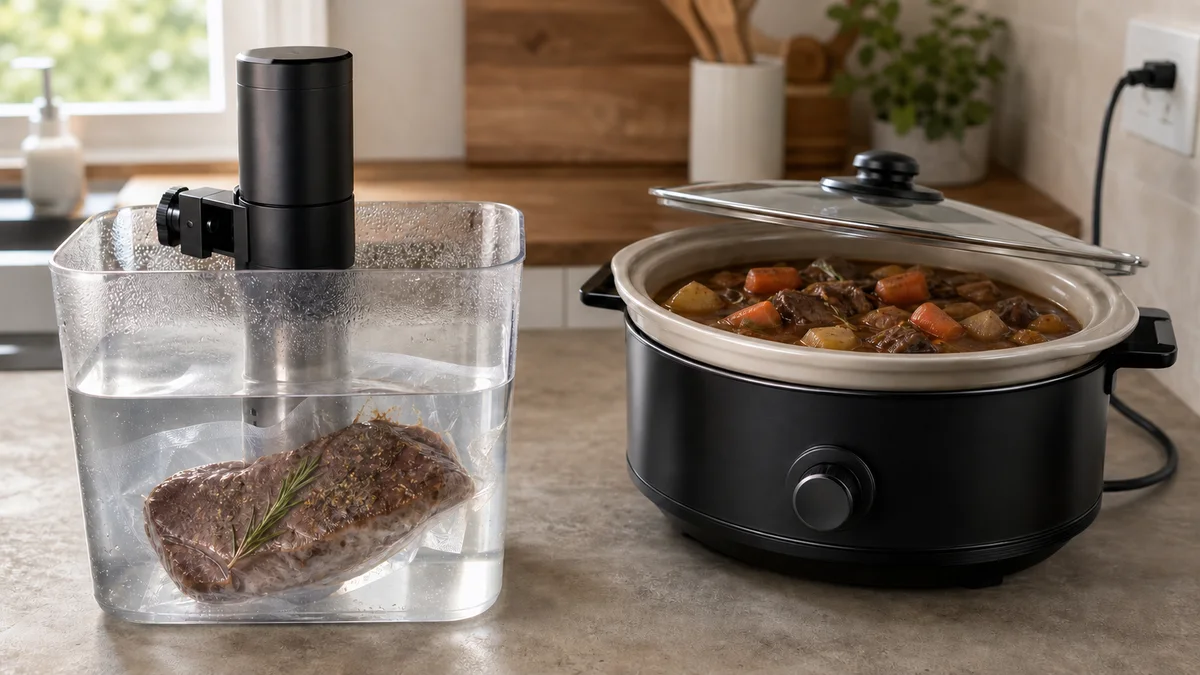
The useful question is not which appliance is “better.” It is whether the finished food should remain a precisely cooked component or turn into an integrated dish. That distinction predicts the right tool more reliably than cook time, price, or countertop popularity.
The difference in one table
| Decision point | Sous vide | Slow cooker |
|---|---|---|
| Cooking environment | Food is sealed in a bag and heated in a controlled water bath | Ingredients cook together in a covered crock, often with added liquid |
| Main control | You select a water-bath temperature and a food-specific time | You select a cooking mode and follow a recipe developed for the appliance |
| Best starting point | Individual proteins or other items where final doneness matters | Braises, stews, chilis, soups, and shredded-meat dishes |
| Moisture | Food retains its released juices inside the bag | Juices mingle with the cooking liquid and other ingredients |
| Browning | Usually added in a hot pan, grill, or broiler after the bath | Usually requires a separate pre-browning or finishing step |
| Texture risk | An excessively long hold can keep changing and softening texture | Lean foods can pass their best texture before a braising cut becomes tender |
| Recipe transfer | Slow-cooker liquid ratios and times do not translate directly | Sous vide setpoints do not translate to Low or High modes |
| Core limitation | Needs bagging, full submersion, and often a finishing step | Does not target rare-to-medium doneness with the same control |
Choose by the result you want
Choose sous vide when doneness is the main job
An immersion circulator heats and moves water around the bag at a selected temperature. Because the cooking environment is close to the desired final temperature, sous vide can limit the steep edge-to-center doneness gradient created by a much hotter pan or oven. If that idea is new, this beginner’s guide to sous vide explains the basic setup.
Precision does not mean time stops mattering. The center still needs time to heat, food-safety targets may require additional holding time, and texture continues to change during a long cook. Sous vide gives you a narrower temperature target; it does not make every cooking duration equally good.
Choose a slow cooker when the liquid is part of the meal
A slow cooker is built around a covered crock and a recipe-level process. Meat, aromatics, vegetables, and liquid cook together, so rendered juices and softened ingredients become part of the sauce. That is an advantage for pot roast, chili, and shredded meat—not a compromise you need to “fix” with more precise temperature control.
The tradeoff is that Low and High are cooking modes, not equivalents of a sous vide setpoint. They control how the appliance progresses through a recipe, and behavior varies by model and load. A slow cooker is therefore a poor fit when your main goal is holding a steak at a chosen rare-to-medium doneness.
A meal-by-meal decision matrix
| Desired result | Better starting point | Why it fits | Tradeoff to plan for |
|---|---|---|---|
| Medium-rare steak with a browned crust | Sous vide | Controls doneness before a brief high-heat finish | Dry the surface well and sear separately |
| Chicken breast for slicing | Sous vide | Lets you pair a chosen texture with a validated thickness-aware time | Doneness and pasteurization are separate checks |
| Pot roast with vegetables and gravy | Slow cooker | The meat and cooking liquid develop as one dish | Liquid may need adjustment or reduction at the end |
| Shredded beef or pork in sauce | Slow cooker | A braising workflow supports a pull-apart result and integrated sauce | Browning still requires a separate step if you want it |
| Chuck roast served in neat, evenly cooked slices | Sous vide | A long bath can tenderize while preserving a sliceable format | Use a cut-specific guide; long holds still alter texture |
| Chili, soup, or a bean-based one-pot meal | Slow cooker | The entire recipe belongs in the cooking vessel | Use a tested recipe rather than guessing liquid and timing |
For the sous vide rows, use a food-specific reference rather than copying a time from this comparison. The site’s steak time and temperature guide and chicken time and temperature guide attach the recommendation to the cut, thickness, and intended result.
The workflow difference matters as much as the heat
| Stage | Sous vide workflow | Slow-cooker workflow |
|---|---|---|
| Prep | Season, bag, remove excess air, and preheat the bath | Prepare ingredients and load them in the recipe’s specified order |
| Cook | Keep the bag fully submerged and maintain the prescribed bath | Keep the vessel covered and follow the recipe/appliance setting |
| Finish | Open the bag, dry the surface, then sear or sauce if needed | Check doneness; adjust or reduce the sauce if the recipe calls for it |
| Best convenience | Repeatable cooking of separate portions | A complete one-vessel dish with minimal finishing |
Sous vide does not always require a vacuum sealer. For many shorter cooks, a sturdy appropriate bag and the water-displacement method can remove enough air to keep the food in close contact with the bath. The bag still needs to remain sealed and submerged as the recipe requires.
Can you convert a slow-cooker recipe to sous vide?
Not with a one-line time-and-temperature substitution. A slow-cooker recipe is a small system: the protein cooks while vegetables soften, aromatics disperse, and the cooking liquid becomes the final sauce. A sealed sous vide bag retains juices but does not reduce or thicken a sauce in the same way.
- Define the endpoint. Decide whether you want slices at a chosen doneness or meat that pulls apart into a sauce.
- Separate the components. Treat the protein, vegetables, and sauce as different jobs instead of placing the entire slow-cooker recipe in one bag.
- Select a validated sous vide guide. Match the food, cut, thickness, fresh-or-frozen starting state, bath temperature, and required holding time.
- Rebuild the finish. Make or reduce the sauce separately, dry the protein, and brown it only if that finish serves the dish.
For example, converting pot roast makes sense if your real goal is tender chuck that still cuts into tidy slices. If your goal is meat that falls into gravy beside vegetables, the slow cooker already matches the desired result with fewer separate steps.
Can a slow cooker work as a sous vide bath?
A conventional slow cooker on Low or High is not a drop-in substitute for an immersion circulator. It is not designed to let you select and circulate a precise water-bath temperature across the container. That makes it unsuitable for blindly following a sous vide chart.
A multi-cooker is a different case if it has a purpose-built sous vide mode. Follow that exact model’s manual, confirm that the mode is intended for water-bath cooking, and use a validated food-specific guide. The word “slow cooker” elsewhere on the control panel does not validate the sous vide mode by itself.
Food safety: the control logic changes with the method
The appliance name does not make food safe. With sous vide, safety can depend on bath temperature, food thickness, starting temperature, time for the center to heat, and any required pasteurization hold. A doneness target alone is not a complete safety instruction. Douglas Baldwin’s practical sous vide guide documents how those variables interact and reproduces government time-temperature references.
For slow cooking, the USDA’s slow-cooker guidance advises thawing meat or poultry before placing it in the slow cooker, keeping the lid in place, and removing it only to stir or check for doneness. Use a tested recipe and the appliance instructions rather than trying to transfer a sous vide holding rule to a crock.
- Do not treat Low or High as a known sous vide temperature.
- Do not treat a sous vide bath temperature as proof that the center has already reached that temperature.
- Do not swap fresh and frozen timing unless the guide explicitly covers both.
- If you plan to chill, store, or reheat bagged food, use a validated cook-chill procedure instead of improvising.
Which one deserves your counter space?
List the five meals you most want the appliance to handle. Mark each as either “one ingredient at controlled doneness” or “one pot that becomes the finished dish.” If the first group dominates, start with sous vide. If the second dominates, a slow cooker is the more direct tool. If both lists are full of meals you cook often, the appliances are complementary rather than redundant.
That simple meal test is more useful than choosing on cook time alone. A long sous vide cook and a long slow-cooker braise may occupy the same afternoon, but they are pursuing different outcomes.
Sources and methodology
This comparison is research-based; we did not run side-by-side appliance tests. We used official slow-cooker handling guidance, a technical sous vide reference that maps time, temperature, and thickness, and the FDA Food Code as background for time-temperature controls. Sources were checked July 30, 2026.