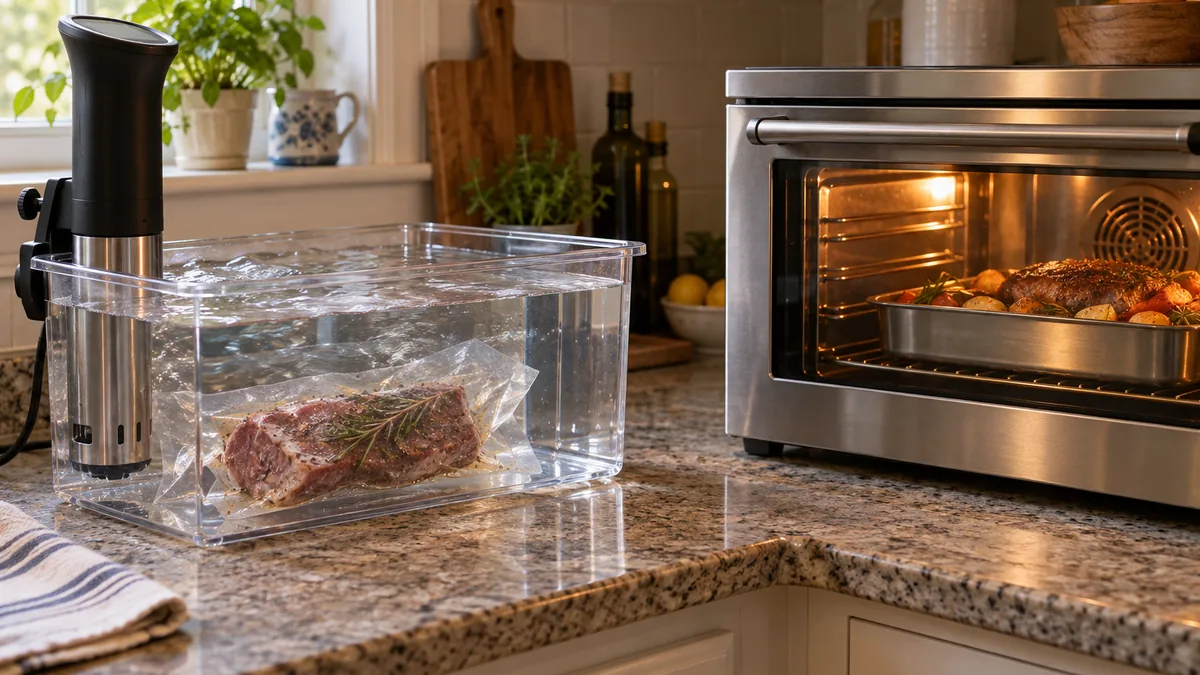
How Heat Moves: Liquid Conduction vs. Air Convection
The culinary differences between sous vide and oven roasting trace directly to physics: the medium transferring thermal energy into your food. While both methods cook food by applying heat over time, water and air behave in radically different ways when transferring thermal energy.
Sous vide combines water circulation and conduction for equilibrium cooking
Sous vide combines forced convection in circulating water with thermal conduction into the food. Water has a high physical density and a specific heat capacity of approximately 4,184 joules per kilogram-kelvin. Because liquid molecules are packed tightly together, water conducts thermal energy into food roughly 24 times faster than still air at the exact same temperature.
This thermal efficiency enables a method known as equilibrium cooking. In a sous vide setup, the water bath is set precisely to the desired final core temperature of the food—for example, 135°F (57°C) for a medium-rare beef roast. Because the water bath never exceeds 135°F, the exterior of the protein cannot heat beyond that set point. An extra hour at the target bath temperature usually will not raise the meat above that set point, although prolonged holding can still soften texture and reduce juiciness.
Ovens use air convection and radiant heat with steep thermal gradients
Conventional ovens operate through air convection and radiant heat from metal heating elements. Air is a poor thermal conductor, with a thermal conductivity of roughly 0.026 W/m·K. If an oven were set to 135°F to cook a steak to medium-rare, heat transfer would be substantially slower, drying out the exterior and potentially prolonging time in the bacterial temperature danger zone depending on cut thickness.
To transfer heat into food within a practical timeframe, ovens must rely on steep thermal gradients. Cooks set the oven air between 325°F and 425°F (163°C and 218°C) to force thermal energy into meat destined for an internal target of 135°F to 165°F. Convection ovens accelerate this process by using fans to circulate hot air, stripping away the cooler “boundary layer” of evaporated moisture that naturally insulates cold food. While convection increases heat transfer efficiency compared to static radiant ovens, it still relies on dry air, maintaining a steep temperature differential between the oven cavity and the core of the food.
Surface Browning, Crust, and the Maillard Reaction
The most immediate practical difference between these two methods is surface texture. Browning is not merely visual; it generates hundreds of complex aroma compounds that define the flavor of roasted meat.
Why sous vide cannot brown meat in the bag
The Maillard reaction—the chemical cascade between amino acids and reducing sugars responsible for savory browning and complex flavors—accelerates as surface temperature rises and moisture falls; rapid culinary browning commonly occurs around 285°F to 330°F (140°C to 165°C).
Inside a vacuum-sealed or zip-top sous vide bag, the relative humidity is near 100%. At atmospheric pressure, liquid water cannot exceed 212°F (100°C), and typical sous vide bath temperatures sit far lower, between 130°F and 185°F. Trapped in this humid environment, surface moisture absorbs thermal energy and keeps the exterior of the protein anchored to the water bath temperature. Under typical sous vide conditions, surface browning is negligible because the food remains wet and far below temperatures used for rapid Maillard browning.
As a result, proteins cooked sous vide emerge from the bag completely pale, gray-pink, and wet. If you want a deeply browned, savory crust, a separate high-heat searing step is mandatory. The physics of water evaporation dictate why surface moisture is the enemy of a good sear: liquid water has a massive latent heat of vaporization (approximately 2,257 kilojoules per kilogram). If wet meat hits a searing skillet, the intense heat is consumed boiling that surface water away rather than triggering the Maillard reaction. By the time the exterior finally dries enough to brown, unwanted heat has penetrated deep into the muscle, creating an overcooked gray band. Searing sous-vide meat successfully requires firmly pressing paper towels over every surface until bone-dry, or resting the meat uncovered on a wire rack in the refrigerator for 10 minutes to desiccate the exterior before searing.
How ovens achieve one-step roasting and crisping
Conventional and convection ovens handle cooking and browning simultaneously. The hot, unsaturated ambient air inside an oven cavity continuously evaporates moisture from the surface of meats, vegetables, and doughs.
Once this surface moisture evaporates, the exterior temperature rapidly climbs past 300°F, initiating the Maillard reaction and rendering sub-surface fat. This mechanism produces golden-brown crusts on prime rib, shatteringly crisp skin on roast chicken, and deep caramelization on roasted brassicas—all in a single step without transferring the food to another pan or appliance.
Internal Doneness: Edge-to-Edge Uniformity vs. The Gray Band
Because thermal gradients dictate how heat penetrates solid muscle, the cross-section of a finished roast reveals whether it was cooked in a precision water bath or an oven.
The overcooked “gray band” of traditional roasting
When cooking a roast in an oven at standard temperatures (350°F to 425°F), thermal energy moves inward from the surface along a steep slope. Because meat conducts heat slowly, the outer layers absorb far more thermal energy than the center. By the time the core reaches a desired medium-rare temperature of 135°F, the outer layers of muscle tissue absorb excessive thermal energy, climbing well above the target.
This dynamic creates the characteristic “gray band” or “bullseye” pattern: a thin center of tender pink meat surrounded by a wide collar of overcooked, gray, and contracted muscle fibers. The proteins in that gray band have expelled much of their intracellular moisture, resulting in a tougher, drier chew near the crust.
Wall-to-wall precision in a sous vide bath
Sous vide minimizes the gray band during the water-bath stage through gentle thermal equalization. With a calibrated circulator, heat slowly equalizes toward the bath set point, greatly limiting the internal temperature gradient before searing.
When sufficient cooking time is allowed for the cut’s thickness, its interior can become highly uniform from edge to edge. A brief, high-heat sear—lasting only 60 to 90 seconds per side—rapidly creates surface flavor without allowing heat to penetrate deeply into the muscle tissue. The result is near-uniform medium-rare doneness capped by a razor-thin browned crust.
The Reverse Sear: When Low Oven Beats Sous Vide
Home cooks often ask whether a low-temperature oven can achieve the edge-to-edge precision of sous vide without requiring bags and immersion circulators. The answer lies in the reverse sear technique.
In an oven reverse sear, thick steaks or large roasts are set on an elevated wire rack inside a low oven (225°F to 250°F / 107°C to 121°C). Cooking at this gentle temperature minimizes the thermal gradient, allowing the interior to warm evenly with only a minimal gray band. Once the core reaches roughly 10°F to 15°F below the target temperature, the meat is removed and finished in a smoking-hot skillet or over direct coals.
The oven reverse sear offers one notable scientific advantage over sous vide: surface desiccation. As meat bakes gently in warm, dry oven air, surface moisture steadily evaporates. By the time the meat is ready to sear, its exterior is bone-dry. When placed into a hot cast-iron skillet, a dry surface browns much faster than wet sous-vide meat, reducing thermal carryover and minimizing post-sear gray banding.
However, the trade-off is timing vigilance. Sous vide provides an elastic, multi-hour holding window; a steak held at 135°F in a water bath can sit for two to three hours without exceeding bath temperature, though extended holding can gradually soften texture. In contrast, an oven set to 225°F will continuously drive heat into the protein. If you leave a reverse-seared roast unattended past its target core temperature, it will continue to cook and eventually dry out.
Do You Need to Rest Meat After Cooking?
One common myth propagated across cooking blogs is that meat cooked sous vide requires a 10-to-15-minute resting period, exactly like an oven-roasted cut. The culinary science reveals why this advice is fundamentally mistaken.
In traditional oven roasting, a steep thermal gradient exists between the superheated exterior and the cooler core. During roasting, heat contracts muscle proteins and redistributes liquid within the meat while a steep temperature gradient remains between the exterior and center. If you carve an oven roast immediately upon pulling it from a 400°F oven, that temperature gradient causes substantial liquid to purge onto the cutting board. Resting for 10 to 15 minutes allows carryover cooking and internal temperature gradients to diminish, which can reduce the amount of liquid released when the meat is sliced.
In contrast, sous vide cooking brings the protein toward thermal equilibrium from edge to center. After sufficient time in the bath, the cut has a much smaller temperature gradient than oven-roasted meat, so resting before the finishing sear is generally less important. When you remove a steak from a sous vide bath, its juices are already evenly distributed. Slicing shortly after a rapid 60-second sear results in minimal juice loss. A brief sear usually creates less carryover cooking than conventional roasting, so a long post-sear rest is often unnecessary. A short pause may still help if the sear was prolonged or especially hot, but extended resting can soften the crust.
Capacity, Batch Size, and Kitchen Workflow
Choosing between sous vide and an oven often comes down to kitchen logistics: the physical size of the appliance, batch throughput, and how much attention the cooking process demands.
Oven strengths: Large roasts, multi-dish meals, and baked goods
Standard domestic oven cavities provide 4 to 5.5 cubic feet of usable space across multiple racks. This volume allows you to cook a 20-pound whole turkey, roast two sheet pans of root vegetables, and bake a dessert simultaneously or in quick succession. Ovens also accommodate diverse culinary formats that require radiant dry heat, such as casseroles, layered gratins, rising bread loaves, and braises in heavy Dutch ovens.
Sous vide strengths: Hands-off holding windows and portion control
Sous vide excels at portioned proteins and stress-free entertaining. Because food held at target temperature warms gradually and cannot exceed the bath set point, sous vide offers a flexible serving window; prolonged holding can still change texture, and safe timing depends on food type, thickness, bath temperature, and pasteurization requirements. When dinner is served, you simply pull the bags, dry the proteins, sear them rapidly, and plate them.
The limitation of domestic sous vide is physical capacity and fluid dynamics. Most domestic immersion circulators are rated for water vessels containing 10 to 20 quarts (10 to 20 liters). If you crowd multiple bags tightly into a container, water cannot circulate freely between them. This restriction creates localized cold spots, leading to uneven heating and potentially unsafe temperature zones.
Sous vide bath temperature alone does not establish microbiological safety. Cooking and holding times must account for food type, cut thickness, starting temperature, bath temperature, and whether pasteurization is required. Food not served immediately should be rapidly chilled in an ice bath and refrigerated under established food-safety guidance.
Energy consumption and kitchen ambient heat
Kitchen energy dynamics represent another practical divergence. Domestic immersion circulators commonly use their rated power during initial heating, then cycle at a lower average draw while maintaining temperature; actual consumption depends on vessel size, insulation, lid use, bath temperature, and room conditions. Because the water bath is enclosed, far less heat radiates into the surrounding room. In contrast, standard domestic electric ovens draw roughly 2,500 to 5,000 watts during active heating cycles across a 4-to-5 cubic foot chamber. An oven inevitably vents substantial ambient heat into the home—a significant operational downside during hot summer months that places extra load on household air conditioning.
Decision Matrix: Sous Vide vs. Oven at a Glance
Use this direct comparison to evaluate how each cooking method performs across key culinary and operational factors:
| Criterion | Sous Vide | Conventional / Convection Oven | Winner / Takeaway |
|---|---|---|---|
| Primary Heat Mechanism | Forced convection in circulating water and thermal conduction into food | Air convection and thermal radiation from heating elements | Sous vide conducts thermal energy roughly 24× faster at matching temperatures; ovens operate at higher absolute temperatures. |
| Temperature Precision | Tight temperature control; accuracy and stability vary by circulator and calibration | Cavity temperature cycles around the set point; fluctuation varies by oven, probe position, load, and operating mode | Sous vide: Eliminates guesswork and minimizes temperature overshoot. |
| Surface Browning & Crust | None in bag (100% relative humidity); requires separate high-heat sear | Direct Maillard browning, fat rendering, and skin crisping | Oven: Delivers one-step crust, caramelization, and crisp skin. |
| Doneness Gradient (Gray Band) | Minimal internal gradient after sufficient bath time; finishing sear may create a thin browned edge | Steep thermal gradient; noticeable gray band at standard roasting temperatures | Sous vide: Near-complete edge-to-edge color and texture consistency. |
| Timing Flexibility & Holding | Flexible holding window; quality and safe duration depend on food, thickness, bath temperature, and pasteurization status | Narrow window; heat drives continuously, requiring active monitoring | Sous vide: Removes dinner timing stress and schedule pressure. |
| Batch Capacity & Versatility | Limited by water vessel volume (10–20 qt) and impeller flow | Large 4–5+ cu ft cavity; multi-rack cooking for large gatherings | Oven: Superior for large holiday birds, casseroles, and sheet-pan meals. |
| Active Attention Required | Low during bath; brief, focused effort during drying and searing | Moderate; requires timer checks, internal probes, and basting/rotating | Tie: Sous vide shifts effort to the sear; oven requires monitoring throughout. |
| Ideal Dishes | Thick steaks, chops, boneless poultry, long collagen-rich braises, fish | Whole roast birds, sheet-pan vegetables, casseroles, gratins, breads | Depends on cut geometry, skin crisping needs, and batch volume. |
When to Choose Which Method: Practical Scenarios
To match your ingredients to the right appliance, use these scenario-based rules:
Choose Sous Vide For:
- Thick-cut steaks and pork chops: For cuts 1.5 to 2 inches thick or greater, water-bath cooking delivers consistent core doneness without overcooking the perimeter. Refer to our detailed sous vide steak temperature guide and our comprehensive sous vide pork chops temperature and time guide for specific doneness targets.
- Boneless, skinless poultry breasts: Lean white meat easily dries out when exposed to dry oven heat. Sous vide minimizes moisture loss compared with high-temperature dry heat; check our sous vide chicken temperature and time guide for safe, juicy parameters.
- Tough, collagen-rich cuts: Cuts like chuck and ribs benefit from 24- to 48-hour low-temperature water baths, converting firm collagen into gelatin while preserving tender, steak-like texture. Review our walkthroughs in the sous vide chuck roast guide and the sous vide ribs guide.
- Delicate fish and seafood: Fish proteins contract rapidly when overheated, pushing out moisture and turning chalky within minutes in an oven. Follow our sous vide salmon temperature and time guide to maintain a tender, buttery texture.
Choose the Oven For:
- Whole roast poultry: Cooking a whole chicken or turkey requires crisping the skin while cooking both white and dark meat. The oven renders subcutaneous fat and crisps skin all over in a single cooking cycle.
- Sheet-pan meals and root vegetables: Dry, high radiant heat caramelizes natural sugars in carrots, potatoes, and Brussels sprouts while evaporating moisture, producing crisp edges that boiled or bagged vegetables cannot match.
- Baked goods, casseroles, and gratins: Breads, pies, lasagnas, and gratins rely on dry ambient heat for rising, crust development, and bubbling cheese surfaces.
- Multi-component holiday meals: When preparing food for large crowds, standard oven cavities handle full-size roasting pans and multiple side dishes simultaneously.
Related Cooking Method Comparisons
Understanding the strengths of different heat transfer methods helps you choose the best tool for every meal. Explore our other appliance comparisons and guides:
- Compare precision water baths with long, unattended moist-heat braising in our guide to sous vide vs. slow cooker.
- Examine how precision water baths compare to rapid, small-basket hot-air convection in our analysis of sous vide vs. air fryer.
- If you are new to immersion cooking and setting up your first water bath, read our foundational beginner’s guide to sous vide.