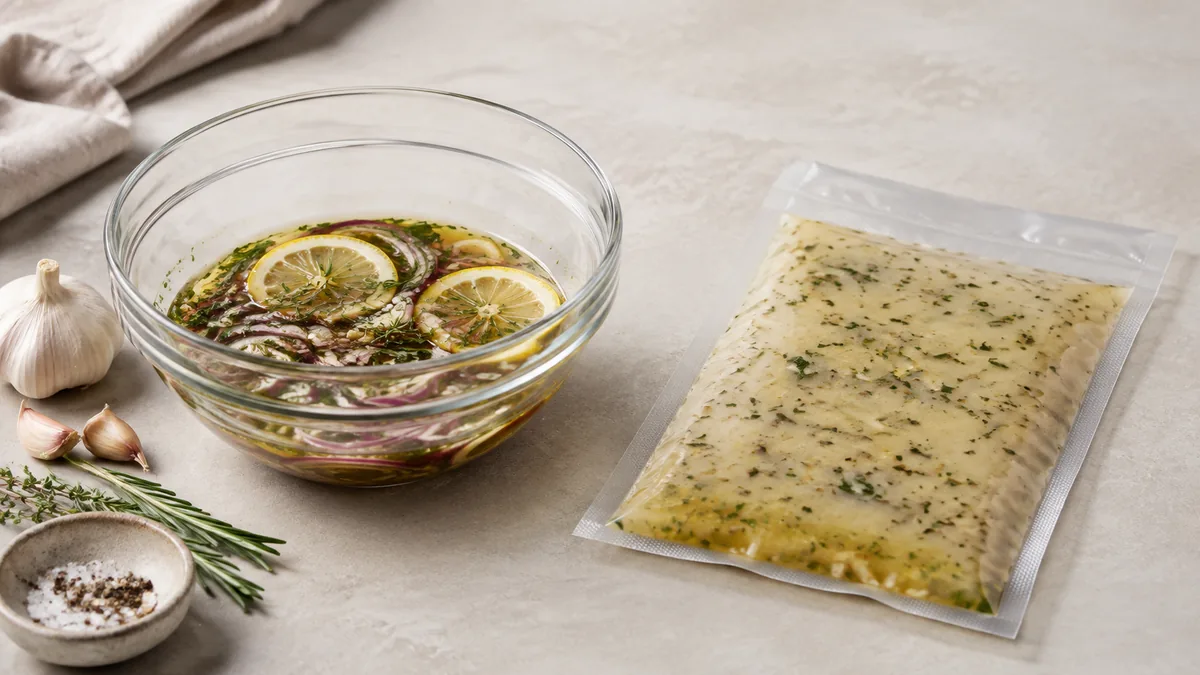
Start with decision, not marinade mythology
Use a marinade because you want its flavor profile or a recipe-specific texture result—not because it changes what a protein needs for doneness or cooking safety. Salt, acid, and other ingredients do not follow one universal penetration or tenderness rule; formulation and food type matter. For marinade steak sous vide, keep steak cooking decisions in a separate sous vide steak temperature guide. Marination research and tested turkey systems show why one broad promise does not hold across recipes or foods.
Marinade decision matrix
Read across each row before bagging. This separates a useful flavor or texture choice from claims the evidence does not support.
| Goal or ingredient signal | What it can reasonably contribute | Decision before bagging | Limit or skip condition |
|---|---|---|---|
| Salt-forward seasoning | Seasoning and possible formulation-dependent water or texture effect. | Use recipe-specific amount; keep cook plan separate. | Do not expect fast or uniform interior seasoning. |
| Acid-forward flavor | Tang and possible surface or texture change. | Choose it for flavor first; use tested recipe if texture matters. | Do not treat acid as universal tenderization. |
| Proteolytic enzyme listed | Potentially strong, variable texture effect. | Use trusted recipe’s exact method or skip. | More time is not universal improvement. |
| Aromatics, herbs, garlic, spices | Surface aroma or flavor contribution. | Use them for final flavor profile. | Do not promise deep penetration or vacuum boost. |
| Thin or liquid-heavy mixture | May complicate air removal and sealing. | Check exact bag or sealer instructions; choose allowed workflow. | No universal external-sealer or water-displacement claim. |
| Sauce wanted at serving | Flavor can be planned separately. | Reserve clean portion before raw contact. | Raw-contact marinade needs full rolling boil before serving as sauce. |
| Cooking safety or doneness goal | None from marinade alone. | Follow validated protein-specific cooking guidance. | Marinade does not replace time-temperature plan. |
Evidence behind matrix: studies of acidic marinades found salt, pH, formulation, and meat type can interact, so acid is not a stand-alone answer to tenderness or texture. A papain study also found an interaction between enzyme concentration and sous vide cooking time; that supports recipe-specific caution, not a generic wait-longer rule. Salt and pH study; dairy-acid study; papain study.
What common marinade advice misses
| Myth | Evidence-bounded answer | Practical choice |
|---|---|---|
| “Acid tenderizes meat.” | Acid can change flavor and texture, but results vary with formulation and food type. | Choose acid for flavor; rely on a tested recipe when texture outcome matters. |
| “Enzymes always make food more tender.” | Enzyme effects are variable; concentration and process interact. | Use exact trusted-recipe method or leave enzyme marinades out. |
| “Vacuum pulls marinade deep into center.” | A stationary sealed pouch is not commercial vacuum tumbling. This guide has no evidence basis for deep or faster forced penetration in home bagging; the available acidic-marination evidence is system-specific. | Use vacuum sealing for its approved bagging role, not as a penetration promise. |
| “Herbs and spices do nothing unless they penetrate deeply.” | They can still matter as surface flavor; no quantitative depth or speed claim is supported here. | Judge them by intended finished flavor, not a deep-flavor promise. |
| “Marinade changes cooking safety.” | Marinade is separate from validated cooking guidance. | Keep marinade choice and cook plan as two decisions. |
Why advice conflicts
“Marinade works” can describe several different outcomes: surface flavor, a change in texture, seasoning, or liquid handling. Research often examines one formulation and one food in a controlled system, while home advice often turns that narrow result into a broad rule. Acidic-marination transfer has been studied in a specific turkey system, not as proof that every home marinade reaches every food the same way. That system-specific evidence, plus findings on salt and pH interaction, is why this guide uses conditional language.
Use this source synthesis as a filter: USDA guidance controls raw-marinade handling; a recipe controls its own ingredient method; exact maker instructions control a named bagging workflow; individual studies explain only their tested system. None of those sources gives permission to turn a home vacuum pouch into a universal “vacuum marinade” shortcut.
Pre-bag marinade workflow boundary
- Decide whether flavor, a recipe-specific texture effect, or serving sauce is goal. Do not use marinade to replace cooking guidance.
- Keep marinade refrigerated while it contacts raw protein.
- Set aside sauce before it touches raw protein.
- If raw-contact marinade will be served as sauce, bring it to a full rolling boil.
- Keep raw-contact hands, utensils, plates, and surfaces away from ready-to-eat food; wash after raw contact.
- For a thin or liquid-heavy mixture, use water displacement or liquid-handling setting only when exact maker instructions allow that bag, closure, or sealer workflow.
These are raw-food handling boundaries, not a sous vide cooking schedule. USDA says to marinate in the refrigerator, reserve sauce before raw contact, and boil used marinade before serving it as sauce; it also stresses preventing raw-food cross-contamination. USDA FSIS: Marinating Meat, Poultry, and Seafood; USDA FSIS: Keep Food Safe.
Keep liquid handling separate from equipment claims
Liquid-heavy marinades can make air removal and sealing less straightforward, but no category-wide method fits every bag or sealer. Follow exact maker instructions for your bag, closure, and sealer before using a liquid workflow. If you need a no-sealer technique, see this guide to the water-displacement method. If bag buoyancy becomes an issue, use separate guidance on why a sous vide bag floats; this article does not diagnose or fix floating bags. Manufacturer instructions remain controlling for a named workflow: Anova water displacement guidance and FoodSaver instruction manuals.
Where to go next
Choose a cut-specific guide when you need doneness or thickness planning. Choose the vacuum sealer guide only when equipment choice is the question. For material questions, see sous vide bag safety. This page stays narrower: pick marinade for plausible flavor or recipe-specific texture goal, then keep raw-marinade handling and cooking plan separate.