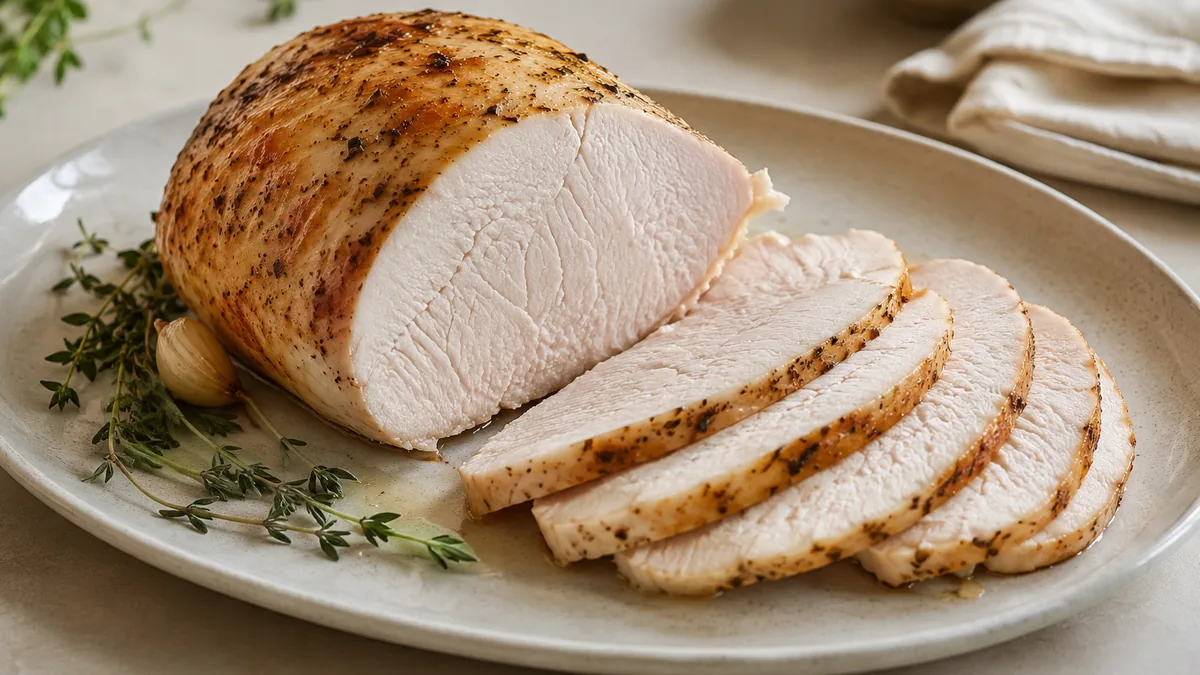
Choose temperature by texture
| Bath temperature | Texture direction | Timing consequence | Best starting point for |
|---|---|---|---|
| 140°F (60°C) | Softer and potentially pinker | Longest total times in table | Cooks comfortable with a softer, less conventional result |
| 145.5°F (63°C) | White, tender middle path | Middle total-time column | Most readers unsure which texture to choose |
| 149°F (65°C) | Firmer and closer to roast turkey | Shortest total times in table | Cooks who want a more familiar, less soft texture |
Temperature sets the culinary direction; it does not replace the time requirement. Anova’s turkey-breast guide describes 145°F meat as white, tender, and moist, while its higher-temperature option moves toward traditional roast texture. Those descriptions can vary with the bird and preparation. The lower-temperature process in this article depends on the complete thickness-based schedule from Douglas Baldwin’s Table 4.1, not texture preference alone.
Pass compatibility gate before using table
Use the lower-temperature table only when every condition below is true. Precise time does not make an out-of-scope turkey breast fit the underlying heating model.
- Thawed start: Turkey begins at 41°F (5°C), not frozen or partly frozen.
- Boneless and intact: It is not a whole breast, crown, bone-in piece, mechanically tenderized product, or loose collection of smaller pieces.
- Plain geometry: It is unstuffed, not rolled or tied, and reasonably resembles Baldwin’s calculated 2:3:5 box model.
- Label checked: It is not injected, enhanced, or solution-added. If label is unclear, do not use table.
- Skin removed: Cook breast meat in bag and handle skin separately.
- Thickness in range: Thickest point measures 0.8–2.8 inches (20–70 mm).
- One portion per bag: Portions and bags do not overlap or stack.
- Full circulation: Bath is preheated, food remains submerged, and water can move around every bag.
If any condition fails, do not improvise an added-time adjustment. Use a published schedule covering the exact product and geometry, or use USDA’s 165°F (74°C) simple internal-temperature endpoint. For chicken, use separate sous vide chicken temperature and time guidance rather than treating this turkey table as a general poultry chart.
Sous vide turkey breast time by thickness
Times below are total bath times. They include heating plus the calculated pathogen-reduction process; they are not extra holding times added after the center reaches bath temperature. Baldwin’s Table 4.1 calculates these poultry schedules for at least a million-to-one reduction in Listeria and a ten-million-to-one reduction in Salmonella, under the source assumptions described here.
| Maximum thickness | 140°F (60°C) | 145.5°F (63°C) | 149°F (65°C) |
|---|---|---|---|
| 0.8 in (20 mm) | 1¼ hr | 50 min | 40 min |
| 1.0 in (25 mm) | 1½ hr | 1¼ hr | 55 min |
| 1.2 in (30 mm) | 2 hr | 1½ hr | 1¼ hr |
| 1.4 in (35 mm) | 2¼ hr | 1¾ hr | 1½ hr |
| 1.6 in (40 mm) | 2½ hr | 2 hr | 1¾ hr |
| 1.8 in (45 mm) | 3 hr | 2¼ hr | 2 hr |
| 2.0 in (50 mm) | 3¼ hr | 2½ hr | 2¼ hr |
| 2.2 in (55 mm) | 3¾ hr | 3 hr | 2¾ hr |
| 2.4 in (60 mm) | 4¼ hr | 3¼ hr | 3 hr |
| 2.6 in (65 mm) | 4½ hr | 3¾ hr | 3¼ hr |
| 2.8 in (70 mm) | 5 hr | 4¼ hr | 3¾ hr |
Measure maximum thickness, not weight
Weight tells you how many people a portion may feed. It does not tell you how far heat must travel to reach the coldest point. Two turkey breasts can weigh the same amount but have different maximum thicknesses and therefore require different total times.
- Remove the skin and place the turkey breast in the shape it will hold inside the bag. Do not roll or tie it.
- Measure the thickest point straight through the meat before bagging.
- Use millimeters when possible; table rows increase in 5 mm steps.
- When the measurement falls between rows, round up to the next thicker row.
- Choose the texture column, then use the time where the rounded thickness row and temperature column meet.
Worked example: a 58 mm turkey breast
A thawed boneless breast measures 58 mm at its thickest point and passes every compatibility check. Round 58 mm up to 60 mm. At 145.5°F (63°C), the 60 mm row gives 3¼ hours total bath time. Do not choose the shorter 55 mm row, and do not replace the measurement with package weight.
If you need help with circulator, container, or bath basics before measuring, use this beginner’s guide to sous vide.
Prepare, bag, and cook one portion at a time
- Remove skin. Set it aside if you plan to crisp it separately.
- Confirm label and shape. Reject table if turkey is enhanced, solution-added, stuffed, rolled, tied, bone-in, or otherwise outside compatibility gate.
- Measure thickest point. Select rounded-up table row before sealing.
- Seal one portion per bag. Keep meat in untied, unrolled shape used for measurement.
- Preheat circulating bath. Set chosen temperature before turkey enters water.
- Submerge without crowding. Keep water moving around all sides; start total-time clock when bag enters fully heated bath.
- Cook for full table time. Do not subtract estimated warm-up period or stop when thermometer first shows bath temperature.
A vacuum sealer is optional if a zipper bag can close securely and stay submerged. Follow the water-displacement steps in this guide to sous vide without a vacuum sealer; that bagging method does not expand this article’s thickness or geometry limits.
Finish turkey without undoing texture choice
Remove the cooked breast from the bag and dry the exterior thoroughly. If browning is wanted, use brief high heat rather than prolonged finishing that continues cooking the interior. Slice across the grain and serve after cooking; this guide does not provide a cook-chill, storage, or reheating schedule.
Skin cooked against moist meat inside the bag will not become crisp. Baldwin and Anova both use a separate-skin path: remove the skin before bagging, then crisp it separately with suitable high heat. Treat crisped skin as a separate finishing element rather than leaving the breast under heat until the skin changes texture.
When this guide does not apply
| Product or condition | Why table cannot answer it | Next action |
|---|---|---|
| Frozen or partly frozen | Starting condition differs from 41°F (5°C) schedule | Use published frozen-start schedule; do not guess added time |
| Bone-in, whole breast, or crown | Bone and irregular geometry fall outside model | Use exact-cut source or USDA 165°F endpoint |
| Rolled, tied, or stuffed | Heat path and center geometry change | Use schedule validated for exact preparation |
| Injected, enhanced, solution-added, or mechanically tenderized | Product assumptions differ from intact plain breast | Follow product-specific authoritative guidance |
| Thicker than 2.8 in (70 mm) | No executable table row is provided here | Split into suitable thinner boneless portions only when shape remains intact and unstuffed; otherwise use exact-cut source |
| Overlapping bags or blocked circulation | Heating model assumes exposed circulating water | Rearrange into one separated layer before timing |
| Chilling, storage, or reheating | Cook-serve article does not provide those controls | Use authoritative cook-chill and storage guidance |
Most bad substitutions start with a fixed-time recipe chosen by weight. A “2.5-hour turkey breast” instruction cannot cover a frozen start, bone-in geometry, rolling, stuffing, or an unusually thick center. Product compatibility and maximum thickness come first; time comes after.
Sources and methodology
This research-based guide combines government endpoint guidance, technical poultry calculations, and culinary texture guidance. It does not report original hands-on testing. Table values preserve Baldwin’s published 41°F (5°C) starting condition and calculated 2:3:5 box model; Anova is used for texture direction, not primary safety validation.
- USDA FSIS Safe Temperature Chart — simple 165°F (74°C) poultry endpoint.
- Douglas Baldwin, A Practical Guide to Sous Vide Cooking — poultry total-time calculations and model assumptions in Table 4.1.
- Anova Culinary turkey-breast guide — attributed texture options and separate-skin approach.